

Brit Milah happens on the eighth day. And the number eight is… interesting. Not as famous as seven, which dances across the Torah — Shabbos, Shemitah, the cycle of creation itself. But eight keeps showing up just enough to demand attention. You wait eight days before offering a newborn animal. Shemini Atzeret — the mysterious eighth-day celebration. And of course, Mila.
Eight is not random. It means something.
I’m not claiming a grand theory that explains every “eight” in Tanakh. But when it comes to Brit Mila — I do see a thread worth exploring. A beginning of an idea. A direction.
To get there, we start in Gan Eden.
The Garden: God’s Museum and God’s Home
Gan Eden is not just a pretty orchard. It’s the showcase of creation — beauty, wonder, taste, texture, and meaning. Like walking into the most breathtaking nature documentary — except you are inside the screen. A museum of divine genius.
But it’s also a home. God’s home. And humanity is invited inside — not merely as guests but as partners. To guard (shmor) and develop (avad) God’s world. To enjoy His gifts like a grandchild enjoying a beloved grandmother’s special cookies — nourishment soaked in love and relationship.
That was our normal.
Then we broke it.
The First Eighth Day
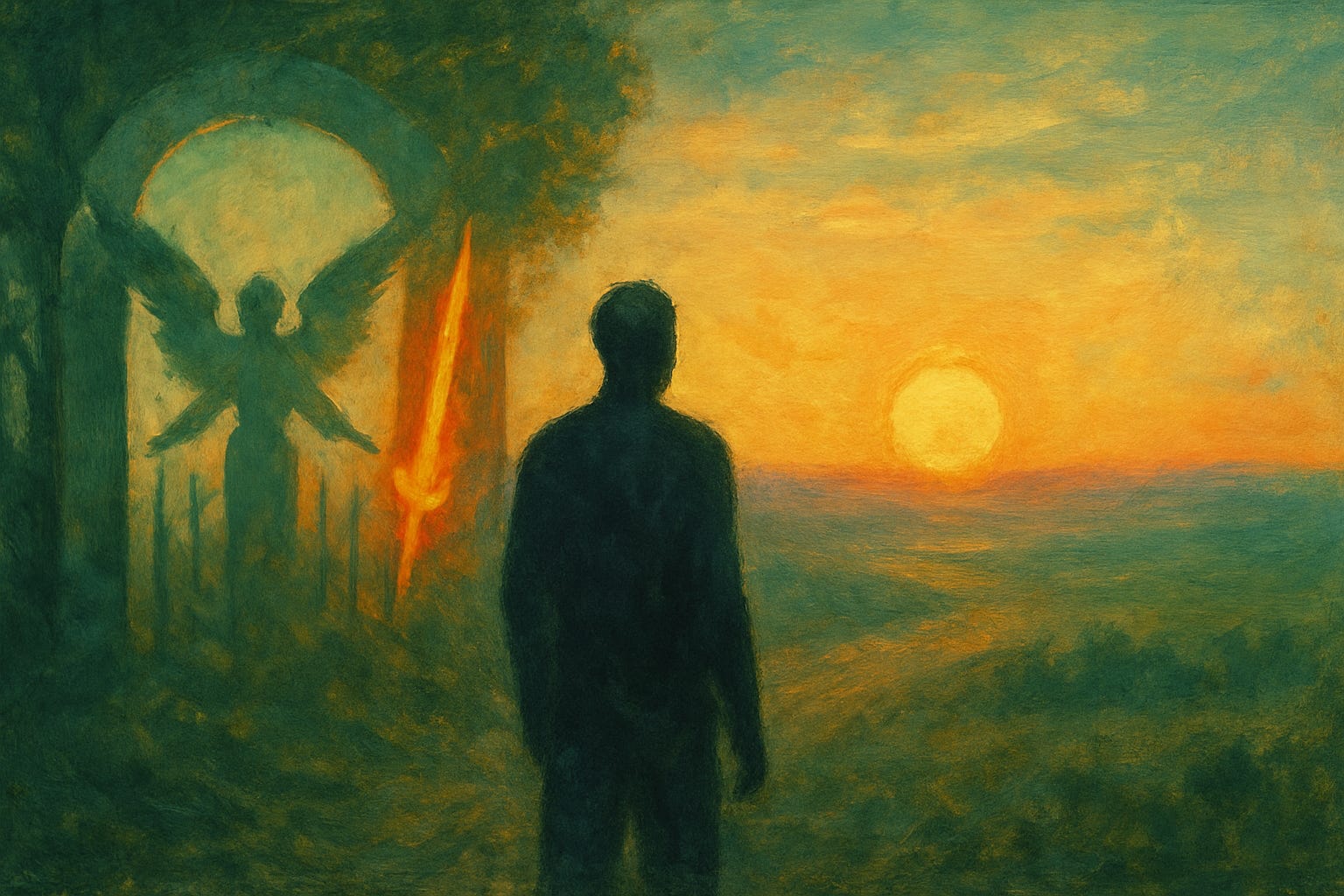
We were exiled. Locked outside.
Chazal debate the timing — did Adam and Chava spend Shabbos in the Garden and get kicked out afterward, or were they forced out beforehand, experiencing the first Shabbos already in exile?
Either way:
Day Eight = the first real day of life after Gan Eden.
The first day humanity wakes up and says:
“How do we live now?”
That question defines all of Jewish history.
Three Early Attempts — All Making the Same Mistake
Humanity experiments with different responses to exile — all flawed.
Kayin — Escape the Garden
He builds a city — a human creation, disconnected from God’s creation. He names it not according to essence (like Adam did with the animals) but after his son — a monument to self. Not God’s work → a human idol.
He wants control — the benefit of civilization without the discipline of divine partnership.
Noach — Recreate the Garden
He plants a vineyard — a miniature Eden. But without tikkun, it collapses into drunkenness, nakedness, and sexual violation. The old pattern returns.
He wants paradise without the process of moral rebuilding.
Migdal Bavel — Become the Garden
“We will make a name for ourselves.”
They try to reach heaven and become gods.
They want the status of Eden without the submission of Eden.
Three attempts. Three failures.
The same underlying flaw:
They want the result without the work.
Eden’s pleasures without Eden’s purpose.
Avraham — The Fourth Way
Avraham does something none of them tried:
He accepts the journey.
Not escape.
Not shortcut.
Not replacement.
A long, slow derech — a path of return.
And that path runs through a Land.
God places Avraham’s descendants in Eretz Yisrael just as He once placed humanity in Eden. But now we cultivate the land — the fields, the orchards, the vineyards spread across the hills. We take the fruit we grew through sweat, patience, and skill — tithes, Bikkurim, produce of mitzvah — and bring it upward to:
A House that we build.
The Beit HaMikdash — God’s new dwelling.
The Garden was planted for us.
The Mikdash is built by us.
That is the tikkun.
Humanity graduates from creature to co-creator.
And at the center of this new covenantal life stands:
Mila. On Day Eight.
Why Mila? Why Eight?
One aspect of Adam and Chava’s sin clearly relates to some sort of sexual sin - and with it came confusion, shame, and distortion. As such, one aspect of the repair needed to get us back to a Gan Eden type state (albeit not the actual garden) is to relating to and dealing with sexuality.
Mila is about transforming sexuality into a raw, physical act into something with meaning, dedication and holiness.
It is neither indulgence nor rejection - but rather elevation.
In other words, since the sin involved sexuality, we have the Mitzva of Mila. And since Mila is about repairing that sin and helping us to get back to the state of Gan Eden, we perform it on the eighth day.
And this marks the first step of a life lived:
On earth — in the fields we cultivate
Facing heaven — in the House we build
Walking the road back toward the Garden
Not a return achieved in one leap, but in a covenant of generations.

