
So Much More Than Just Stealing | Parshas Noach
The deeper meaning of the word hamas (חמס) as used in the Torah - and its eerie echo in the terrorist organization which bears the same name.

I’ve been trying to figure out what the word חמס (ḥamas) means in the Torah. It’s a difficult, somewhat obscure term that shows up in very different contexts — contexts that don’t, at first glance, seem to connect.
On the one hand, in our parsha, Hashem looks at the world before the Flood and says that “the earth was filled with ḥamas.” Clearly something negative is happening here. But what, exactly, did Hashem see?
The second appearance is Sarah and Hagar. Sarah cannot have children, so she enters into a surrogate parental relationship with Hagar. She allows Hagar to be with her husband Avraham so that Sarah can, through Hagar, have and raise a child—a child who otherwise would not exist. Sarah enables this relationship; she makes it possible. The purpose is clear: to allow Sarah to build her family and fulfill her role as a mother.
But Hagar uses that very arrangement to belittle Sarah — perhaps even to reverse the relationship, to make herself the one in power. As Rashi explains, Hagar saw herself as more righteous than Sarah and viewed Sarah as a kind of hypocrite. The Malbim notes that Hagar even took this as justification to free herself from servitude, seeing herself as no longer bound to Sarah. I would conjecture further that she saw herself not merely as independent, but as replacing Sarah altogether.
It is in this context that Sarah turns to Avraham and says, “חמסי עליך—my ḥamas is upon you.” You hear and see what’s going on: in response to becoming pregnant, she is belittling me, perhaps defaming me, trying to free herself from her obligations to me, even attempting to replace me—and you have said and done nothing.
The third example is Edim Zomemim. Edim Zomemim are false witnesses who lie in court for the explicit purpose of convicting someone of a crime they did not commit. That might mean using the court to take money improperly, causing the person to receive lashes, or even causing their execution. The point is that they perjure themselves in court to achieve a false conviction. The Torah itself calls them an “eid ḥamas”— a ḥamas-witness.
At first glance, these three cases share little: the corruption of society before the Flood, a personal conflict in a household, and a legal crime of perjury. Yet the same word — ḥamas — names all three. What connects them?
“Legal” Theft
To answer this, let’s look deeper at our parsha, with the Midrash in Bereishit Rabbah 31:5. The Midrash wants to distinguish between ‘regular’ theft (gezel, גזל) and ḥamas (which, evidently, is also a type of stealing, but see below).
The distinction, says Rabbi Chanina, is that Ḥamas includes theft of items less in value than a perutah. In today’s equivalent, that would be like (the ancient equivalent of stealing an item worth less than a penny or a single agurah). Gezel, on the other hand, would not include such cases.
To help illustrate the point, Rabbi Chanina offers a parable — which will we slightly modify.
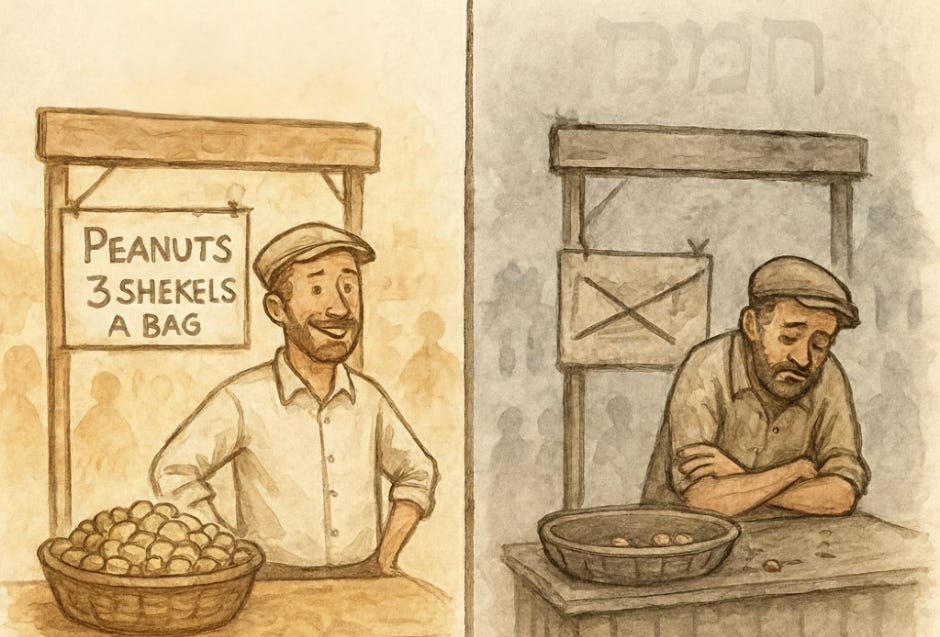
Imagine a peanut vendor in a public market. He sells bags of peanuts for three shekels a bag. However, throughout the day, as people pass by, they grab a peanut or two and eat them (without paying). A minor theft, less than a peruta (or penny) in value.
As the day goes on, the vendors supply of peanuts slowly dwindles until eventually he has nothing left to sell.
Everyone knows what’s happening and understands the damage. Yet they all participate anyway — perhaps even gleefully, with desire.
Indeed, that is how I imagine it was in the generation of the Flood: a societal state so perverted that this type of theft wasn’t merely justified — it was celebrated.
Manipulating the System
That’s ḥamas. Using the very structures and rules meant to protect against theft to enable it. Using the systems created to uphold justice and fairness and twisting them to serve unjust and unfair goals and desires.
This isn’t rebellion from outside; it’s manipulation from within.
Sarah and Hagar—Through the Same Lens
Seen this way, we can understand the ‘hamas’ that Sarah saw in Hagar. The arrangement between Sarah and Hagar was a known and common form of surrogate parenthood in the ancient world. Sarah allowed her maid-servant to cohabitate with her husband so that through that union Sarah could build a family.
But Hagar attempts to manipulate this system for her own benefit. She takes what was meant to enable Sarah and uses it to belittle her and (perhaps) even replace her.
Edim Zomemim—Justice Used Against Itself
Let’s now turn our attention to the ‘hamas’ witnesses (eidim zomemim).
We appoint judges and officers and grant them authority to impose their will on society. Power, however, is dangerous; safeguards are needed. The Torah therefore requires at least two witnesses, whose testimonies coincide—not only to counter liars, but also to protect against honest mistakes.
The point of the system is to protect the innocent and ensure that justice is done. Edim Zomemim exploit that structure designed to ensure justice to help them to pervert justice. They use the court’s authority and power to achieve — through the legal system itself — what they could not achieve on their own. They are not attacking justice from the outside; they are using justice itself as a weapon for personal gain and unjust ends.
Again: ḥamas is not the system broken; it is the system used against itself.
The Horror of Ḥamas
The horror of ḥamas is that it rots the system from the core. When a society not only fails to uphold moral and legal structures but manipulates them for unjust ends, the collapse that follows is total. The framework that makes moral life possible can no longer sustain itself.
Here I feel almost obligated to reference what we see in our time with the organization that bears this very name — Hamas. I generally avoid politics in divrei Torah, but I find the parallels too striking to ignore.
Part of the evil of Hamas—and those who support them—is not only the terror they commit, but that they have successfully manipulated the structures and values of modern society to undermine those very structures and values. Human-rights language, international law, the media — institutions created to uphold truth and justice — are repurposed as tools of distortion and harm.
Human rights becomes a weapon against those who truly uphold human rights.
International law is wielded against those who respect law itself.
The media is used as propaganda against people who cherish truth.
One by one, pillars of moral civilization are corrupted. It seems no coincidence that this organization bears the same name. The Torah already taught what ḥamas is: when the systems designed to sustain moral order are turned into instruments of moral collapse.
And this, perhaps, sheds light on the divine response in the Flood. When such manipulation becomes not only the norm, but an evil that society as a whole joyfully commit, the corruption has firmly set in. It is as if Hashem said: “I must start over. Otherwise, the world I dream of — moral, humane, law-abiding world — will never materialize.”
Thank you! Loved this
Very insightful, thank you!