
The Interruption | Parsha Tazria - Metzora 5786
Why Sefer Vayikra pauses between the eighth day and Yom Kippur to teach kashrus, tumah, and tahara

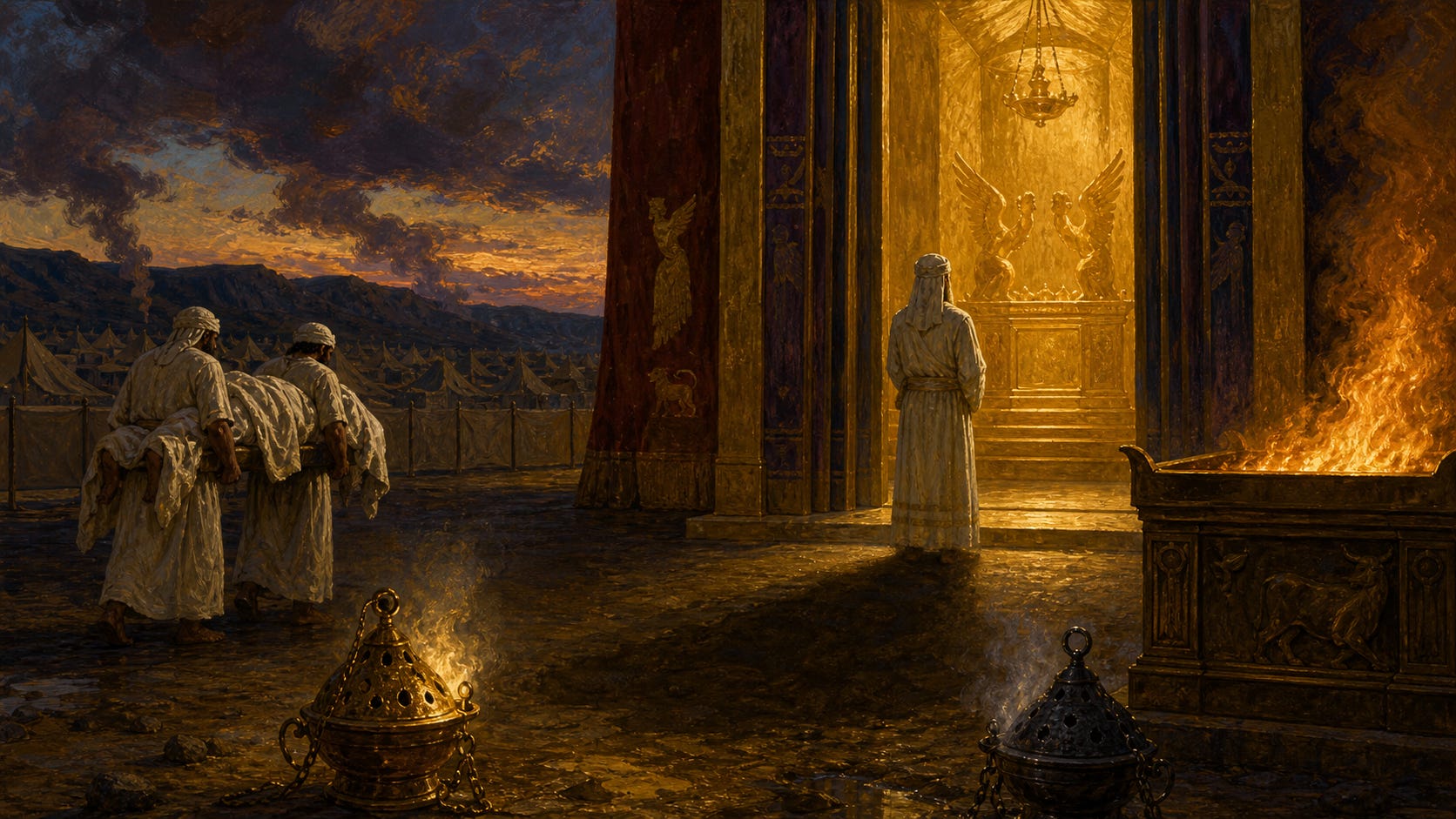
Sefer Vayikra has been building toward something. Chapters 1-5 lay out the korbanos. Chapters 6-7 give the kohanim their procedural laws. Chapter 8 describes the seven days of milu’im. Chapter 9 arrives — the first real day of avodah — and catastrophe strikes. Two of Aharon’s sons bring an eish zarah and die.
וַיִּקְחוּ בְנֵי־אַהֲרֹן נָדָב וַאֲבִיהוּא אִישׁ מַחְתָּתוֹ וַיִּתְּנוּ בָהֵן אֵשׁ וַיָּשִׂימוּ עָלֶיהָ קְטֹרֶת וַיַּקְרִבוּ לִפְנֵי יקוק אֵשׁ זָרָה אֲשֶׁר לֹא צִוָּה אֹתָם׃
And Aharon’s sons, Nadav and Avihu, each took his fire-pan, put fire in them, laid incense upon it, and offered before Hashem an alien fire — which He had not commanded them. (Vayikra 10:1)
Chapter 10 handles the fallout. Aharon may not publicly mourn. He and his remaining sons may not leave the Mishkan. They are told what they must eat, and when, and where. And they work out — painfully — why the Se’ir Rosh Chodesh was burned rather than consumed. They are also given a law for the future: no wine, no hard drink, so that a kohen can always distinguish between tamei and tahor.
יַיִן וְשֵׁכָר אַל־תֵּשְׁתְּ אַתָּה וּבָנֶיךָ אִתָּךְ בְּבֹאֲכֶם אֶל־אֹהֶל מוֹעֵד וְלֹא תָמֻתוּ חֻקַּת עוֹלָם לְדֹרֹתֵיכֶם׃ וּלֲהַבְדִּיל בֵּין הַקֹּדֶשׁ וּבֵין הַחֹל וּבֵין הַטָּמֵא וּבֵין הַטָּהוֹר׃
Wine and strong drink you shall not drink, neither you nor your sons with you, when you enter the Ohel Mo’ed — that you shall not die. An eternal statute throughout your generations. And to distinguish between the holy and the profane, and between the tamei and the tahor. (Vayikra 10:9-10)
If I were writing the Chumash, I know what would come next. Chapter 16. Look how it opens:
וַיְדַבֵּר יקוק אֶל־מֹשֶׁה אַחֲרֵי מוֹת שְׁנֵי בְּנֵי אַהֲרֹן בְּקָרְבָתָם לִפְנֵי־יקוק וַיָּמֻתוּ׃
And Hashem spoke to Moshe after the death of Aharon’s two sons — when they had drawn close before Hashem, and died. (Vayikra 16:1)
Chapter 16 is happening right now, in the middle of our story. In fact, I don’t even need the middle clause. I don’t need “acharei mos shnei bnei Aharon be’korvasam lifnei Hashem va’yamusu”, because I’m already inside that story. I could simply write “Vayedaber Hashem el Moshe” and continue straight into the laws of Yom Kippur.
But that’s not what the Chumash does. The Chumash turns away to something new, something seemingly tangential: kashrus. And from kashrus it turns to another tangent — tumah and tahara. We learn about the tumah of a yoledes, about the many forms of tzaraas, about seminal emissions. Only then does the Torah return to where we were — and deliver the laws of Yom Kippur, laws about the Mishkan and the avodah inside it, exactly the subject of the first ten chapters.
Tumah and tahara do have some connection to the Mishkan — the Ramban notes it; becoming tahor often involves a korban. But the connection is faint compared to Yom Kippur’s. And kashrus has no connection at all. There is no korban of kashrus. Kashrus is not a korban question. Kashrus is about what I may or may not eat — whether or not there is a Beis HaMikdash, whether or not I am a kohen. It stands on its own.
And yet, for some reason, the Torah places these laws here, smack in the middle of the story. The eighth day, the laws of Yom Kippur — they will have to wait. The avodah of the Mishkan will have to wait. We have to talk about kashrus, about tumah and tahara. And I have no idea why.
It’s stranger than that.
Grant, for a moment, that there is some reason we need to talk about tumah right now. Go down the list. What’s missing? What kind of tumah would you expect to find that isn’t there?
Put it differently. If I asked you for the paradigmatic example of tumah — the most severe case, the one above all others — what would you say? Tumas meis. Go look at chapters 11-15. Find me tumas meis. It isn’t there. Not the law that a corpse transmits tumah. Not the process for becoming tahor from it.
We get the tumah of a yoledes, and of tzaraas in the skin and the clothing and the house, and of a zav, and a zavah, and a niddah. We get their purification. The parah adumah? Nowhere. Tumas meis? Nowhere.
Strangeness within strangeness. The Mishkan has a Kodesh HaKodashim; our parshiyos have a Kodesh HaKodashim of their own — a zone of deeper mystery inside an already mysterious whole. We transition into tumah for reasons we cannot fathom. And once we’re there, the one kind of tumah everyone would expect at the center is precisely the one the Torah omits.
It’s even worse than that.
The omission isn’t only of the process of becoming tamei from tumas meis, and of the process of becoming tahor — the parah adumah. Of all the purification processes that could have been presented here, the parah adumah is the one we’d most expect to find.
We can split tumah-tahara into two halves: how you become tamei, and how you become tahor. On the tamei side, if you were going to mention any tumah at all, surely tumas meis. On the tahor side, if you were going to describe any purification here, surely the parah adumah. No better case. No better candidate.
Why? Because the parah adumah references chet ha’Egel. As Rashi says — following, I believe, Rav Moshe HaDarshan or Chazal — let the mother come and clean up after the son. Let the parah atone for the egel. And chet ha’Egel is Aharon’s story, as we know from Shemos, and as we know from the opening chapters of Sefer Vayikra, and as we know from chapter 16 itself.
In other words, the laws of tumah-tahara are bookended by references to chet ha’Egel.
Rashi says the egel ben bakar that Aharon brings on his inaugural day comes to atone for chet ha’Egel:
קַח־לְךָ עֵגֶל. לְהוֹדִיעַ שֶׁמְּכַפֵּר לוֹ הַקָּבָּ”ה עַל יְדֵי עֵגֶל זֶה עַל מַעֲשֵׂה הָעֵגֶל שֶׁעָשָֹה׃
“Take for yourself a calf.” To make known that HaKadosh Baruch Hu atones for him, through this calf, for the act of the Egel he made. (Rashi, Vayikra 9:2)
The Ramban says Aharon’s hesitation at the Mizbe’ach is because, as Chazal describe, the image of the egel was before his eyes:
וְטַעַם דָּבָר זֶה כִּי בַּעֲבוּר שֶׁהָיָה אַהֲרֹן קְדוֹשׁ ה’ וְאֵין בְּנַפְשׁוֹ חֵטְא זוּלָתִי מַעֲשֵׂה הָעֵגֶל, הָיָה הַחֵטְא הַהוּא קָבוּעַ לוֹ בְּמַחְשַׁבְתּוֹ, כְּעִנְיָן שֶׁנֶּאֱמַר “וְחַטָּאתִי נֶגְדִּי תָמִיד”, וְהָיָה נִדְמֶה לוֹ כְּאִלּוּ צוּרַת הָעֵגֶל שָׁם מְעַכֵּב בְּכַפָּרוֹתָיו׃
The reason: since Aharon was holy to Hashem, and there was no sin on his soul except the deed of the Egel, that sin was fixed in his thought — as it is said, “my sin is ever before me” — and it seemed to him as if the form of the Egel was there, blocking his atonements. (Ramban, Vayikra 9:7)
Rashi on 10:12 says the death decree on Aharon’s sons came from chet ha’Egel itself — and that Moshe’s prayer halved it, saving Elazar and Itamar:
הַנּוֹתָרִים. מִן הַמִּיתָה, מְלַמֵּד שֶׁאַף עֲלֵיהֶן נִקְנְסָה מִיתָה עַל עֲוֹן הָעֵגֶל, הוּא שֶׁנֶּאֱמַר “וּבְאַהֲרֹן הִתְאַנַּף ה’ מְאֹד לְהַשְׁמִידוֹ”, וְאֵין הַשְׁמָדָה אֶלָּא כִלּוּי בָּנִים, שֶׁנֶּאֱמַר “וָאַשְׁמִיד פִּרְיוֹ מִמַּעַל”, וּתְפִלָּתוֹ שֶׁל מֹשֶׁה בִּטְּלָה מֶחֱצָה, שֶׁנֶּאֱמַר “וָאֶתְפַּלֵּל גַּם בְּעַד אַהֲרֹן בָּעֵת הַהִיא”׃
“The remaining ones” — remaining from the death. This teaches that even upon them [Elazar and Itamar] the decree of death was issued for the sin of the Egel, as it is said, “And with Aharon Hashem was very angry, to destroy him” — and “destruction” means the annihilation of children, as it is said, “And I destroyed his fruit above.” Moshe’s prayer halved it, as it is said, “And I prayed also for Aharon at that time.” (Rashi, Vayikra 10:12)
Later, when we’re told the Kohen Gadol — who every other day wears the full bigdei zahav — leaves the gold outside when he enters the Kodesh HaKodashim on Yom Kippur, the reason is ein kategor na’aseh saneigor: the prosecutor cannot become the defender.
וְלֹא הָיָה רַשַּׁאי לִכָּנֵס לִפְנַי וְלִפְנִים בְּבִגְדֵי זָהָב לְפִי שֶׁאֵין קָטֵגוֹר נַעֲשֶׂה סָנֵיגוֹר׃
And he was not permitted to enter lifnei v’lifnim in the gold garments — because ein kategor na’aseh saneigor, a prosecutor cannot become a defender. (Rabbeinu Bahya, Vayikra 16:3)
The gold of the egel stays out. Clearly, chet ha’Egel — if not in the foreground, is in the background throughout.
So why not mention the parah adumah here? Why not mention the one tahara process that directly answers the chet those bookends keep pointing to? If we are already on the subject of tumah and tahara — if Aharon and the egel are the subtext of everything around us — how can the parah adumah be absent?
One more question. You might say: maybe tumas meis isn’t mentioned here because it wasn’t yet known. Maybe it wouldn’t be given until later. Maybe now is simply the time for these laws, and tumas meis will come in its turn.
That also doesn’t hold up. Go back to the eighth day. Nadav and Avihu die, and Moshe calls their cousins to carry them out:
וַיִּקְרְבוּ וַיִּשָּׂאֻם בְּכֻתֳּנֹתָם אֶל־מִחוּץ לַמַּחֲנֶה כַּאֲשֶׁר דִּבֶּר מֹשֶׁה׃
And they approached, and carried them in their tunics outside the camp, as Moshe had said. (Vayikra 10:5)
The cousins carry them out in their tunics. The Sforno asks the obvious question: why didn’t anyone remove the sacred garments first?
בכתנותם אל מחוץ למחנה. שלא חששו לפשטם את כתנות הקדש, מאחר שכבר נטמאו׃
“In their tunics, outside the camp.” They did not concern themselves with removing the holy tunics, since they had already become tamei. (Sforno, Vayikra 10:5)
Tumas meis is already embedded in the story itself.
Later, the Torah gives the kohanim explicit laws about avoiding tumas meis. A kohen may not attend to a body except for one of the seven closest relatives — father, mother, son, daughter, brother, sister, wife. A Kohen Gadol cannot do even that.
So they knew about tumas meis. And this was precisely a moment in which that knowledge mattered.
One last detail makes the absence here especially strange. These chapters of tumah-tahara are surrounded by death. Nadav and Avihu just died, and — as the Sforno notices — tumas meis is already embedded in the story. And on the other side, the laws of Yom Kippur open by reminding us that they were given after Nadav and Avihu died. If there is any moment in the Chumash when tumas meis should appear, this is it.
So why isn’t it mentioned?
Where to Look for an Answer
I’ll make a confession. When these questions first formed, I had no idea where to begin. So I did the most basic thing I could think of: I turned to the laws of tumah-tahara themselves. I wanted to see if, on their own terms, they could tell me something — and whether they were, in some way, distinct from tumas meis.
Let me start there. Let me ask a narrower, simpler question. What connects the cases of tumah-tahara that we find in chapters 11-15? Let’s list them again.
Chapter 11 — Animal Tumah
We start with the tumah tied to kashrus. The Torah opens:
וַיְדַבֵּר יקוק אֶל־מֹשֶׁה וְאֶל־אַהֲרֹן לֵאמֹר אֲלֵהֶם׃ דַּבְּרוּ אֶל־בְּנֵי יִשְׂרָאֵל לֵאמֹר זֹאת הַחַיָּה אֲשֶׁר תֹּאכְלוּ מִכָּל־הַבְּהֵמָה אֲשֶׁר עַל־הָאָרֶץ׃
And Hashem spoke to Moshe and to Aharon, saying to them: Speak to Bnei Yisrael — these are the animals you may eat from among all the beasts that are upon the earth. (Vayikra 11:1-2)
It turns out that if you touch, or even carry, the carcass of a non-kosher animal — a neveilah — you become tamei. Certain other animals also transmit tumah: the shemoneh sheratzim, the eight creeping creatures.
And it’s not only the non-kosher animals and the shemoneh sheratzim. Even kosher animals — if one dies and it is a neveilah (which I believe means it wasn’t properly shechted) — transmit tumah. Eat it, you become tamei. Carry it, you become tamei.
This comes first in the Torah, so it should come first here. But for now, I want to hold it aside.
I said we were going to look for what connects the different types of tumah in these five chapters. Let me walk that back, slightly. I want to suggest that the animal-tumah of chapter 11 is connected and not connected to the tumahs that follow. A mystery within a mystery. If there is only a loose connection — why is it here? If there is a strong connection — what is it? We’ll return to that.
First, a different question: what is kashrus doing here at all? These chapters are about tumah-tahara. And in the middle of them sits a compact subsection about kashrus. Where did it come from?
Set that aside for the moment. Let’s keep going and see what connects the rest.
Chapter 12 — Yoledes and the Word Zera
Chapter 12 describes a woman who becomes pregnant and gives birth. And the way her pregnancy is described is unusual:
אִשָּׁה כִּי תַזְרִיעַ וְיָלְדָה זָכָר וְטָמְאָה שִׁבְעַת יָמִים כִּימֵי נִדַּת דְּוֺתָהּ תִּטְמָא׃
A woman who takes seed and bears a male — she shall be tamei seven days, as the days of her menstrual niddah she shall be tamei. (Vayikra 12:2)
Take a trip back with me to Sefer Bereishis, chapter 4:
וְהָאָדָם יָדַע אֶת־חַוָּה אִשְׁתּוֹ וַתַּהַר וַתֵּלֶד אֶת־קַיִן...
And the man knew Chavah his wife, and she conceived, and she bore Kayin... (Bereishis 4:1)
She becomes pregnant; she bears Kayin. Va’tahar, herayon — pregnancy. Later, Kayin knows his wife:
וַיֵּדַע קַיִן אֶת־אִשְׁתּוֹ וַתַּהַר וַתֵּלֶד אֶת־חֲנוֹךְ...
And Kayin knew his wife, and she conceived, and she bore Chanoch... (Bereishis 4:17)
She becomes pregnant; she bears Chanoch. Fast-forward to Sarah Imeinu, who tries for years and cannot conceive. She gives Hagar to Avram:
וַיָּבֹא אֶל־הָגָר וַתַּהַר...
And he came to Hagar, and she conceived... (Bereishis 16:4)
You could keep going — with Sarah herself, with the other Imahos. Again and again, a woman becomes pregnant and gives birth.
Now read what happens in our chapter: Isha ki sazria. “A woman who takes seed” — I don’t know exactly how to best translate it. I only know this: the root here is not pregnancy. The Torah doesn’t say she becomes pregnant and gives birth. It says there is a zeriah, a seeding — and then she gives birth.
Why the change? Why the focus on zera?
Could it be that something about the zera is what relates to her particular tumah? I don’t know. I’m not claiming it. I’m thinking out loud, as I like to do.
Let me try to strengthen the possibility. Note where we are: we’ve moved into the world of man and tumah. The next four chapters describe tumahs of human beings and of things close to us — our clothes, our houses — as against the animals we just left behind. By the fifth of these chapters we’ll be reading about someone who is zav mi’besaro:
אִישׁ אִישׁ כִּי יִהְיֶה זָב מִבְּשָׂרוֹ זוֹבוֹ טָמֵא הוּא׃
Any man who becomes a zav from his flesh — his emission is tamei. (Vayikra 15:2)
Someone whose emission is zera. There is that word again.
It seems these tumahs relate to the zera of a man — the emissions of a man, or of a woman. They come out from us. And yet — here is the puzzle — it isn’t the becoming pregnant that brings a woman’s tumah, but the giving birth. I don’t know if that’s the full picture. I note also that her post-birth tumah is reckoned in the same units as her niddah.
The Body as the Axis
Evidently, there is a tumah tied to the body of a human being. How exactly? We don’t know. But we see tzaraas appearing on the body, in the flesh, in the hair, on the head. There are variations on clothing and on the house. But we begin with what is b’or b’saro — in the skin of his flesh.
Look across these four chapters as a whole. They are things that either afflict our bodies or come out of our bodies. That is what generates the tumah, in all its forms.
So the chapters 11-15 arrangement looks like this: a unit of tumah that relates to animals — kosher, non-kosher, the shemoneh sheratzim. A sub-unit. And then a larger unit of tumah that relates to human beings.
Perhaps it all relates to food. Though I don’t know where the shemoneh sheratzim fit — the creatures we may not eat. For non-kosher animals, shechting makes no difference: a neveilah is tamei either way. For kosher animals, shechting matters — shechitah matzelet mi’ydei nevelah, a proper shechting prevents neveilah status — but if it is a neveilah, it does transmit tumah.
Then the shemoneh sheratzim, about which I know very little. Then the world of emissions and zeriah. Then the tumah of afflictions — b’or b’saro, b’or b’saro.
Whatever the full answer, one thing is clear. These tumahs feel different from tumas meis.
A Closer Look at Tumas Meis
I think I last noted that our tumahs look different from tumas meis. With that in mind, let’s look at tumas meis itself.
Tumas meis doesn’t come from inside. It comes from contact with someone who has left this world. It is a tumah of interaction, not of emission or affliction. Which suggests that it is, in some meaningful way, a different kind of thing.
You might object: animal-tumah also comes by contact and interaction. Fair. But the animal-tumahs seem tied somehow to kashrus (which we don’t understand), and the shemoneh sheratzim sit inside that bundle. Whereas tumas meis is something else entirely — it is the tumah of death.
All told, we have three categories:
Kashrus- and animal-related tumah (chapter 11)
Tumah of the body — whether emitted or afflicted (chapters 12-15)
The tumah of interacting with death (tumas meis)
For reasons we do not yet know, the death-tumah is not in our section. I won’t pretend to have the full answer this week. But at least we have something to think about.
What Tumas Meis Actually Teaches — The Chiddush of Bamidbar 19
Before we move on, let me look briefly at how tumas meis is actually presented in the Chumash. Turn to chapter 19 of Sefer Bamidbar, where the laws of tumas meis appear.
הַנֹּגֵעַ בְּמֵת לְכָל־נֶפֶשׁ אָדָם וְטָמֵא שִׁבְעַת יָמִים׃
One who touches the dead of any human soul shall be tamei seven days. (Bamidbar 19:11)
זֹאת הַתּוֹרָה אָדָם כִּי־יָמוּת בְּאֹהֶל כָּל־הַבָּא אֶל־הָאֹהֶל וְכָל־אֲשֶׁר בָּאֹהֶל יִטְמָא שִׁבְעַת יָמִים׃
This is the Torah: when a person dies in a tent, all who enter the tent and all who are in the tent shall be tamei seven days. (Bamidbar 19:14)
Look carefully at what the focus is — and, just as importantly, what it is not.
It does not seem that the Torah in Bamidbar 19 is telling us that there is such a thing as tumas meis. That was already known.
It is telling us the uniqueness of the process by which one becomes tahor — the parah adumah. And it is telling us the uniqueness of how one becomes tamei in the first place — tumas ohel: that one becomes tamei simply by being under the same roof as a corpse.
In other words: the chiddush of Bamidbar 19 is not tumas meis itself. It is tumas ohel — the reach of tumah across an entire ohel — and the elaborate process required to lift it.
We still don’t know why this chiddush lives in Sefer Bamidbar. I don’t have that answer today. We still don’t know why it is absent here. But at least we see that it is something else.
A Picture Begins to Develop
A picture begins to come into focus. There are different kinds of tumah. Two of our three categories are on full display. The category we’d most expect is the one that’s missing — and the ones least expected are the ones that are here.
We’re still confused. But the confusion now has a shape.
With that, let’s turn to one piece of the puzzle: the place of kashrus. What is kashrus doing here?
I’ll be honest — we’re going to walk away from this question still somewhat confused. But along the way we can drop a few ideas that may help.
What Is Kashrus Doing Here? Three Loci
How do we make sense of kashrus in this place? I want to hold three loci in view:
The flood
The korbanos
The inauguration — the eighth day we just lived through
The Flood
Start with the flood. Already in the days of Noach there seems to be a distinction between animals that are tahor and animals that are tamei. I wonder if the distinction was already known to Adam and Chavah. After all, Hashem brought the animals before Adam to be named — to let him see their nature and grasp something about them. Perhaps the tahor/tamei categories were present from the beginning. Chazal would be the place to ask. Either way, by Noach’s time, the distinction is already there.
Certain animals are different. They carry a quality we call tahara. Those are the animals we offer on the Mizbei’ach, and those are the animals we are permitted to eat.
I wonder: is there a connection? Is it that the animals we can offer as korbanos are precisely the animals we are permitted to eat?
The Korbanos — A Proactive Connection?
The standard way to think about kashrus is that there is some inherent reason these particular animals may or may not be eaten. I once read a beautiful treatment of this question by a student of Rav Hirsch — his name escapes me right now — and I was helped along by a friend, the son of a good friend of mine, a young man named Yehuda Epstein.
I wonder whether there might be an inherent connection between kashrus and the korbanos: the animals you may offer as a korban are the animals you may eat; the animals you may not offer, you may not eat. I don’t know if there’s a source for this. I don’t know if it’s true. But it strikes me as worth exploring.
As I sit with the idea, here is what comes to mind.
Korbanos are given to us to bring us close to Hashem — to do teshuva, to express gratitude, to transform ourselves. But much of that is after the fact. After the sin. After the moment of gratitude has passed. After we’ve failed at something we were meant to do. We’re making amends.
What about before? Are we only allowed to be reactive? Is there a place for being proactive?
Perhaps kashrus carries its own proactive dimension. Not only as a way of keeping Hashem constantly in mind — though I think it is that — but something more specific: that, consciously or subconsciously, when we keep kosher, we are binding ourselves to the tahor animals. The animals Noach offered at his mizbei’ach. The animals Hashem commanded us to offer at ours. The animals entrusted with mending and deepening our relationship with Him.
Keeping kosher becomes a quiet reminder — before the chet — not to do it. A quiet reminder — before the moment of thanks — to see what we’ve been given. A reminder to remember the Creator.
If so, it is striking that now, here, just after the Torah has finished laying out the various korbanos, we open with kashrus. As though the Torah is taking the avodah of the Mishkan and carrying it out into our daily lives outside the Mishkan.
Another thought occurs to me. In Gan Eden, you are either in or out. In Eretz Yisrael there is no in or out — only degrees. I may not be standing in the Mishkan, or later in the Beis HaMikdash, but I am still connected even when I am not physically inside. Inside in some other way — not physically, but mentally and spiritually.
The Inauguration — The Day That Was Both Wondrous and Horrible
Return to that day. The moment just after Nadav and Avihu died. We know the initial response: Aharon is silent. Moshe says what he says. Mishael and Eltzafan remove the bodies. Moshe commands Aharon and his remaining sons not to mourn publicly. That is the immediate handling of the moment in front of them — stay in the Ohel Mo’ed, don’t tear your garments, don’t grow your hair. The bodies will be taken care of. Even in the midst of catastrophe, as Kohen Gadol, you have a seat — something small and positive inside something terrible.
After that, Hashem speaks to Aharon. Either through Moshe, or — as the Ramban seems to read it, and as Rashi indicates was Aharon’s reward for his silence — directly to Aharon himself: “Don’t drink wine or hard drink.” We’ve already seen the pasuk above. It reads almost like a mini-kashrus for the kohanim. Not the sweeping kashrus given to Am Yisrael; something narrower. In general, wine is permitted. But approaching the Ohel Mo’ed, it is not. There is a limit on what a kohen may consume.
Then Moshe speaks to Aharon:
וַיְדַבֵּר מֹשֶׁה אֶל־אַהֲרֹן וְאֶל אֶלְעָזָר וְאֶל־אִיתָמָר בָּנָיו הַנּוֹתָרִים קְחוּ אֶת־הַמִּנְחָה הַנּוֹתֶרֶת מֵאִשֵּׁי יקוק וְאִכְלוּהָ מַצּוֹת אֵצֶל הַמִּזְבֵּחַ כִּי קֹדֶשׁ קָדָשִׁים הִוא׃
And Moshe spoke to Aharon, and to Elazar and Itamar his remaining sons: Take the mincha that is left from Hashem’s fire-offerings, and eat it unleavened beside the Mizbei’ach — for it is kodesh kodashim. (Vayikra 10:12)
There is food that must be eaten, even today. It is kodesh kodashim, and it must be eaten in a holy place — because you are the kohanim. Difficult as this day is, that is what the nation, and HaKadosh Baruch Hu, and all of us require of you. The chazeh ha’tenufah and the shok ha’terumah must be eaten in a makom tahor:
וְאֵת חֲזֵה הַתְּנוּפָה וְאֵת שׁוֹק הַתְּרוּמָה תֹּאכְלוּ בְּמָקוֹם טָהוֹר אַתָּה וּבָנֶיךָ וּבְנֹתֶיךָ אִתָּךְ כִּי־חָקְךָ וְחָק־בָּנֶיךָ נִתְּנוּ מִזִּבְחֵי שַׁלְמֵי בְּנֵי יִשְׂרָאֵל׃
And the breast of waving and the thigh of lifting — you shall eat them in a pure place, you and your sons and your daughters with you. For they are your portion and your sons’ portion, given from the peace-offerings of Bnei Yisrael. (Vayikra 10:14)
This is almost the mirror image of kashrus. Kashrus is about things you may not eat. Here we are told about things you must eat.
Wine: you may not drink wine during the avodah.
Liquor: you may not drink liquor during the avodah.
Mincha: you must eat the mincha in a holy place.
Chazeh ha’tenufah and shok ha’terumah: you must eat them in a pure place.
Se’ir ha’chatas — which was not eaten. It was burned. And Moshe grew angry about it:
מַדּוּעַ לֹא־אֲכַלְתֶּם אֶת־הַחַטָּאת בִּמְקוֹם הַקֹּדֶשׁ כִּי קֹדֶשׁ קָדָשִׁים הִוא וְאֹתָהּ נָתַן לָכֶם לָשֵׂאת אֶת־עֲוֺן הָעֵדָה לְכַפֵּר עֲלֵיהֶם לִפְנֵי יקוק׃
Why did you not eat the chatas in the holy place? For it is kodesh kodashim, and it was given to you to bear the avon of the congregation — to make kapparah for them before Hashem. (Vayikra 10:17)
That is what this is about — the kapparah, so the Shechinah can come back down. This eating is a chov. It is the anti-kashrus — what you are bound to consume.
Aharon answers: “There is another way to see this, perhaps a better one.” Moshe hears him — and it is good in his eyes.
And then: kashrus.
We close the story of Nadav and Avihu with what Aharon and his sons may not consume and what they must consume. And immediately the Torah turns to the animals — the same animals one brings to the Mizbei’ach — telling us which may be eaten and which may not. I can’t shake the sense that there is a food connection running through all of this.
The Flow
There is more here to work out. Loose ends remain. But I can feel the connections taking shape — connections that may actually be the reason kashrus lives in this place. Kashrus is tied to the korbanos, and kashrus is tied to the story we just came from. Inside kashrus sit the laws of tumah and tahara. And as we’ll see, tumah too is tied to the Mikdash — though differently. When you are tamei, you may not enter the Beis HaMikdash, you may not enter the Mishkan, and you may not eat what is holy.
So the flow may be:
Korbanos → Yom HaShemini → kashrus, because they belong together.
Kashrus → tumah, because the animals which are temei’im — the ones forbidden to eat — are also inherently tamei, shechted or not. And once we’re speaking of tumah, we widen the frame to the other categories: the tumah that comes from within us, inherent to us — tumah we emit, or tumah that afflicts the body.
There is more to develop. But the connections are tightening. The picture is sharpening. Kashrus may relate to the korbanos. Tahara relates to the Mishkan. Whether you are tamei or tahor decides whether you can enter the Mishkan and eat of kodashim. We’ll return to that.
Into Yom Kippur — The Two Matarot
But first, we move forward into Yom Kippur — because something interesting is coming into focus. Take a closer look at the halachos of Yom Kippur in Parshas Acharei Mos.
Hashem tells Moshe to speak to Aharon: there is only one time Aharon may enter the Kodesh. He sets out a particular avodah for that day. Part of it: take two se’irei izim as a chatas — one for Hashem, one for Azazel. Take the one for Hashem, the Se’ir HaChatas, and bring its blood into the Kodesh HaKodashim. Sprinkle it on the kapores, as the passuk in 16:16 describes:
וְכִפֶּר עַל־הַקֹּדֶשׁ מִטֻּמְאֹת בְּנֵי יִשְׂרָאֵל וּמִפִּשְׁעֵיהֶם לְכָל־חַטֹּאתָם וְכֵן יַעֲשֶׂה לְאֹהֶל מוֹעֵד הַשֹּׁכֵן אִתָּם בְּתוֹךְ טֻמְאֹתָם׃
And he shall atone for the Kodesh from the tumos of Bnei Yisrael and from their transgressions, for all their sins — and so shall he do for the Ohel Mo’ed, which dwells among them in the midst of their tumos. (Vayikra 16:16)
Bring kapparah on the holy things — the vessels and the Mishkan itself. They need some form of kapparah, some wiping-away. Of what? Of the tumah of Bnei Yisrael.
What does the tumah of Bnei Yisrael mean? Rashi explains:
עַל הַנִּכְנָסִין לַמִּקְדָּשׁ בְּטֻמְאָה וְלֹא נוֹדַע לָהֶם בַּסּוֹף, שֶׁנֶּאֱמַר “לְכָל חַטֹּאתָם”, וְחַטָּאת הִיא שׁוֹגֵג׃ וּמִפִּשְׁעֵיהֶם — אַף הַנִּכְנָסִין מֵזִיד בְּטֻמְאָה׃
“From the tumos of Bnei Yisrael” — those who entered the Mikdash in tumah and never came to know it, as it says “le’chol chatotam” — and a chatas is shogeg. “U’mi’pishei’hem” — even those who entered with deliberate intent, b’mezid, in tumah. (Rashi, Vayikra 16:16)
The passuk continues: ha’shochen itam b’toch tumosam — the One who dwells with them in the midst of their tumah. Rashi, drawing on the Sifra:
אַף עַל פִּי שֶׁהֵם טְמֵאִים שְׁכִינָה בֵּינֵיהֶם׃
Even while they are teme’im, the Shechinah is among them. (Rashi, Vayikra 16:16)
Yom Kippur, we see, has two matarot — two targets:
Kapparah from our sins. Atonement.
Dealing with the tumah we carry into the Mikdash, whether by accident or on purpose.
The Mikdash needs kapparah from our tumah as much as we need kapparah from our chet.
Why Yom Kippur Comes Here
I want to suggest that one reason the Torah holds back the halachos of Yom Kippur is this: we need to understand the laws of tumah-tahara first. We have to see that Yom Kippur answers to both — to sin, the subject of chapters 1-7 (with every rule for how a korban is offered so we may come close), AND to tumah, the subject of chapters 11-15.
If the Torah had laid out Sefer Vayikra in strict chronological order, we would have missed — at least narratively — how Yom Kippur binds to tumah-tahara.
Not that Bnei Yisrael actually learned the laws of tumah-tahara before Hashem told Aharon the laws of Yom Kippur. That doesn’t seem to be the case. The Ramban, in particular, doesn’t read it that way. The Ramban — who generally holds that the Chumash goes kaseder — treats this as an exception, a place where the order on the page is not the chronological order. Here is the Ramban’s full comment:
טַעַם אַחֲרֵי מוֹת שְׁנֵי בְּנֵי אַהֲרֹן — כִּי מִיָּד כַּאֲשֶׁר מֵתוּ בָּנָיו הִזְהִיר אֶת אַהֲרֹן מִן הַיַּיִן וּמִן הַשֵּׁכָר שֶׁלֹּא יָמוּת, וְאָמַר עוֹד לְמֹשֶׁה שֶׁיַּזְהִיר אוֹתוֹ שֶׁלֹּא יָמוּת בְּקָרְבָתוֹ לִפְנֵי ה’. וְהַקָּרוֹב שֶׁהָיוּ שְׁתֵּי הַמִּצְוֹת הָאֵלֶּה בְּיוֹם הַמָּחֳרָת לְמִיתָתָם... אֲבָל הִקְדִּים הַכָּתוּב הָאַזְהָרוֹת שֶׁהִזְהִיר אֶת יִשְׂרָאֵל שֶׁלֹּא יָמֻתוּ בְּטֻמְאָתָם בְּטַמְּאָם אֶת מִשְׁכָּנִי אֲשֶׁר בְּתוֹכָם, וְאַחֲרֵי כֵן כָּתַב אַזְהָרַת הַיָּחִיד. וְעַל דַּעְתִּי כָּל הַתּוֹרָה כַּסֵּדֶר, שֶׁכָּל הַמְּקוֹמוֹת אֲשֶׁר בָּהֶם יְאַחֵר הַמֻּקְדָּם יְפָרֵשׁ בּוֹ, כְּגוֹן “וַיְדַבֵּר ה’ אֶל מֹשֶׁה בְּהַר סִינַי” (ויקרא כה:א) בַּסֵּפֶר הַזֶּה, וּכְגוֹן “וַיְהִי בְּיוֹם כַּלּוֹת מֹשֶׁה לְהָקִים אֶת הַמִּשְׁכָּן” (במדבר ז:א) בַּסֵּפֶר הַשֵּׁנִי, וְכַיּוֹצֵא בָּהֶן. וּלְכָךְ אָמַר בְּכָאן “אַחֲרֵי מוֹת”, לְהוֹדִיעַ כִּי הָיָה זֶה אַחֲרֵי מוֹתָם מִיָּד׃
The reason for “acharei mos shnei bnei Aharon”: Immediately when his sons died, [Hashem] warned Aharon about wine and strong drink — lest he die — and further said to Moshe to warn him that he should not die in drawing close before Hashem. And it seems clear that these two mitzvos were given the day after the deaths... But the text placed first the warnings to Israel — that they should not die in their tumah by defiling My Mishkan which is in their midst — and only afterward wrote the warning to the individual. In my opinion, the whole Torah is kaseder: in every place where the Torah delays the earlier, it makes this explicit — as in “Vayedaber Hashem el Moshe b’Har Sinai” (Vayikra 25:1) in this book, and “Va’yehi b’yom kalos Moshe l’hakim et ha’Mishkan” (Bamidbar 7:1) in the following book, and the like. And therefore it says here “acharei mos” — to let us know that this was immediately after their deaths. (Ramban, Vayikra 16:1)
And a side note on the Ramban. You may have wondered why the Ramban treats the Torah as generally chronological, working so hard to show that it is. It isn’t a blind principle. He explains it in Acharei Mos itself — in the very comment above: the Torah, he says, signals its exceptions. Where the narrative departs from chronology, the Torah tells you. He gives his two examples — “Vayedaber Hashem el Moshe b’Har Sinai” at Vayikra 25:1, and “Va’yehi b’yom kalos Moshe l’hakim et ha’Mishkan” at Bamidbar 7:1. Those openings are the Torah’s own markers for displacement. So the Ramban’s kaseder principle doesn’t come from dogma. It comes from close reading. It is an interpretation, and a reasonable one — not an imposition. Which makes it all the more striking that here, in Acharei Mos, the Ramban himself says: here, the text is not kaseder.
First came the laws of Yom Kippur. Then came the laws of tumah-tahara. But the Torah, for its own reasons, chose to reverse the order on the page — because Yom Kippur answers to both korbanos and tumah-tahara, and the reader needs both in hand before the Yom Kippur laws arrive.
And the passuk that precedes chapter 16 already tells us where the danger lies:
וְהִזַּרְתֶּם אֶת־בְּנֵי־יִשְׂרָאֵל מִטֻּמְאָתָם וְלֹא יָמֻתוּ בְּטֻמְאָתָם בְּטַמְּאָם אֶת־מִשְׁכָּנִי אֲשֶׁר בְּתוֹכָם׃
And you shall separate Bnei Yisrael from their tumah — and they shall not die in their tumah, by defiling My Mishkan which is in their midst. (Vayikra 15:31)
Day-to-Day vs. Annual
To strengthen the idea, I want to suggest that the first fifteen chapters of Sefer Vayikra are, for the most part, about day-to-day life in the Mishkan. Day to day, we face a reality in which we sometimes sin, sometimes fall short, sometimes interact with what we call tumah — tumah that either blocks us from coming close (and from cleaning up our sin), or, paradoxically, moves us toward coming close, toward teshuva.
Because here is the strange thing about tumah-tahara. If you are tamei, you can’t bring a korban. You can’t enter the Mishkan. Which means you can’t do the final act of kapparah at all. You are held back. We have built this beautiful structure — to undo the sins of Gan Eden, to offer us the experience and the shape of Gan Eden even while we’re still contending with its fallout. But you can’t step inside that structure if you are tamei, for whatever reason.
So the Torah has to teach us what will keep us from coming close through a korban: the kinds of tumah, and how we become tahor from each.
And from the other side: hoshi’einu. Tumah itself can bring you close to Hashem. You are distanced from people — and, as others have noted, that distance is what helps you do the kind of teshuva you would not otherwise have done. Tumah can itself be an engine of teshuva.
Rock Bottom — A Conversation with the Late Dr. Avraham Twerski
I once had a conversation with the late Rabbi Dr. Avraham Twerski. I didn’t have a relationship with him; I didn’t really know him, though later in life I met him a few times. At the time, a friend of mine had a friend whose child was addicted to drugs, and he didn’t know what to do, so he turned to me. And I didn’t know what to do, so I turned to Dr. Twerski.
He told me something I’ve never forgotten. In his experience, in cases like the one I was describing, there is nothing to do until the pain of the current situation becomes greater than the pain of asking for help. Addiction — at its heart, if not always, then often — is about pain. There is inner pain, and the substance is what relieves it. So one path is to find a way to alleviate the source of that pain, with love and connection and meaning. But sometimes, he said, that is easier said than done. I am not an expert in any of this. I’m telling a story.
Sometimes, he said, the only thing that helps is hitting rock bottom.
And then he told me a story that still horrifies me. I had that conversation about thirty years ago. At the time, I found it difficult — I understood it, I accepted it, but I found it difficult — as a son of parents who loved me and whom I loved. Today, as a father, and as a son of children I love and who love me, I still find it difficult. I don’t know whether, at some earlier point, there might have been a different option. I wasn’t there. But it speaks to our parsha, so I’ll tell it.
A young woman was addicted to drugs. Heroin, I seem to remember, though I don’t actually know which drugs they were. And I don’t know if I’ve filled in a detail to soften the story or if it’s true — but I think it was a case of pikuach nefesh. The counsel the parents were given was this: do not let her back into your home.
Good advice? Bad? I don’t know. But the reasoning was exactly the principle he had just named: she needed to reach the place where she herself would ask for help.
It was a Friday night. A freezing night in the middle of winter. For some reason I have Toronto in my mind — or at least Canada — as the setting, though I’m not sure. But I do think there was snow. It was snowing. It was cold. And at one in the morning, or two, late at night and early into the next day, there was a loud knock at the door.
She had nowhere to go. She was freezing. She was begging: please let me in.
The mother wanted to let her in. She had been told not to. But this was her child. She was crying, she was begging. The father reminded her. And somehow, both of them found the strength. And they did not open the door.
And he told me — I believe this is exactly how he told it — that afterward, she went and got help. That was her rock bottom. It had become more painful to stay where she was than to say, at last, please help me.
What she didn’t understand, in that moment at the door, was that she was being helped. She kicked the habit. She left her addiction behind.
So when you are tamei, you are often forced to be alone. Distanced. And that distance is often what it takes to transform. Now you will come close. Now you will bring the korban. You weren’t willing before.
The Wife Who Expected You Showered
Looking at the whole picture, I see two distinct connections between tumah and the korbanos.
One: tumah is sometimes what it takes to make a person willing to do teshuva.
The other: even after you’ve done teshuva, even after you’ve repaired what you’ve done — if you are not tahor, you still cannot come fully close. You have to go through the process of tahara before you can actually bring the korban and complete your teshuva with vidui, and all that the korban entails.
Here is a story I made up in my head — though it is a story that has happened, in one form or another, many times.
A husband has, in some way, upset his wife. Wronged her. Hurt her. He wants to make it right. He changes. He transforms. He stops doing what he was doing, or he starts doing what he should have been doing all along. He apologizes. And he wants to take her out to dinner — to spend the evening together, to rekindle what had grown distant.
Picture it. She says yes. She sees he’s changed. She is looking forward to the night.
He comes home. He’s been at work. After work, he hit the gym. He’s sweaty, in his shorts and tank top. He says, Okay honey, let’s go.
Like that? You’re not going to shower? You’re not going to change? This evening doesn’t mean anything to you?
Sometimes the state you are in, on its own, blocks the final act of closeness.
This is the second connection I see between tumah and the korbanos: it is the final state of tahara that lets you actually come close. You have to change the state of yourself.
What is it about emissions and afflictions — and, perhaps, about contact with certain animals — that holds us back? A wonderful question. One we’ll have to take up another time. But it is there. The structure of the narrative, and the halachos themselves, say so.
And so the Torah places these five chapters after the inauguration of the Mishkan and before the halachos of Yom Kippur — because both ends require them. On one side, tumah-tahara belongs to the day-to-day life of the Mishkan. It helps us do the teshuva we need to do, so that we can bring a korban and come close. And it reminds us that even after that teshuva, something else is still required — tahara.
On the other side: once a year, we need a reset. However careful we’ve been, some tumah gets in. It builds up, subtly, quietly, and it has to be removed.
Think of it like going to the dentist to scale the plaque off your teeth. It accumulates. Sins accumulate too. We know we can’t catch every chet in real time. So there is a day — an intense, focused day, wholly dedicated to clearing out the residue of everything that has built up.
Almost Done, Not Quite — Death, Danger, and Gan Eden
By now we are, in a sense, done — and not done.
Done, in that I think we have something like an answer. Not done, in that several loose ends remain, and we’re not tying them up today. Not done, in that the question about tumas meis and the parah adumah is still open — a question without an answer.
But one more thread before we leave.
I wonder if you noticed it as we moved along. Do all the references to Gan Eden come back to you?
Tzaraas, Chazal say, is tied to lashon hora — which is tied to the Nachash. The midrashim make that link explicitly. The Nachash was the first to undermine the will of G-d through speech — so subtly, so sinisterly. He was the master of lashon hora par excellence.
And then there is death. We haven’t focused on it. But death is the consequence of the chet of Gan Eden.
וּמֵעֵץ הַדַּעַת טוֹב וָרָע לֹא תֹאכַל מִמֶּנּוּ כִּי בְּיוֹם אֲכָלְךָ מִמֶּנּוּ מוֹת תָּמוּת׃
And from the Tree of the Knowledge of Good and Evil, you shall not eat from it — for on the day you eat from it, you shall surely die. (Bereishis 2:17)
We have to contend with death.
And while the story would be cleaner if tumas meis and parah adumah sat at the center — even without them, death is everywhere in these chapters. The pesukim mention death in various forms. We have to reckon with the danger that comes from being connected to Kedushah.
Because we are no longer in Gan Eden. Remember, Hashem stationed at the entrance not only the keruvim:
וַיְגָרֶשׁ אֶת־הָאָדָם וַיַּשְׁכֵּן מִקֶּדֶם לְגַן־עֵדֶן אֶת־הַכְּרֻבִים וְאֵת לַהַט הַחֶרֶב הַמִּתְהַפֶּכֶת לִשְׁמֹר אֶת־דֶּרֶךְ עֵץ הַחַיִּים׃
And He drove out the man, and He stationed east of Gan Eden the Keruvim — and the turning blade of the sword — to guard the way to the Tree of Life. (Bereishis 3:24)
Something was lurking at the edge of the garden. And that same something seems to be lurking at the edge of the Mishkan. Nadav and Avihu just died. When Hashem tells Moshe to tell Aharon that he cannot enter the Kodesh HaKodashim at any time and in any way, the phrase He uses is v’lo yamus — lest he die:
וַיֹּאמֶר יקוק אֶל־מֹשֶׁה דַּבֵּר אֶל־אַהֲרֹן אָחִיךָ וְאַל־יָבֹא בְכָל־עֵת אֶל־הַקֹּדֶשׁ מִבֵּית לַפָּרֹכֶת אֶל־פְּנֵי הַכַּפֹּרֶת אֲשֶׁר עַל־הָאָרֹן וְלֹא יָמוּת כִּי בֶּעָנָן אֵרָאֶה עַל־הַכַּפֹּרֶת׃
And Hashem said to Moshe: Speak to Aharon your brother — he shall not come at any time into the Kodesh, inside the paroches, before the kapores upon the aron — lest he die. For in the cloud I appear upon the kapores. (Vayikra 16:2)
Bring tumah and the Mishkan together, and death is there as well.
Something is happening here around death, and I don’t fully know what it is. But I want to offer an idea.
Fire
The loftier the ideal — the loftier the value, the loftier the principle, the loftier the relationship — the more dangerous it is.
Stand between a mother bear and her cubs and see what her love for her cubs becomes. Look at the movements and ideologies that, driven by their ideals, have caused enormous harm. Look at Islamic terrorists today, with their messianic vision, and the destruction they do, and the destruction they would do if they had the power.
Come close to G-d, and you are coming close to an Eish Ochla:
כִּי יקוק אֱלֹהֶיךָ אֵשׁ אֹכְלָה הוּא אֵל קַנָּא׃
For Hashem your G-d is a consuming fire, a jealous G-d. (Devarim 4:24)
Come close to Torah, and you are coming close to the Eish Das:
מִימִינוֹ אֵשׁ דָּת לָמוֹ׃
From His right hand, a fiery law for them. (Devarim 33:2)
There is a fire here. Fire is dangerous. Play with fire and you will be burned. Be careless with fire, and it will spread.
But that same fire, rightly channeled, cooks your food. Lights up the night. Keeps you warm. Lets you see.
The Mishkan is a dangerous place. Bring tumah into it, or carry tumah inside yourself, and you can be burned.
So I wonder if this is yet another reason these chapters sit here. Something may be happening — some tikkun of the Nachash’s lashon hora, some further reckoning with the fallout of the first place where man and G-d met. A reckoning with the consequence that first meeting now carries — death, and the handling of death.
Em ha-Chai
One more connection I wonder about. We are told that Adam gave Chavah her name:
וַיִּקְרָא הָאָדָם שֵׁם אִשְׁתּוֹ חַוָּה כִּי הִוא הָיְתָה אֵם כָּל־חָי׃
And the man called his wife’s name Chavah, for she was the mother of all living. (Bereishis 3:20)
And we open our parsha with tazria, a woman taking seed, so that she can become em kol chai. And yet, somehow, that very act of giving birth carries a tumah like that of her monthly cycle, her niddah. There is a tumah there.
I wonder if these threads meet. I don’t have all the ideas. I note also that the emissions of chapter 15 tie directly to the reproductive capacity of man.
I don’t have it worked out into a neat package. Questions remain. But the connections are real, and I want to lay them out for us to carry forward.
Choosing Life
So perhaps we can sum it up this way:
Relationships require work. Deep relationships require deep work.
Building the Mishkan isn’t enough. Setting up the framework isn’t enough. We have to actually use the framework inside that place. And if we don’t handle tumah and tahara in our lives proactively — if we don’t head off sin before it arrives — reacting afterward will not be enough. It may not work at all.
One last idea before we close.
There is a great deal of death in our parsha. The dangers of Yom Kippur. The tumah in the Torah. Tzaraas, Chazal say, is like death itself. But flip it around.
We are not embracing death. We are reckoning with the reality of death. We are relating to death’s impact on our lives. And that maturity is exactly what makes space for a more fundamental principle of the Torah:
הַעִידֹתִי בָכֶם הַיּוֹם אֶת־הַשָּׁמַיִם וְאֶת־הָאָרֶץ הַחַיִּים וְהַמָּוֶת נָתַתִּי לְפָנֶיךָ הַבְּרָכָה וְהַקְּלָלָה וּבָחַרְתָּ בַּחַיִּים לְמַעַן תִּחְיֶה אַתָּה וְזַרְעֶךָ׃
I call heaven and earth to witness against you today: I have set before you life and death, blessing and curse — so choose life, so that you may live, you and your descendants. (Devarim 30:19)
Uvacharta ba’chayim — choose life.
You can choose life only if you don’t look away from the dangers of death. Because Hashem says ha’idoti vachem hayom — I testify in you today — and sets the choice before you, you can choose life. And with it, the relationships that flow from it.
Good Shabbos.