
The Light Did Not Stay in the Cave
Revealing the light hidden in the darkness within the darkness

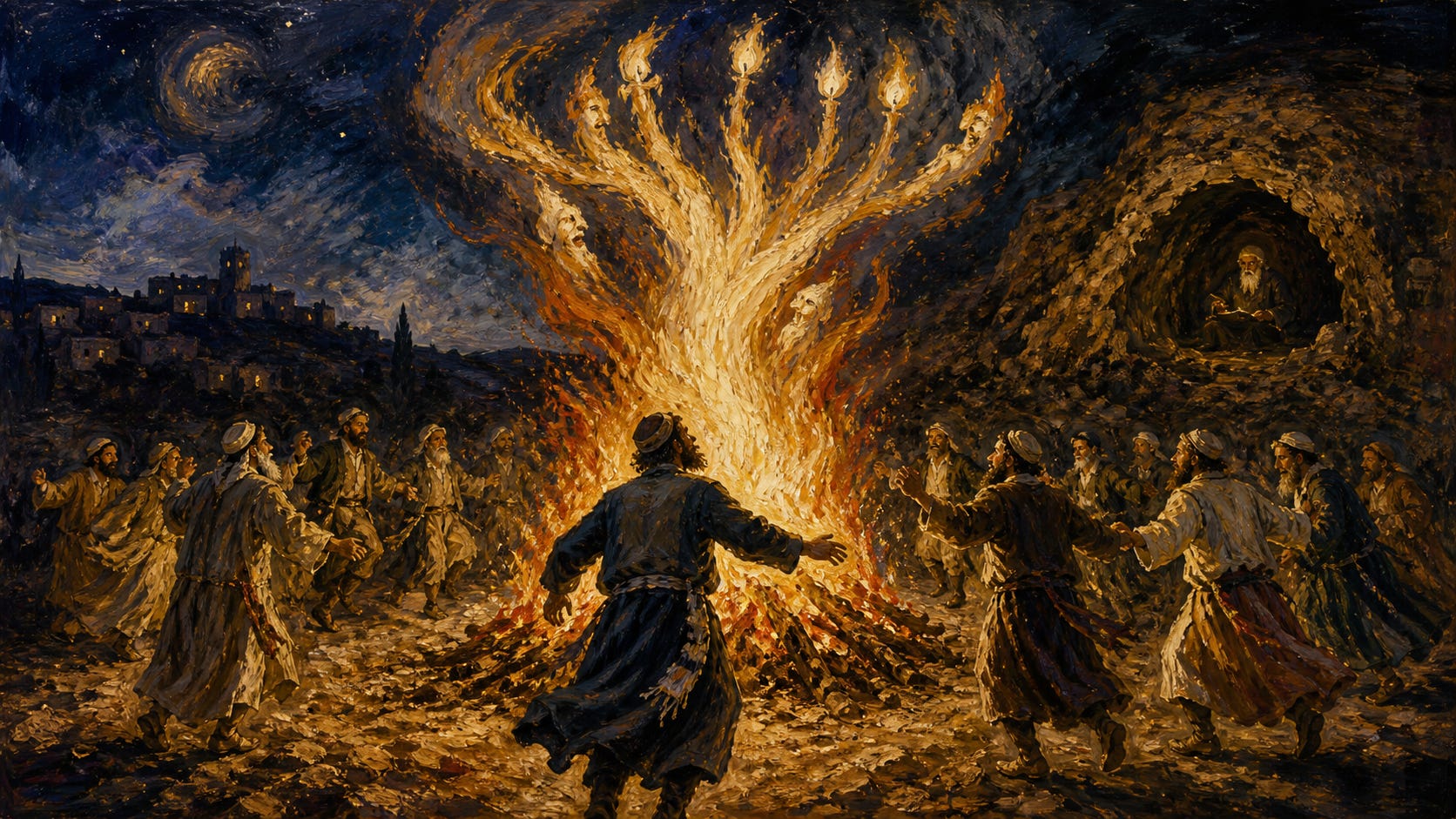
I remember standing on the hill. A Judean hill. Lag B’Omer night, and a massive bonfire in front of me.
Not just me, of course — I was with a group of people, most of whom were dancing and singing. But I was just standing there, looking at the fire.
I was dumbfounded.
Thoughts flew through my mind.
What in the world are we doing here?
What is this about?
Why a fire?
Why such a massive fire?
And why are we dancing around it?
It felt so strange.
So foreign.
It felt, I hate to say it, not Jewish. Like some foreign practice had snuck its way into the very center of the Jewish people.
And so I looked.
And I wondered.
What is this all really about?
As I continued to stare at the fire, I noticed how mesmerizing it was.
The fire also dances.
It dances for us.
A dance for a dance.
But the fire didn’t just dance.
It soared.
It towered over us — stretching, as it were, for the heavens themselves.
Reaching, climbing to the dark night sky.
Now the questions were gone.
In their place were flickers of thoughts.
There is something there.
There is something in those flames.
In the dance.
In the climbing mountain of flames.
But that was all I had.
Flickering thoughts.
Thoughts that also evaporated into the darkness of the night.
And then, it came.
An idea.
Is it my idea?
I don’t think so.
I didn’t piece it together.
I didn’t do any research or discuss it with anyone. It just appeared.
And it seemed (and to me still seems) right.
After the Destruction
Let us go back in time.
Rabbi Akiva is the master.
The Rosh Yeshiva of the Roshei Yeshiva.
The leader of the leaders.
And his students are everywhere.
Thousands of them.
Tens of thousands of them.
And then, they are gone.
Not diminished — gone.
An image may help.
Imagine every Yeshiva in the world is gone.
The Roshei Yeshiva — gone.
The talmidim — gone.
But it’s not just the yeshivos. It’s also the kollelim. And the printing presses. And the sefarim.
It’s all gone — from every walk of Jewish life.
Litvish and chasidish.
Chareidi and daati leumi.
Ashkenazim and Sefardim.
It is all gone.
There is no Mir Yeshiva in Shanghai.
No Yeshiva University in New York.
No Ponevezh in Bnei Brak.
All there is is desolation.
Death.
Despair.
Darkness.
That is the world in which Rabbi Akiva found himself. And in that world, he did the most Jewish thing he could do — he started again.
Gone were the 24,000 students.
In their place were just five.
But through those five, all was rebuilt.
Stam Mishnah is Rebbi Meir.
Stam Sifra is Rebbi Yehuda bar Ilai.
Stam Sifrei is Rebbi Shimon bar Yochai.
Rebbe Yosi ben Chalafta quoted in virtually every mesechta.
Rebbe Elazar ben Shamua, the teacher of Rebbe Yehuda HaNasi, the redactor of the Mishnah.
The oral law and its connection to the written law (and more) — preserved and passed down.
Not for just a few years — but for every year. Year after year — including the one we find ourselves in right now.
We can imagine these five talmidim as a menorah — a five-branched menorah. Each branch a unique, pure light. Each light shining in its own way — and lighting other lights.
And for now, it is to one of these lights that we turn. And we find it in the darkest of all places — a cave. For there, in that cave, we find a different kind of light.
A hidden light.
The type of light that only the darkness can reveal.
That light didn’t shine (initially) as the other lights. And only a few saw its glow. Although, I imagine, that for them, it was as bright as could be.
And yet, here we are — almost 2000 years later — and now that light shines far and wide. No longer is it dim. No longer is it hidden.
It shines through the Nefesh HaChaim and the Baal HaTanya and beyond.
Indeed, its light even reaches the non-Jewish world.
Carl Jung.
Jorge Luis Borges.
Anselm Kiefer.
Whether or not they understood it, they were aware of and drawn to it.
The light did not stay in the cave.
Back to the Wood
So what does any of this have to do with wood and fire on Lag B’Omer night?
Look at that bonfire.
Where does that light come from?
Take a tree — any tree.
Now chop it down.
Well, you don’t have to necessarily chop.
Let the wind break it in two.
Let it get struck by lightning.
It doesn’t matter.
What does matter is that it is now dead.
It is disconnected from its source.
No more growth.
No more life.
It is finished.
But it’s all a mirage.
It’s just not true.
That tree may not be alive.
And it may not be filled with life.
But it is certainly filled with light.
Lots and lots of light.
And all you need is just one single spark to let it shine.
The right spark, at the right time, in the right place will reveal a whole world of light that we just did not know existed.
Then, that seemingly lifeless piece of wood will come “alive”.
It will dance.
It will soar.
It will reach for the sky — and beyond.
That, I believe, is the light of Lag B’Omer.
And that was the light of Rebbe Shimon bar Yochai (and of his great teacher, Rebbe Akiva).
There was a time when it all seemed over.
No life.
No hope.
Just death.
And from within that darkness, Rebbe Akiva found hidden lights.
Five pure hidden lights, waiting to relight the entire Jewish world — and all of future Jewish history.
And within those hidden lights, lay an even deeper hidden light. Darkness within darkness.
And from within that deeper darkness came a light which would light up the souls of the Jewish people in the future darker times.
Back to the Dance
And so now, we return to that Judean hill on a Lag B’Omer night so many years ago.
My dumbfoundedness of just a moment ago was gone.
In its place was a new understanding.
And with that new understanding came a new inspiration.
And so, I rejoined the circle of dancing.
And as I did, I realized something else.
I myself, but just a moment earlier, was a dead piece of wood.
I was lifeless, disconnected, distant.
And now, I was alive.
All because of one simple idea — a spark that somehow or other brought my spirit back to life.
And so, I danced.
And I sang.
All this happened many years ago, on a dusty hill in the Judean hills. And every year since then, I have shared this Dvar Torah.
With family.
With friends.
And anyone else who cared to listen.
And so I do again this year.
But now, there is something new.
This year I have come to Lag B’Omer with a new idea.
An idea that has come from approaching the Eish Das of Torah each and every week since Parshas Noach.
As we have made our way through the Chumash, I began to notice a pattern. The constant theme of fire.
When G-d makes a covenant with Avraham Avinu, He passes between the pieces as a lapid eish, a torch of fire.
When G-d appears to Moshe Rabbeinu at the sneh, He does so from within a fire.
When we travelled through the desert, G-d led us at night with a pillar of fire.
When He descended onto Har Sinai, He descended with fire.
Later on, in Sefer Devarim, Moshe Rabbeinu describes G-d as a consuming fire.
And the Torah, he tells us, is a law of fire.
And, of course, in the Mishkan we offer up our korbanos on an altar of fire.
And as I started to notice this, I once again started to wonder.
What is it about fire?
Why are we constantly referencing G-d (and the Torah) via fire?
And once again, from the midst of my not knowing came an idea.
Fire is so versatile.
So powerful.
So capable.
You can bring light to the darkness.
Heat to the cold.
Hope to those who feel despair.
You can cook your food with it.
Light up your home with it.
Guide yourself at night with it.
The flame can be small or large.
A singular candle or a massive bonfire.
Fire, in short, is a fundamental part of man’s world. And it is no exaggeration to say that our ability to control fire gives us almost G-d-like capabilities.
And yet, as true as all of that is, it is not the whole truth. Because there is also an aspect of fire beyond our control, beyond our capability. And if we are not careful, it consumes.
Just ask Nadav and Avihu when they brought an eish zarah — a foreign fire.
When that happened, G-d responded by consuming them with a heavenly fire.
In short, fire represents that which is within us and at the very same time that which is beyond us.
We are tremendously rational beings — and yet there is so much we do not and cannot know.
We can be tremendously passionate — and yet woe to those whose passions run free.
Part of the essential richness of life comes from our deep emotional experiences and connections. But they can be so painful, so destructive, and so overwhelming.
Fire has this essential duality. On the one hand, it is a fundamental part of the world of man. On the other hand, totally beyond.
As such, I am now updating my “understanding” of the fires of Lag B’Omer. In my mind, the fire of Lag B’Omer relates not only to that which is hidden, but also to that which is beyond.
Beyond our understanding.
Beyond our control.
Beyond our capabilities.
And that too, I believe, is an aspect of the mystical light. A light which we apprehend and do not apprehend. That we connect to and at the same time recognize as totally beyond our grasp.
Sometimes we use fire to help us understand. The rational light.
Sometimes we see that there is a fire that we cannot understand. And so, we have to make another human move. Not a rational move, but an emotional and spiritual one. The move of letting go. Of recognizing that not everything is within our control. That there are fires that are simply beyond us — which we watch and wonder at.
It is a light that dances for us and that we dance around. An artistic dance. An interactive dance. A non-rational, but yet so deeply human dance.
A dance that we can dance only when we first and foremost let the fire have its own dance.
Beautiful and profound