
The Unity Hidden Within the Division
What the rocks at Yaakov's head can teach us about true achdus

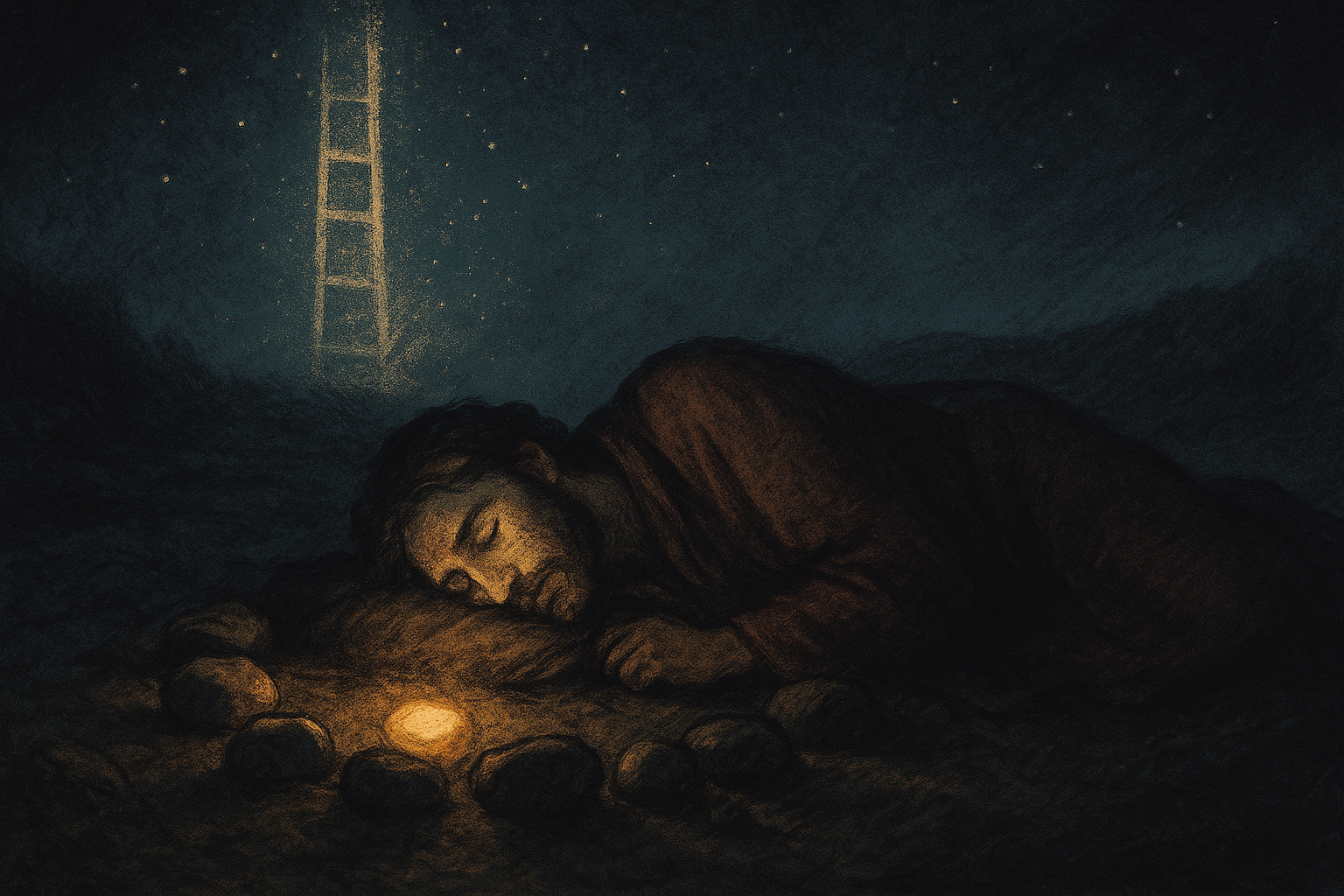
This week I’m going to do something different. I’m not going to write a Dvar Torah — I’m going to speak it out. I’m not going to polish it or edit it afterwards. There is one fundamental idea I want to get across from our parsha, and I truly believe it is one of the Torahs our generation needs.
And it has to do with rocks.
You might have missed it, but rocks play a fundamental role in the story of Yaakov and his dream.
Yaakov is fleeing from Esav. He is also traveling to Lavan. And in this in-between state — between leaving and arriving — he finds himself alone, at night, on a hill, with nowhere to stay.
So he takes from the rocks of the place and puts them around his head. Rashi says this was to protect him from wild animals.
This is an interesting detail, but it’s not the kind of detail you expect the Torah to emphasize unless something deeper is going on. And indeed, the story itself hints that there is something significant here.
Because in the morning, Yaakov gets up, takes one of those rocks, and sets it up as a matzevah — a memorial stone.
Yaakov clearly sees something significant in these stones.
He sets one up as a memorial.
And when he makes his neder, he says that if Hashem brings him back home, he will take that same stone and make it a Beit Elokim, a house of God.
Yaakov sees something here.
We don’t — at least not yet.
Hard as a Rock
But then comes a Rashi that helps.
Rashi quotes a fascinating Midrash: the stones began fighting.
Not a disagreement. Not a simple machloket. A merivah — a battle.
One stone said, “This tzaddik — Yaakov — will rest his head on me.”
Another said, “No — he will rest his head on me!”
Back and forth they fought.
Then God saw this and — miyad, immediately — made them into one stone.
And that stone became the one Yaakov set up as a matzevah.
What in the world is going on here?
What are these stones fighting about?
What does God see in their fight?
Why does He make them into one?
And why does Yaakov choose this stone?
There is a tradition — and I found it in at least one commentary — that there were twelve stones.
Twelve!
That number should immediately make you think of something. Yaakov is on his way to Lavan to marry Rachel and Leah, to have children who will become the twelve tribes of Israel.
So if you tell me there are twelve stones fighting, I immediately think: twelve tribes fighting.
Each tribe, each stone, saying:
“The tzaddik will rest his head on me.”
What is in Yaakov’s head that they are so eager to support?
We know exactly what it is.
It’s happening right now in the story:
His dream.
Yaakov is about to go to sleep and have the dream — the vision — of connecting heaven and earth. The ladder. The malachim going up and down. G-d standing atop the ladder, or over Yaakov.
It is the vision of uniting Shemayim and Aretz.
And each rock — meaning each tribe, each future shevet — each one as stubborn and unyielding as a rock — says:
“I am the one who supports this dream.
Yaakov will rest his head — the head containing the vision — on me.”
Meaning: my shevet, my path, my perspective is the right way to bring heaven down to earth.
This is a battle over how to connect heaven and earth.
What is Heaven and What is Earth?
But if we’re really going to understand this battle, we have to understand what “Heaven and Earth” actually mean — and why a ladder between them matters.
On the simplest level, “Heaven and Earth” can mean the sky and the ground: the atmosphere above and the dry land below. Many commentaries explain it this way on the pshat level.
But there is a deeper layer.
“Heaven and Earth” is also a relationship. A relationship where one realm is higher, more fundamental, the source — and the lower realm receives from it, depends on it, and tries to bring its influence down into lived reality.
A classic example of this is the rain that falls from the sky to the earth. Heaven gives. Earth receives.
I want to suggest another example — one that connects directly to our Midrash, and also to the makhloket among the “twelve stones.”
It is the Heaven of ideas and ideals.
The heaven of:
truth
justice
compassion
chesed
holiness
purity
emes, tzedakah, mishpat, kedusha, tahara
This is a realm of values — pristine, clear, elevated.
This is the “rain” of inspiration that pours into our minds and souls.
But here on earth, things are not pristine.
Here on earth, ideals need to be implemented.
It’s one thing to believe in peace.
It’s another thing entirely to create peace in a real world with real conflicts.
It’s one thing to believe in justice.
It’s another to build a society that is just.
This is one gap that exists between Heaven and Earth — but there are two other gaps as well.
The first gap is the one we mentioned:
How do you implement ideals in the real world?
How do you take peace, justice, chesed, kedusha, and bring them down into action?
But the second gap is deeper:
What are these ideals in the first place?
What is justice?
What is truth?
What is holiness?
Two people can both care about justice, but disagree passionately about what justice actually demands. Two people can both love holiness, but understand holiness in opposite ways. So we can fight — like rocks — not only about how to implement ideals, but about what the ideals themselves mean.
And then there is a third gap, maybe the most difficult of all:
Which ideals do we even believe in?
Some people strongly uphold compassion but downplay holiness.
Some elevate holiness but ignore justice.
Some believe deeply in truth but overlook chesed.
Some honor peace but neglect strength.
So we can disagree not only on how to implement ideals, and not only on what they mean, but even on which ideals matter in the first place.
In other words, when we try to connect Heaven and Earth, there are at least three areas where machloket can appear:
How to implement ideals
What those ideals actually mean
Which ideals we value and prioritize
And because these things matter deeply — because they shape our values, our identity, our mission — we become stubborn about them. Hard as rock. Fixed in our viewpoint. And so the twelve stones fight.
And yet — this is the miracle of the midrash — specifically because they are fighting over the unification of Heaven and Earth, God unifies them.
If what we ultimately want — underneath all our differences — is the same great project of connecting Heaven and Earth, then even if I get one (or more) of those three elements wrong, and even if you get another one (or more) wrong, we are still bound together by a shared desire.
If we can learn to see the world this way — to look at another and ask, “How is he trying to bring Heaven and Earth together?” — then we will find a unity that would otherwise escape us.
Let’s bring this into concrete examples.
If I see someone who is passionate about justice, but dismisses or downplays holiness, I have two choices. I can focus on what he lacks, or I can first appreciate the enormous good he does for justice — the ideal he is trying to implement — and then perhaps find a way, gently and respectfully, to speak about holiness later. Or maybe I will learn from him first.
If we both believe in justice but disagree on what justice actually means, I can still value the fact that he cares deeply about justice — that he wants a just world — even before we argue about definitions.
And if we share the same ideal but disagree on how to implement it, I can at least honor the fact that he wants it to be implemented. He is trying — sincerely — to bring the ideal down to Earth.
And the more we reciprocate this type of appreciation, the more it naturally softens the rock.
Like water dripping on stone, slowly carving depth and opening channels.
We may begin to see:
“Oh — he actually has an insight I was missing.”
“She actually has a better balance than I do.”
“That perspective is something I didn’t consider.”
As long as we hold onto the big picture — that there is a Heaven, there is an Earth, and they must be unified — we can start to see each other more positively. We can respect differences without denying truth.
This is the meaning of the midrash:
Because the rocks were fighting over how to unify Heaven and Earth, Hashem immediately unified them into one.
Not by erasing their differences —
but by revealing the unity beneath their disagreements.