
Where Tefillah Grows: Yitzchak in the Field | Parsha Chayei Sarah
How a moment between day and night becomes the birthplace of a deeper kind of prayer

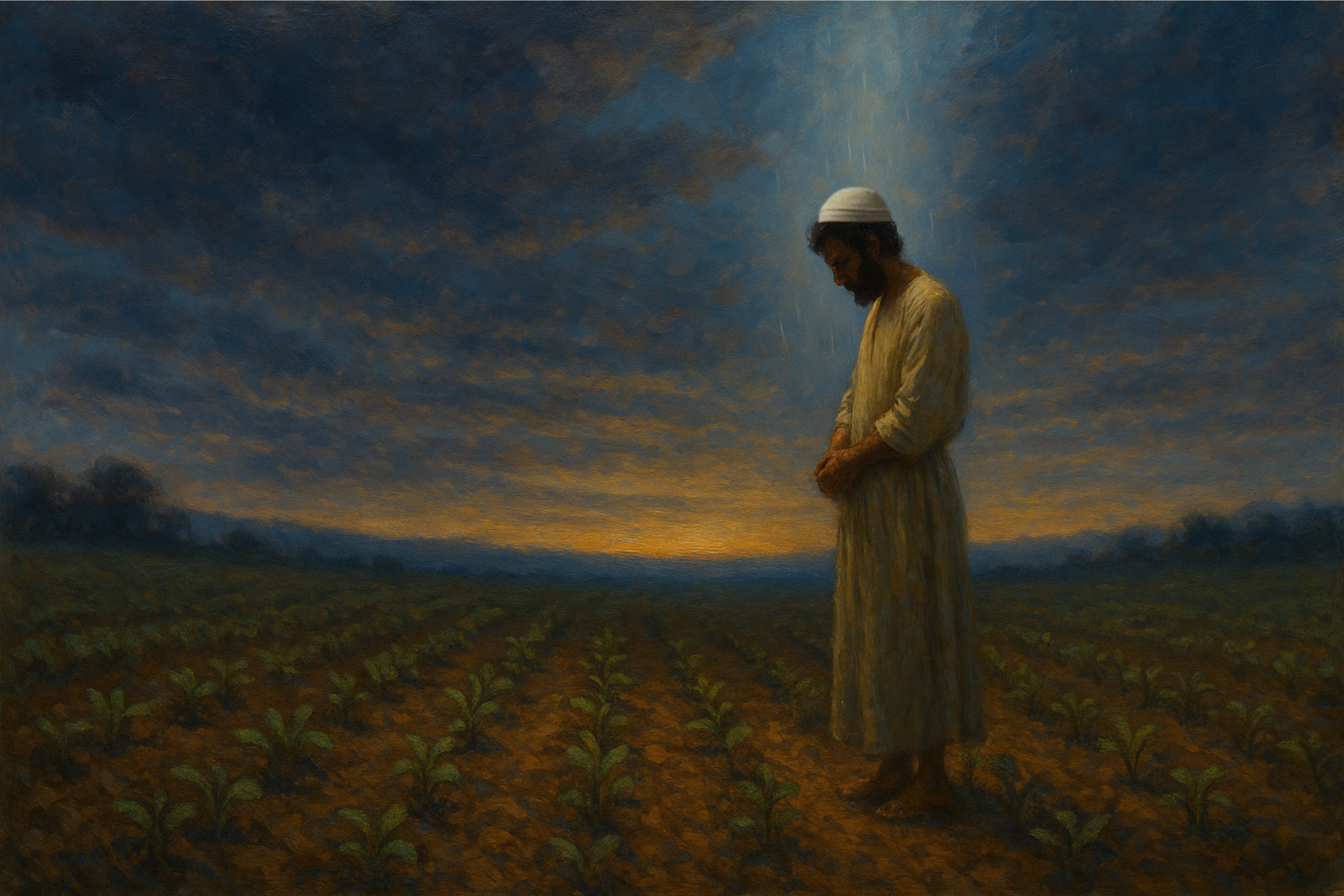
At the end of this parasha, Rivka is on her way to meet Yitzchak for the first time, and the Torah describes what Yitzchak is doing at that moment and how she responds. He’s going out לָשׂוּחַ בַּשָּׂדֶה (laseuach basadeh) — into the שָׂדֶה (sadeh) — to do something described by a Hebrew word whose meaning isn’t fully clear. It’s not a completely unfamiliar term, but it’s rare enough that we don’t immediately know what he’s doing. Rivka is clearly struck by it; the Torah shows that in her reaction. But the question for us is: what was Yitzchak doing that was so meaningful, and how can we uncover it?
I’d like to take a stab at this. I have an idea forming — something that may very well be true, even though the pieces aren’t all perfect yet. I’ll lay out what I do have and show the picture that seems to be emerging.
What “Siach” Really Means
The first piece comes from Rashi. Rashi sends us to Tehillim, to a pasuk where someone in distress “pours out his שִׂיחוֹ (sicho).” That siach is a form of tefillah — a spoken-out emotional or spiritual expression. We may not know the exact form it takes, but it is clearly a mode of prayer.
And this signals something important: there are multiple types of tefillah. Just as there are different kinds of songs — happy, sad, country, opera, rock — and different kinds of writing — prose, poetry, fiction, non-fiction — so too there are distinct modes of prayer. One particular mode carries the name שִׂיחַ (siach).
That’s where we begin.
But it becomes even more interesting when we recall that siach appears together with sadeh in a very different context earlier in the Torah.
The Other “Siach Basadeh”
At the beginning of Bereishis, the Torah says: כָּל שִׂיחַ הַשָּׂדֶה (kol siach hasadeh) — “all the siach of the field” — had not yet appeared. There, siach clearly does not mean prayer. It refers to a type of plant.
What kind(s)?
Not clear, but the Ramban points us in the right direction. He notes that the word שָׂדֶה (sadeh) refers specifically to land that is worked. It is farmland, cultivated soil, not just open earth. This contrasts with אֲדָמָה (adamah), which is simply ground.
In other words, when the Torah says there was no siach in the sadeh, it means there was no agricultural growth in land meant for farming.
So clearly we are talking about plants that exist on farms. Think wheat, barely - maybe even olives and dates.
Either way, we now we have two strikingly similar expressions:
• Yitzchak davening in a farm — laseuach basadeh
• Plants growing in the farm — siach basadeh
ש–ו–ח and ש–י–ח — trees and tefillah. Both in the field.
Interesting.
Rain, Work, and Human Need
But there is more to this story.
The pasuk explains that the siach hasadeh had not yet started to appear in the land.
Why not? Two reason are given.
There was no man to work the land.
And there was no rain — specifically no מָטָר (matar).
Or, put otherwise. There were no farmers and there was no rain to sustain the farms.
But Rashi sees it slightly differently.
There were no farmers and therefore there was no rain to sustain the farms. What, you may ask, is the connection between farmers and rain actually falling? Simple, Rashi says, tefillah.
Rashi, for some reason, inserts tefillah into our verse — even though the pasuk, at first glance, has nothing to do with prayer .
To get a glimpse of that reason, take a moment and think about the setting.
A sadeh, as the Ramban taught us, is a farm.
If a person is going to work a farm, he will need rain. He will be dependent on that rain. But he will not be in control of it.
That combination — needing something and not being able to guarantee it — creates a real internal tension. And whenever that happens, whenever a human being needs something they cannot produce or force or secure, they need a healthy, productive, constructive way of dealing with that tension.
That is where tefillah comes in.
Tefillah begins by acknowledging the need.
Then acknowledging the dependency.
Then acknowledging the lack of control.
And only after all that — after the inner truth has been spoken honestly — turning toward the One who does have control, the One who can provide what I cannot provide.
The alternative is to be swallowed by the fear and worry and stress that come when you feel dependent but powerless. Without tefillah, that tension has nowhere healthy to go.
And this — this exact dynamic — is what the world was missing.
This is the type of tefillah Rashi says the pasuk is alluding to.
Only after such tefillah appears can matar appear.
Here the Malbim sharpens the picture. The Torah uses two different words for rain, because they describe two different systems of rain:
Geshem is the natural cycle. Water evaporates, clouds form, the world turns. The system runs on its own. It is automatic, mechanical, meteorological.
Matar is different. Matar is responsive. It comes only through hashgachah. It arrives because human beings turn to God from a place of need and dependency. It is not just rain; it is relationship.
So when the Torah says that matar had not yet fallen, it means the responsive rain had not yet appeared — because humanity had not yet offered the kind of tefillah that calls it forth.
And now all the pieces can come together.
A human being standing in the sadeh, looking at the siach, recognizing his need for those plants and recognizing the plants’ need for rain — and then recognizing that he has no control over the most essential factor in their survival — that human being is perfectly positioned for tefillah. Once he takes all of those recognitions, and all of the emotions tied to them, and turns them upward into tefillah to God, then the rain can come.
Not as geshem — the rain of nature — but as matar, the rain of blessing.
Rain that comes because man has reached the limit of his control and turned toward God.
Rain that comes because tefillah has created a connection that wasn’t there before.
And that is the type of tefillah the world needed before anything could truly grow.
The Sadeh in the Beis HaMikdash
Now we come to a famous Chazal:
Avraham → mountain (הַר)
Yitzchak → field (שָׂדֶה)
Yaakov → house (בַּיִת)
Avraham’s service appears on the mountain — Har HaMoriah.
Yaakov’s world becomes the house — family, continuity, stability.
Together, they form the Beis HaMikdash on Har HaBayis.
But the sadeh — the field — seems missing. Where is Yitzchak’s element?
All around it.
It is there in תְּרוּמוֹת (terumos) and מַעַשְׂרוֹת (ma’asros) - the gifts that the farmer gives to the Kohanim who do the avaoda in the Beis HaMikdash.
It is there in בִּכּוּרִים (bikurim) — the first fruits which he publicly brings to the Beis HaMakidash.
It is there on Sukkos, at the time of the harvest, we celebrate for 7 days inside the Beis HaMikdash.
In short, Yitzchak is the one who infuses the mountain (הר) and the house (בית) with the field.
What Yitzchak Is Doing at Twilight
With that we can return to that fateful meeting with which we started this dvar Torah.
Yitzchak goes out toward evening — לִפְנוֹת עָרֶב (lifnot erev) — to laseuach basadeh. This time (which we will call twilight) is an in-between moment: the workday is over, but the night hasn’t fully begun. It’s when the unspoken concerns of the day rise to the surface. You’re no longer busy enough to ignore them, but you’re not fully removed from them either.
Yitzchak chooses that moment to daven.
And not just any tefillah — the tefillah that belongs to the sadeh, to human dependence, to need, and to gratitude.
There are essentially two such tefillos:
• the prayer of need — when you feel vulnerable and dependent
• the prayer of thanks — when the blessing finally appears
And the place most suited to fully developing these two types of prayers is the sadeh in general and the siach of the fields in particular.
Turning the Siach Into Laseuach
With that said, let’s note what exactly Yitzchak is doing here in the sadeh. He is taking the entire physical reality of the siach — the plants of the field — and transforming it into spiritual articulation.
The siach are the plants humans depend on.
They are essential for life.
But their success depends on elements we cannot control — most of all the rain.
That dependency — that structure of human need — is what becomes tefillah.
This is why the linguistic connection matters.
It’s as if Yitzchak makes a verb out of the noun:
שִׂיחַ (siach) → לָשׂוּחַ (laseuach)
Plants → Prayer
Physical dependency → Spiritual expression
Yitzchak takes the vulnerability embedded in the siach — the farmer’s dependence on rain, the gap between human effort and divine response — and turns it into tefillah directed upward toward heaven.
No longer is the field a mere place of sustenance. No longer is it a place where one solely lives by the sweat of their brow. No, the field is now something else entirely, it is the source of tefillah itself.
In essence, the field’s plants become the field’s prayers.
And Rivka sees this, and is overwhelmed.
A Seed of Yaakov’s Ladder
One last thought. Soon Yaakov will dream of a ladder connecting שָׁמַיִם (shamayim) and אָרֶץ (aretz), with angels ascending and descending. I want to suggest that the seed of that idea appears here.
The world needs the rain of heaven.
Heaven waits for the prayers of earth.
The angels rising are the tefillos;
The angels descending are the rains — the divine response.
A thought for another time.
Good Shabbos,
Moshe.