
Anochi Hashem Elokecha: The Command That Was Never Commanded | Parshas Yisro
What Hashem wanted us to know before anything else

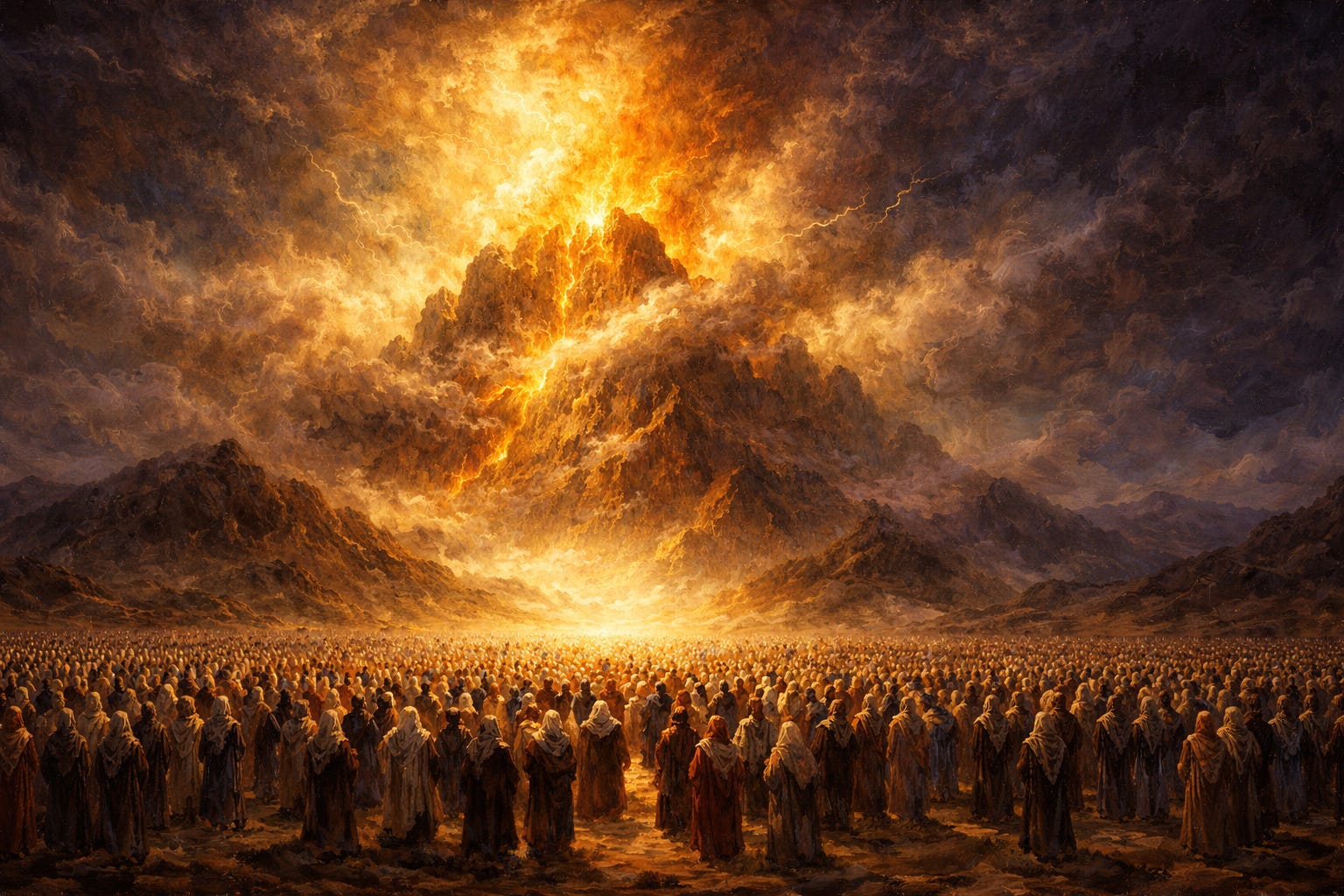
We begin this week’s dvar Torah not in the words of the Torah itself, but in the words of the Rambam.
In particular, we’re going to take a look at the first line in the first set of halachos in the first book of the Mishneh Torah. Why? Because this Rambam is going to relate directly to our parasha.
יְסוֹד הַיְסוֹדוֹת וְעַמּוּד הַחָכְמוֹת
The foundation of all foundations and the pillar of all wisdoms...
Now, we have to stop here for a moment.
These four words of the Rambam have to be understood in and of themselves before we get to the point that we actually want to discuss. Because the Rambam is telling us that he’s about to share an idea that is the foundational idea of all foundational ideas. And if that doesn’t make sense to you yet — hold on. We’re about to explain it.
He’s also telling us that this idea is the pillar of all the different types of wisdoms that exist. And again, if that sounds confusing — don’t worry. We’re going to explain that too.
Let’s start with the foundation of all foundations.
This first set of halachos of the Rambam — the one that this line is found in — is called Yesodei HaTorah. The Foundations (plural) of the Torah. It’s a set of halachos that the Rambam tells us are fundamental to the entire Torah.
Just as a foundation holds up a building, so too these halachos hold up the Torah. That’s why the Rambam calls them Yesodei HaTorah — the Foundations (plural) of the Torah.
But here, in this line, in these two words — *yesod ha-yesodos* — the Rambam is saying something more. This halacha that we are about to learn — it’s not only fundamental to the Torah — it’s fundamental to the other foundations of the Torah as well. In other words, the Rambam is about to define for us the idea upon which everything else — including all the other foundational ideas — is built.
It’s as if you have a building with two foundations. One foundation holds up the building. The other foundation holds up the first foundation.
And there is another point that the Rambam wants us to know — that this upcoming halacha is also the *amud ha-chochmos* (the pillar of all wisdoms — plural). In other words, there are different types of “wisdoms” in the world — and they too are held up by our halacha.
One last point before we actually get to this halacha itself — I would be remiss if I didn’t point out a beautiful linguistic detail in this line. Take a look at the first letter of each word:
יְסוֹד הַיְסוֹדוֹת וְעַמּוּד הַחָכְמוֹת
יסוד: Yud (י)
היסודות: Heh (ה)
ועמוד: Vav (ו)
החכמות: Heh (ה)
Combined, these letters make up the Shem Havayah (the “proper” name of Hashem). Which should give us a hint as to what this halacha is about to tell us.
But we won’t really need hints. Because we’re about to learn it ourselves right now.
Matzui Rishon
So — what is this foundation of all foundations and this pillar of all wisdoms?
The Rambam tells us right away:
לֵידַע שֶׁיֵּשׁ שָׁם מָצוּי רִאשׁוֹן. וְהוּא מַמְצִיא כָּל נִמְצָא.
To know that there is a First Existing Entity. And He brings into existence all that exists.
This is philosophical language — exact and precise. So let’s take a moment to read it as exactly as the Rambam wrote it. I’ll do so by “modernizing” the Rambam — relating to the world as we understand it today. But the concepts, I believe, are the same.
Two words need unpacking: “existence” and “first.”
Existence. We exist — you, me, the universe, everything in it. But our existence is finite and unstable. Ice melts into water. Water evaporates into air. Seeds become trees, trees produce fruit, and the right match on the right day turns it all to ash. Things are. But the things that are don’t stay the same.
First. This word carries two meanings. One is temporal — first in sequence, in cause and effect. I had parents. They had parents. At some point, there has to be a starting point. An infinite chain of cause and effect going back forever? I find that inherently absurd. Can I disprove it? I don’t know. But I see no reason to take it seriously. I look at it the way a chess grandmaster looks at a board — not every move is worth considering. I shrug my shoulders, roll my eyes, and move on.
The second meaning is structural — first in terms of building blocks. I’m made of organs,
which are made of cells,
which are made of molecules,
which are made of atoms,
which are made of particles,
which are made of quarks,
which are made of... I’m not sure we know yet.
At some point, there has to be a foundation. An infinite regress of smaller and smaller parts? I find that also inherently absurd. And if anyone wants to suggest otherwise, I give the same shrug and the same eye roll — unless, of course, HaKadosh Baruch Hu built that sort of infinity into the very fabric of the universe. A sense of the infinite within the finite. But then that just means that HaKadosh Baruch Hu Himself is the ultimate foundation. Either way, we arrive at the same place.
And here’s the key. Whether we approach it through time (cause and effect, going back to a beginning) or through structure (building blocks, going down to a foundation) — the Rambam is telling us we arrive at the same place. There is an entity which exists, which is the source of everything else that exists.
The Rambam calls this a *Matzui Rishon* — a First Existing Entity.
That’s all the Rambam tells us here. He doesn’t tell us *how* we know this. He doesn’t tell us what he means by “knowing” — whether it’s awareness, understanding, or rigorous proof. He leaves that unstated. For now, he simply wants us to know *that* such an entity exists.
The Dependency
So there exists a First Existing Entity — a Matzui Rishon — and everything else that exists comes from it.
But what exactly is the *relationship* between the Matzui Rishon and everything else?
The Rambam answers this with a thought experiment. Actually, two thought experiments — mirror images of each other.
Here’s an analogy that might help us feel what the Rambam is getting at.
Imagine someone invents a time machine. He travels back to the past, gets into a terrible car accident, and accidentally kills his parents — before he was ever born.
What happens to him?
He ceases to exist. Not dies — ceases. He’s erased from reality. Because his existence depends entirely on his parents. No parents, no him. He doesn’t have within himself the capacity for his own existence. He’s derivative. Dependent. And when the source is gone, so is he.
Now flip it.
Same time machine. Same car accident. But this time, he accidentally kills his younger self.
What happens to his parents?
Nothing. They’re fine. They’ll grieve, but they’ll still exist. Because their existence doesn’t depend on his. The dependency runs one way. He needs them for his existence. They don’t need him for their existence.
That is exactly what the Rambam is telling us about the Matzui Rishon and everything else.
וְאִם יַעֲלֶה עַל הַדַּעַת
שֶׁהוּא אֵינוֹ מָצוּי
אֵין דָּבָר אַחֵר יָכוֹל לְהִמָּצְאוֹת.וְאִם יַעֲלֶה עַל הַדַּעַת
שֶׁאֵין כָּל הַנִּמְצָאִים מִלְּבַדּוֹ מְצוּיִים
הוּא לְבַדּוֹ יִהְיֶה מָצוּי.
וְלֹא יִבָּטֵל הוּא לְבִטּוּלָם.If it were to arise in the mind
that the First Existent did not exist,
nothing else could exist at all.And if it were to arise in the mind
that nothing exists besides Him,
He alone would still exist,
and He would not be nullified by their absence.
We don’t have within us the capacity for our own existence. We are entirely derivative. Entirely dependent. The Matzui Rishon doesn’t depend on us for anything.
The dependency runs one way.
We are one hundred percent dependent. The Matzui Rishon is one hundred percent independent.
Hashem Elokim Emet
Let’s recap what we’ve learned so far.
The Rambam has told us that there’s an ultimate source to all of reality — a Matzui Rishon. He brought all of reality into existence. All of reality is one hundred percent dependent upon Him. And He is in no way whatsoever dependent upon it.
Says the Rambam: this means something.
לְפִיכָךְ אֵין אֲמִתָּתוֹ כַּאֲמִתַּת אֶחָד מֵהֶם.
The nature of His reality is utterly different from ours. He is, in essence, the only truly existing entity.
Now, I don’t think the word *emet* here means “true” in the sense of true versus false. I think a better translation would be something like “real.” So: His reality is not like the reality of anything in the natural world. He is of a different nature than us entirely.
And the Rambam shows us that this idea is not his own — it’s found in the Navi Yirmiyahu:
הוּא שֶׁהַנָּבִיא אוֹמֵר וַה’ אֱלֹהִים אֱמֶת.
What did Yirmiyahu mean by *Hashem Elokim Emet*? Says the Rambam: he meant that Hashem is the true reality. Only Hashem is *Emet*. He alone truly exists. Nothing else exists the way He does.
הוּא לְבַדּוֹ הָאֱמֶת וְאֵין לְאַחֵר אֱמֶת כַּאֲמִתָּתוֹ.
And the Rambam adds: we find this same concept, in different words, in the Torah itself:
וְהוּא שֶׁהַתּוֹרָה אוֹמֶרֶת אֵין עוֹד מִלְּבַדּוֹ.
*Ein od milvado* — there is nothing else besides Him.
If you understand that everything exists only because of this Matzui Rishon, and that without Him nothing else could exist, then in the deepest sense — there really is nothing else. Everything else is an extension of His existence. A reflection of His reality. Dependent upon Him for every moment of its being.
The Mitzvah
Let’s take stock of what we’ve learned.
There is a First Existing Entity. He brings everything into existence. Everything depends on Him — if He didn’t exist, nothing could. But He depends on nothing — if nothing else existed, He would still be. His reality is not like our reality. He is the only truly existing entity. There is nothing else besides Him.
That’s the definition.
And now the Rambam tells us something remarkable:
וִידִיעַת דָּבָר זֶה מִצְוַת עֲשֵׂה.
And knowing this matter is a positive commandment.
According to the Rambam, everything we just learned is not simply philosophy or theology. It is a mitzvah — a commandment. This is something that we need to know, like we need to keep Shabbos and keep kashrus. Or perhaps even more so.
But of course, if there’s a commandment — and by commandment here, the Rambam means a mitzvat aseh min HaTorah, a positive commandment from the Torah itself — then it has to have a source in the Torah.
Where in the Torah does it tell us that we have a mitzvah to know all of this?
Says the Rambam: in our parasha. At Har Sinai. In the first of the Aseres HaDibros. When HaKadosh Baruch Hu said to us:
שֶׁנֶּאֱמַר אָנֹכִי ה’ אֱלֹהֶיךָ.
Anochi Hashem Elokecha.
Those three words, says the Rambam, are not just information. They are a commandment — a commandment to know and understand everything that the Rambam just explained to us.
And we should note: this is not something that the Rambam made up. This idea is found in the Gemara, in Masechet Makkos.
The Gemara is found at the bottom of daf 23b and continues to the top of 24a. It reads as follows:
דָּרַשׁ רַבִּי שִׂמְלַאי: שֵׁשׁ מֵאוֹת וּשְׁלֹשׁ עֶשְׂרֵה מִצְוֹת נֶאֶמְרוּ לוֹ לְמֹשֶׁה, שְׁלֹשׁ מֵאוֹת וְשִׁשִּׁים וְחָמֵשׁ לָאוִין כְּמִנְיַן יְמוֹת הַחַמָּה, וּמָאתַיִם וְאַרְבָּעִים וּשְׁמוֹנָה עֲשֵׂה כְּנֶגֶד אֵיבָרָיו שֶׁל אָדָם. אָמַר רַב הַמְנוּנָא: מַאי קְרָא – ״תּוֹרָה צִוָּה לָנוּ מֹשֶׁה מוֹרָשָׁה״, ״תּוֹרָה״ בְּגִימַטְרִיָּא שֵׁית מְאָה וְחַד סְרֵי הָוֵי, ״אָנֹכִי״ וְ״לֹא יִהְיֶה לְךָ״ – מִפִּי הַגְּבוּרָה שְׁמַעְנוּם.
Rabbi Simlai taught: Six hundred and thirteen mitzvos were said to Moshe. Three hundred and sixty-five negative commandments, corresponding to the days of the solar year, and two hundred and forty-eight positive commandments, corresponding to the limbs of a human being. Said Rav Hamnuna: What is the pasuk that tells us there are 613 mitzvos? He quotes a pasuk at the end of Sefer Devarim: *Torah tziva lanu Moshe, morasha kehilas Yaakov* — “Moshe commanded us Torah, an inheritance for the congregation of Yaakov.” The word *Torah* in gematria equals 611. “Anochi” and “Lo yihyeh lecha” — we heard directly from the mouth of the Almighty.
Now, you may notice that 611 and 613 are not the same number. Rav Hamnuna noticed that too. But he says: there are two more mitzvos. Anochi and Lo yihyeh lecha — the first two statements of HaKadosh Baruch Hu at Har Sinai. Those we heard directly from HaKadosh Baruch Hu Himself. So you take the 611 mitzvos that Moshe commanded us, add the two that Hashem commanded us directly, and you get 613.
For our purposes, we just want to note that Rav Hamnuna says that the phrase Anochi Hashem Elokecha — which is what he references when he uses the word Anochi — is a mitzvah. The Rambam didn’t make this up. This understanding already existed in the time of Chazal. The Rambam is simply explaining to us what the mitzvah is.
The Problem
But whether the idea comes from Chazal or from the Rambam, we still don’t understand what either of them is talking about.
Because where is the command?
Let’s look at the other mitzvah that came mi-pi ha-Gvurah, directly from Hashem: Lo yihyeh lecha — “There shall not be for you [other gods].” That’s command language. You cannot do this.
Or look later in the Aseres HaDibros. Zachor es yom haShabbos l’kadsho — Remember the day of Shabbos to sanctify it. That’s a command. Lo sirtzach — Don’t murder. That’s a command. Lo signov— Don’t steal. That’s a command. They’re all phrased as directives. HaKadosh Baruch Hu tells us: do this, don’t do that.
But Anochi Hashem Elokecha? That’s a statement. An introduction. A declaration. HaKadosh Baruch Hu is telling us who is speaking — but He’s not telling us to do anything.
So how does the Rambam, following Chazal, derive a mitzvah from this?
We need to understand these three words. Because evidently there’s a lot more hidden in them than we realized. We thought it was just information — a sort of introduction before the “real” commandments begin. But evidently we’re missing something. And we want to see what we’re missing.
In order to do so, we have to take the time to understand each of these three words: the word Anochi, the word Hashem, and the word Elokecha. We’ve already explored the names Hashem and Elokim a bit, so that will be easier. But even the word Anochi has hidden treasures in it that we didn’t think to look for.
And then — and this is the beautiful part — we’re going to have to figure out how these three words relate to each other. How to punctuate them, so to speak. Because the relationship of one word to the next is not at all obvious, as we will see when we start to explore the commentaries.
These three words. What they mean. And what they mean when put together — particularly in the context of Har Sinai.
Anochi
In order to see how this is a mitzvah, we first have to address a particular challenge — or one might say, opportunity — that exists within the Hebrew language.
Hebrew doesn’t have punctuation. And Hebrew doesn’t really have a word for “is” or “am.” Which means we have to figure out where to put them ourselves.
And that’s particularly true with our verse:
אָנֹכִי ה’ אֱלֹהֶיךָ אֲשֶׁר הוֹצֵאתִיךָ מֵאֶרֶץ מִצְרַיִם
I am Hashem your God who took you out of the land of Egypt.
How are we to translate this verse? It’s not so simple — particularly because we don’t know where to place the word “is” or “am” in this sentence. And there’s nothing in the actual words themselves that gives any indication. The answer comes from how we intone the verse, not from anything inherent in the words as they’re written on the page, on the daf, in the Torah.
As such, let me give you three possible translations.
Possibility One: I, Hashem your God, am the one who took you out of Egypt.
Let’s ask ourselves: according to this translation, what is the message of HaKadosh Baruch Hu? What does He want us to know?
He wants us to know that He is the one who took us out of Egypt. The phrase “Hashem your God” is what we call a parenthetical statement. It’s not what He’s trying to tell us. He’s not trying to tell us about Himself — that He is Hashem, our God. He’s just identifying who He is. So the point would be: He and no other god, no other power, is the one who took us out of Egypt. That is what He would be telling us if we intone the verse in such a way that this would be the proper translation.
Possibility Two: I am Hashem — your God, the one who took you out of Egypt.
Let’s ask the same question. What does He want us to know?
Here, the message is that He is Hashem — Yud-Keh-Vav-Keh. And He’s just identifying a bit more about who Hashem is, what His function is. His essence is Hashem, but He’s also our God, and He’s also the one who took us out of Egypt. But those are parenthetical statements.
Possibility Three: I am Hashem, your God — the one who took you out of Egypt.
We’ll ask our question one last time. What does He want us to know?
According to this reading, He wants us to know that He is Hashem. And He wants us to know that He is our God. Both of those points are being communicated at once. What the fact about taking us out of Egypt has to do with anything — that’s not our focus right now. It’s an interesting question, but not one we’re going to address today.
The Third Reading
Now, this third reading is the one we need.
If we are going to derive a mitzvah from this line, we need to understand what it means for Hashem to address the entire Jewish people all at once, to reveal Himself unmasked to all of them, and to say: Anochi Hashem Elokecha (אָנֹכִי ה’ אֱלֹהֶיךָ) — I am Hashem, your God. Where the main point is not something about what Hashem did, but something about who He is. That He is the entity represented by the combination of the proper name Hashem and the descriptive name Elokim.
Ani and Anochi
To get the full weight of this statement, we have to understand the difference between the word ani (אֲנִי) and the word anochi (אָנֹכִי).
It’s quite fascinating that in the Hebrew language, there are two ways to say the word “I.” One is ani (אֲנִי) — aleph, nun, yud. The other is anochi (אָנֹכִי) — aleph, nun, chaf, yud.
If there are two ways to say the word “I,” it stands to reason that there is some significant nuance in meaning between them.
And indeed, the Malbim offers one such nuance. He gives a very interesting example.
Imagine someone says, “I am standing.” In English, he could mean: I am standing as opposed to sitting. Or he could mean: I am standing, as opposed to the other people who are sitting.
In the first example, the focus is on what he’s doing. What am I doing? Standing or sitting? In the second, the focus is on him as opposed to other people. I’m the one standing — not others.
Says the Malbim: the word ani (אֲנִי) relates to the first idea — something about what one is doing. If I want to say that I am standing as opposed to sitting, I’d say ani omeid (אֲנִי עוֹמֵד). I’m not talking about me and my personhood. I’m not the focus — what I’m doing is the focus.
But if I want to talk about me — if the focus is on my personhood — I’d use anochi (אָנֹכִי). If I want to say I’m standing and no one else is, then it’s anochi omeid (אָנֹכִי עוֹמֵד).
As such: Anochi Hashem Elokecha (אָנֹכִי ה’ אֱלֹהֶיךָ).
When the message is that HaKadosh Baruch Hu wants us to know something about Him — that’s anochi. Not just “no one else” — although that’s part of it. But: I want you to know something about the essence of who I am. I want you to understand who is speaking to you. And that can be expressed in the two words: Hashem Elokecha.
The Names
Now, we have already spent time on these two names (though there is more to the names than we mentioned before). But for now, we just have to note that the philosophical definition the Rambam gave to God — everything we just went through at the beginning of Hilchos Yesodei HaTorah — can be derived from these names.
As a short reminder, the Shem Havayah (Yud-Keh-Vav-Keh) is considered Hashem’s “proper” name. Whereas Shem Elokim relates to His “position.”
It’s as if Bibi said, “I am Bibi Netanyahu, your Prime Minister.” His name is Bibi Netanyahu. His position is Prime Minister.
So it is with God. He has a proper name which tells us something about the essential nature of Hashem (as far as we can relate to it). And He has a position which tells us something about how Hashem created and runs the world.
Within that name and that position, if you understand what they mean, you understand everything the Rambam just laid out. It’s all in there. You just have to understand what the names mean.
And if you understand the grammar of the word anochi, then you understand that when all of Am Yisrael stood before Hashem at Har Sinai — this is what He wanted them to know.
I am of a totally different nature than anything else. I am the ultimate source of all reality. All reality finds existence within Me. I am totally independent of the world. And you are totally dependent upon Me.
That is who I am.
One Moment, One Message
But we still don’t have a mitzvah yet.
We can see how the concept is there — this is what Hashem is saying. And we can see how the philosophically exact language the Rambam uses at the beginning of his work is found within the names of God as expressed directly to the Jewish people at Har Sinai.
But where is the command?
So this is how I see it.
From the first moment that HaKadosh Baruch Hu spoke to Moshe Rabbeinu and told him that He was going to take the Jewish people out of slavery and bring them to Eretz Yisrael, He mentioned that they were going to serve Him on this mountain — Har Sinai. And indeed, the entire request to Paro was framed upon this revelation. They didn’t come to Paro and say, “Set us free and let us return to our homeland.” They said, “Let us go into the desert and serve Hashem.” Let us have Matan Torah.
And then finally, HaKadosh Baruch Hu brings the entire Jewish people before Him, and He is going to speak to them directly. One time.
According to Rav Hamnuna, this is the only line they heard directly from Hashem. The rest was conveyed through Moshe (see Rashi). Anochi Hashem Elokecha and Lo yihyeh lecha — I am Hashem your God, and you will not have any other gods.
But only one part of this says anything about Hashem Himself. Lo yihyeh lecha is just saying: you’re not going to have anyone else. It’s as if your wife says, “I am your wife — you’re not going to have any other girlfriends.” When you get married to me, that’s it. It’s just the two of us. But only one part says something about who she is.
So there’s only one line in which Hashem says to the Jewish people directly anything about Himself.
And this, evidently, is the one message He wanted them to hear directly from Him. Not through Moshe Rabbeinu. When the whole nation was in front of Him, and He could say whatever He wanted to say to them — what did He want to say? What did He want them to hear directly from Him, while the rest could be passed on through Moshe?
Understand who I am. Understand the relationship between the two of us — the nature of that relationship. Because everything else flows out from it. It is the yesod of all the yesodos. It is the basis of the entire relationship. It’s why we do everything we do. The entire structure and relationship and everything else flows out from that.
And so — if I only have one moment, and only one thing to say to you — this is what I want to say.
The Command is Understood
And so I ask you.
If Hashem thought that this was the most important message to give over to the Jewish people — and this was the one message He wanted all the Jewish people to hear directly from Him — do you think this was just something they were supposed to hear and get for the moment, but afterwards they could remember it if they wanted to or forget if they wanted to?
Do you think Hashem wanted them to know this — and their children, and their grandchildren, and their great-grandchildren?
It is self-evident. It is obvious. This is what Hashem wants every single Yid in every single generation to know.
And therefore — there’s no need to command.
Because once you hear it, you know. This is what we’re supposed to know. Not just on an intellectual level, but in our guts. Intuitively. At the foundation and the deepest level of who we are. Because when we hear Hashem say that — we get it. We live that. We experience that connection.
The mitzvah is built into the entire way the statement was given over. The fact that it was to everyone. From Hashem directly to them.
When you’re talking to Moshe, then you have to tell Moshe: command them. But when I’m speaking to them directly — you don’t have to say that.
If your wife says to you, “I’m your wife,” she doesn’t have to add, “Remember that.” It’s self-evident. It’s understood.
If your parent says to you, “I’m your father, I’m your mother,” they don’t have to add an explanation of how to act. They do sometimes — but if the child gets it, they don’t need to.
If a friend says, “That’s your father — you shouldn’t act that way. That’s your mother — you shouldn’t talk that way. That’s your wife — you shouldn’t treat her that way” — then they add in the command.
But when it comes directly from the source?
The command is understood.
Beautiful and insightful!
Very clearly and well-written, as well!