
The Place Power Can’t Go | Parshas VaYigash
How Yehuda Stepped into the Space Yosef Could Not Control

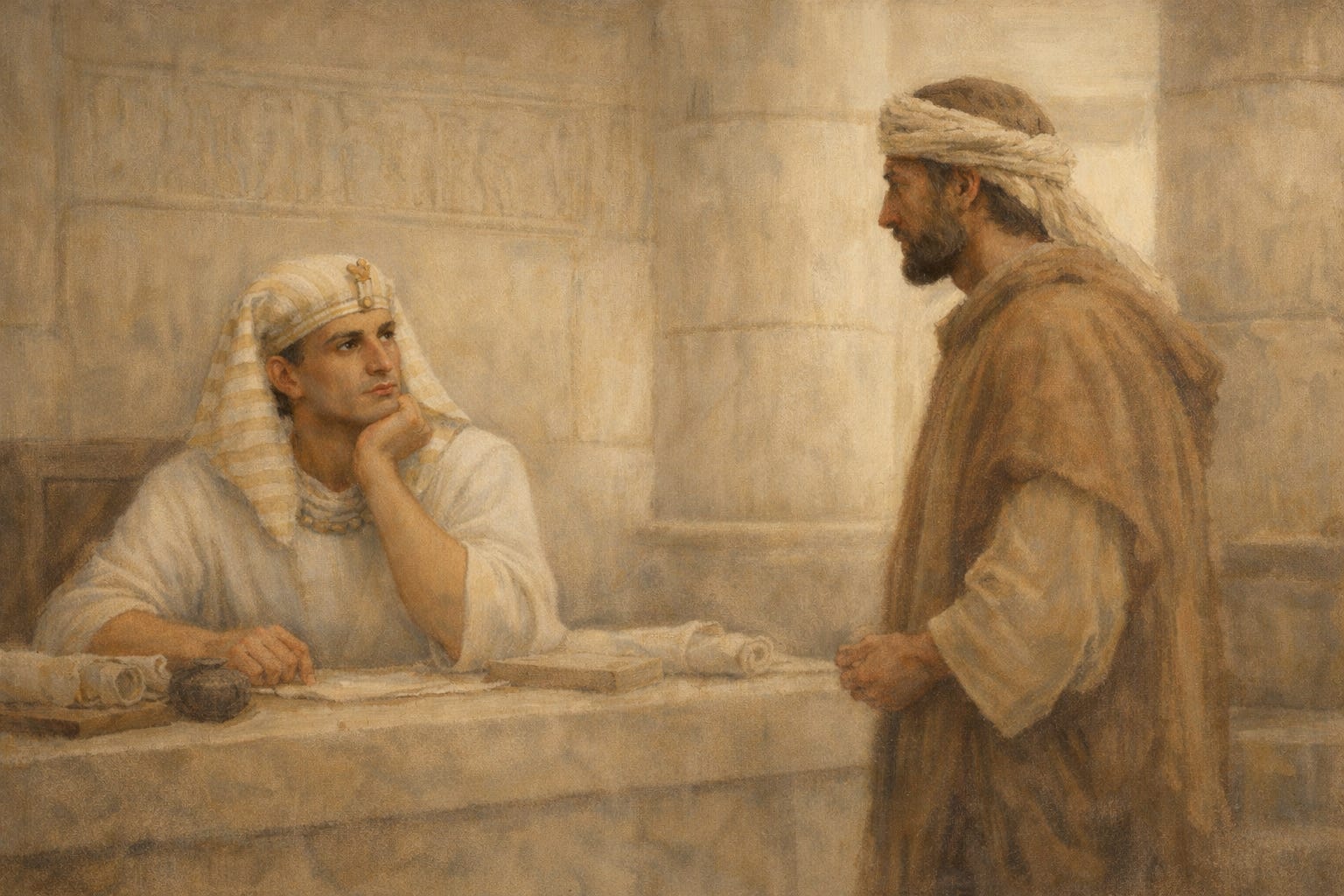
This week, I want to try something a little different.
I’m not starting with a question, and I’m not starting with a thesis. I just want to read a particular story in this week’s Parsha — the confrontation, if that’s the right word, between Yehuda and Yosef — and see what it reveals.
Because even before we begin, it’s clear that something profound is happening here.
What we are witnessing is the meeting of two power structures within the Jewish family.
On one side stands Yehuda.
Yehuda — the one who suggested that they sell Yosef as a slave.
Yehuda — the one who admitted that Tamar was right.
Yehuda — the one who gained Yaakov’s trust.
On the other side stands Yosef.
Yosef — the one who carries Yaakov’s love.
Yosef — the master of the dreams.
Yosef — the viceroy of Egypt who is carefully orchestrating events from behind the scenes.
And now these two forces finally meet.
And already I have a question. Now that Yehuda has stepped up, has Yosef lost some of his control? Is he still orchestrating events like he used to?
And I also have my first thought — this story is not foreign to the Jewish people.
This may be the first time a Jew stands before someone far more powerful, but it is certainly not the last. We will see it again with Moshe and Pharaoh, and again throughout Jewish history, in moments when we are David facing a contemporary Goliath.
In that sense, Yehuda — the progenitor of David — is already playing that role here. Yosef is not a villain, but he is the power structure. He has authority and control that Yehuda does not.
And yet Yehuda steps forward anyway.
That negishah is familiar to us: the willingness to confront power, not because the odds are equal, but because the cause is just.
Setting the Stage: Yosef in Control
So let’s begin — though not at the beginning of our parsha. For me, the real beginning is at the end of last week’s.
Up until this point, Yosef is still the conductor. He is orchestrating every move. And now he arranges matters so that Binyamin will be found guilty.
They catch up to the brothers. Everyone rushes to take down their bags and open them. The search begins, starting with the oldest and moving down the line. One by one, each bag is opened. Nothing. Ten brothers are found completely innocent.
And then, at the very end, the cup is found in Binyamin’s bag.
That detail matters. It’s not just that Binyamin is found guilty — it’s that everyone else is explicitly discovered to be innocent, and therefore free to go.
The Offer — and the Trap
Look carefully at the conversation before the search even begins. Yosef tells his servant exactly what to say: Why are you repaying good with evil? We treated you well — is this how you repay us?
The brothers respond with complete confidence. Whoever the cup is found with should die, and the rest of us will be slaves. They are certain of their innocence — because they are innocent. They don’t yet realize they are being set up.
Yosef then changes the terms.
No. The one the cup is found with will be my slave. The rest of you will go free.
The brothers had offered collective responsibility: if one of us is guilty, we are all guilty. Yosef rejects that. Only the guilty party. Everyone else walks.
And that is exactly what happens.
They find the cup in Binyamin’s bag. The brothers tear their garments. And they return to the city.
Yehuda Steps Forward
And now the focus shifts.
Until this point, the brothers act as a single unit. They speak together. They respond together. But now the Torah singles someone out.
Yehuda and his brothers come back to Yosef’s house. They bow before him. Yosef repeats his accusation.
And Yehuda speaks.
“What can we say to my lord? How can we justify ourselves? God has found the sin of your servants.”
He is not admitting guilt for the cup. He is saying something deeper: God is involved here. This is bigger than the moment. And then he says it clearly: We are all your slaves — both us and the one the cup was found with.
No separation. No leaving anyone behind.
But Yosef still insists on control.
“Far be it from me to do that. The one the cup is found with will be my slave. You — go back in peace to your father.”
They are free to leave. No one is stopping them. Everything has been arranged so that they should go — and leave Binyamin behind.
And then comes the turning point.
Vayigash elav Yehuda.
Yehuda approaches.
He was already speaking. But this is different. This is not just conversation. This is movement. Drawing closer. Stepping forward.
Whatever vayigash means precisely, one thing is clear: Yehuda is no longer simply responding to Yosef’s orchestration.
He is stepping up.
And the confrontation is about to begin.
What Kind of Approach Is This?
So what exactly is this negishah?
On the one hand, it is clearly assertive. Yehuda is stepping forward. There is courage here, inner strength, even a kind of daring. This is not the posture of someone retreating.
And yet, listen carefully to how he speaks.
“Bi adoni… please, my lord.
Let your servant speak in my lord’s ears.
Please do not be angry with your servant — for you are like Pharaoh.”
The language is deferential. Soft. Careful. Almost the opposite of confrontation.
So which is it?
Strength Within the Structure
The answer is that Yehuda is operating inside a political and diplomatic reality that he cannot ignore. He knows exactly who holds power here — and he speaks accordingly. Not because he is weak, and not because he is afraid, but because he understands that access itself is not guaranteed. It is not obvious that he will even be allowed to speak.
The supplication is not surrender. It is strategy.
By fully acknowledging Yosef’s power — “you are like Pharaoh” — Yehuda creates room for himself. He recognizes Yosef’s authority in order to engage it, not to deny it. And in doing so, he subtly boxes Yosef in. Once Yosef is acknowledged as absolute power, there is a political and moral cost to shutting Yehuda down.
He speaks softly, but he steps forward.
He lowers himself in language, but advances in action.
By admitting his relative weakness, he gains relative strength.
Why Tell a Story Yosef Already Knows?
Why is Yehuda telling a story that Yosef already knows?
And once we ask that, the deeper question follows: why tell it at all?
To answer that, we have to understand Yehuda’s endgame.
Yehuda is moving toward a very specific offer: that he, Yehuda, be taken as a slave instead of Binyamin. And more than that, he is going to argue why Yosef should accept that deal.
Before we go further, we should pause and notice something important. Did Yehuda have to make this offer at all?
Could he have argued legally?
Could he have appealed to justice?
Could he have insisted on Binyamin’s innocence?
Could he have made some other claim that would allow Binyamin to go free without Yehuda offering himself up as a slave?
Perhaps. But Yehuda does not try any of those arguments. And that choice itself is telling. It suggests that, in Yehuda’s assessment, none of those paths were likely to succeed.
So he accepts the reality: Yosef wants a slave. If Binyamin goes free, someone else must take his place. And Yehuda understands that someone else has to be him.
Why him? We’ll get there.
But once that is clear, another question emerges. Why make this argument? Why not argue self-interest? Why not say: I’m older, stronger, more experienced, more useful. Take me — I’ll be the better slave.
He doesn’t say that.
Instead, Yehuda tells a human story. He speaks about his father. About emotional dependence. About what it will mean if Binyamin does not come home.
Why?
For one of two reasons — and likely both.
First, because Yehuda believes that compassion is the strongest appeal available to him. He assumes that even the viceroy of Egypt, operating within power and authority, is still capable of being moved by human suffering.
But second — and this is just as important — Yehuda is explaining himself.
Who offers to be a slave for the rest of his life in Egypt? Yosef needs to understand Yehuda’s motivation. Yehuda is saying: I am not acting irrationally. I am acting out of responsibility and compassion. I cannot live with myself if I do not do everything in my power to bring Binyamin home.
And that brings us to the idea of collateral.
Yehuda explains that he made himself the arev — the guarantor — for Binyamin. Binyamin was, in effect, loaned to the brothers by their father, and Yehuda pledged himself as the collateral.
Collateral exists to guarantee repayment. If the loan cannot be repaid, the collateral is taken instead.
But here Yehuda does something subtle. He uses the collateral to ensure the loan is repaid.
I am the collateral, he is saying. Take me — so that the loaned son can be returned to his father.
Put together, Yehuda’s appeal has two layers.
One is inward: this is why I must make this offer.
The other is outward: perhaps you, too, can act with compassion.
Just as I am willing to give up the rest of my life so that my father does not go down to the grave in agony, perhaps you can give up this slave and accept another in his place — out of compassion for an old man you have never met, but whose suffering you can still recognize.
Yosef Breaks — and Why
And now we come to the response.
Yosef breaks down. Yehuda has won. The orchestration is over.
At this point, it’s worth pausing to notice how this happened.
Yehuda did not know who he was dealing with. He did not understand the larger picture. He did not know that Yosef was his brother, or that this entire encounter had been carefully engineered from the beginning.
And yet, he did one crucial thing — one move that set off a cascade of consequences.
He stopped reacting.
Until this moment, Yosef had been in complete control. He set the terms, and the brothers responded. They explained. They defended themselves. They complied. They went down to Egypt. They brought Binyamin because Yosef demanded it. Everything they did was reactive.
But here, something changes.
Because Yehuda made himself an arev. Because he bound himself fully to the responsibility of bringing Binyamin home — not as a tactic, but as a genuine commitment — he breaks the pattern.
He takes initiative.
Not initiative for its own sake, and not as a power play. Initiative that grows directly out of responsibility he accepted before he ever returned to Egypt.
And that is the moment Yosef loses control.
Because once Yehuda was acting honestly and independently, Yosef's ability to control events had ended. And Yehuda's ability to influence them had begun.
A First Reading
That’s my initial reading of this story.
I haven’t looked at the mefarshim this time around. I had the impulse to, but I’ll admit — I’m comfortable with where this landed. For now, I’m going to share it as is.
I’d love to hear any thoughts, questions, or ideas you’d like to add.
Good Shabbos.
Know someone who would appreciate Masmid.org?
Please feel free to share it with them: