
The Theme of Sefer Shemos
How Sinai, Mishpatim, and the Mishkan reveal the inner structure of Exodus.

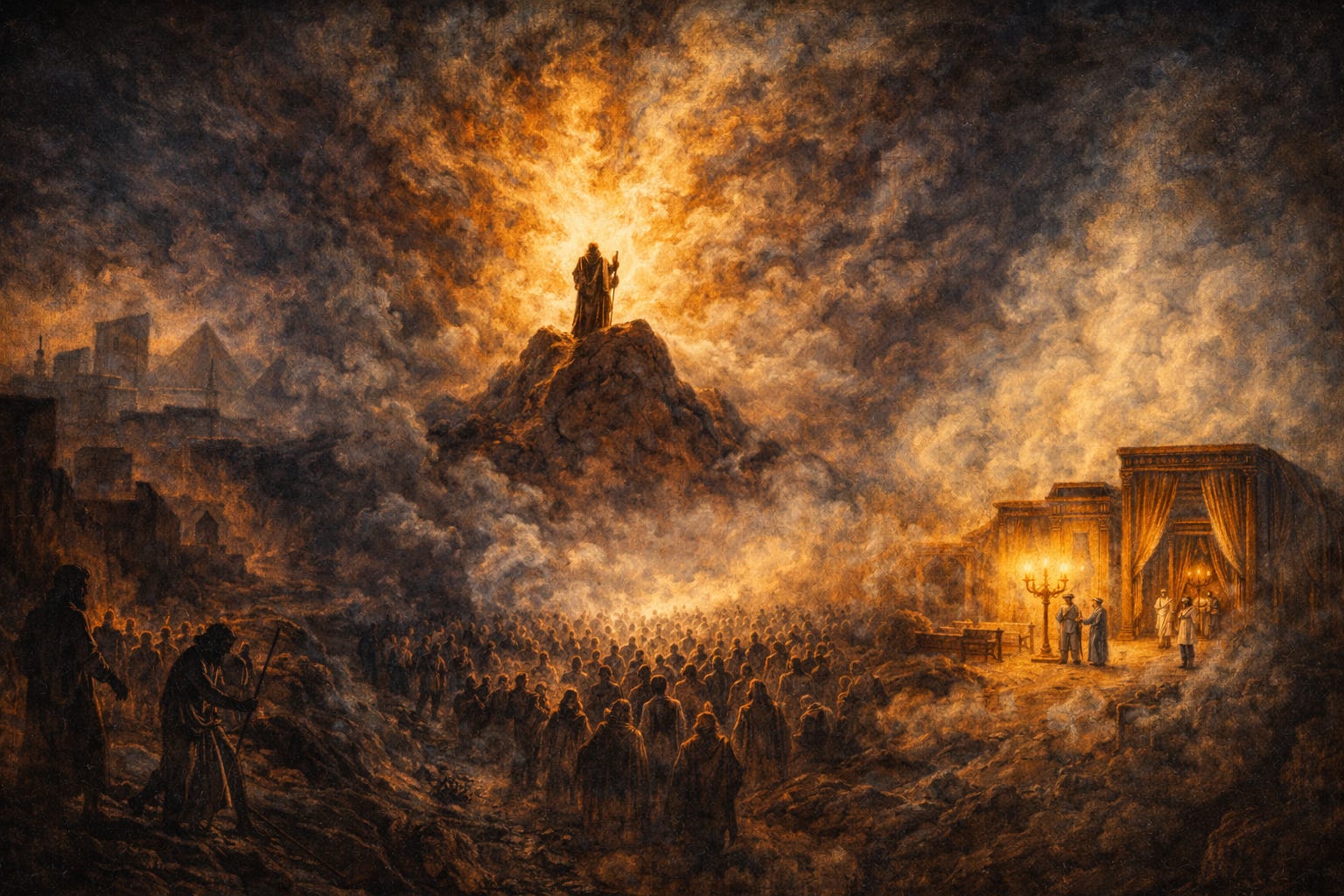
We are at the end of Sefer Shemos, and I want to take a step back and look at the sefer as a whole. Not to construct a single grand theory — that’s a bit ambitious — but to trace several themes that run through it, connecting the beginning to the center to the end, and into the opening of Sefer Vayikra. The goal is to see whether the sefer has an architecture, and whether that architecture reveals something we might otherwise miss.
To do that, I want to start in the center.
There are forty chapters in Sefer Shemos. Chapters 19, 20, 21 — the giving of the Torah at Har Sinai, the Aseres HaDibros, the beginning of Parshas Mishpatim — sit at the physical center of the sefer. I believe they also sit at the conceptual center. So we will begin there and radiate outward — backwards into the story of the Exodus, forward into the Mishkan — until the structure of the whole sefer begins to emerge.
The Destination
Let’s begin with a simple observation.
When Bnei Yisrael arrive at Midbar Sinai, something happens that has not happened at any other stop on their journey: וּמֹשֶׁה עָלָה אֶל הָאֱלֹהִים — Moshe went up to the Divinity (19:3).
Two things are remarkable about this.
First, note what it says and what it doesn’t say. It doesn’t say Moshe went up to the mountain. It says he went up to Elokim — to the Divinity. This sounds like a spiritual ascent. Perhaps he physically went up the mountain to aid him in his spiritual elevation, but the ascent itself seems spiritual in nature.
Second — and this is crucial — no one told him to do it. There was nothing he was reacting to. No crisis, no complaint, no instruction from Hashem. Moshe, on his own volition, decided to have a spiritual ascent. And then, from the mountain, Hashem calls out to him: וַיִּקְרָא אֵלָיו ה׳ מִן הָהָר.
This is unlike any of the other stops made until now.
Trace the journey that brought them here. From Ramses to Sukkos, from Sukkos to Eisam, through the Yam Suf to Midbar Shur, Marah, Eilim, Midbar Sin, Refidim — at every stop along the way, there are crises: no water, no food, quarreling. And at every stop, Moshe responds. He cries out to Hashem, he is given solutions, he deals with whatever arises. But he never initiates. There is no stop at which Moshe, on his own, unprompted, goes up to the Divinity.
Until Sinai.
At Sinai, unprompted, uninstructed, Moshe goes up. Why?
Because this was always the destination.
Go back to the very beginning. At the sneh, on this very mountain, Hashem told Moshe: בְּהוֹצִיאֲךָ אֶת הָעָם מִמִּצְרַיִם תַּעַבְדוּן אֶת הָאֱלֹהִים עַל הָהָר הַזֶּה — When you take this nation out of Mitzrayim, you will serve the Divinity on this mountain (3:12).
Isn’t that interesting? The verse says they will serve Ha’Elokim (האלהים) — the Divinity. And what did Moshe just do? He went up el Ha’Elokim (אל האלהים) — to the Divinity. The same word. Moshe knew exactly where they needed to go, and when he returns here, he knows exactly what he needs to do. The other places were just stops on the way. This is the destination.
The Proposal
It’s not just Moshe who knows what to do. HaKadosh Baruch Hu also knows exactly what He needs to do. He needs to talk to the Jewish people. He needs to get a message to them, and Moshe is the one to deliver it. So after Moshe rises up towards God, God calls to Moshe. We need to take note of that word kriyah (קריאה) — what it means for God to call Moshe — but He does so. And when He does, He tells Moshe there is a message he has to give to the Jewish people.
That message begins with two words: ko somar (כה תאמר). We need to remember those two words. They are going to come back.
כֹּה תֹאמַר לְבֵית יַעֲקֹב וְתַגֵּיד לִבְנֵי יִשְׂרָאֵל
Thus shall you say to Beis Yaakov, and tell to Bnei Yisrael.
Two different verbs — tomar (תאמר) and tageid (תגיד). Ko somar suggests a precise formulation, almost a direct quote. Tageid, from the root of Haggadah (הגדה), suggests something more expansive: relate, discuss, tell the story. There is both a message and a conversation about that message.
So what is it that God wants to tell the Jewish people? It starts with another two words: atem re’isem (אתם ראיתם). We have to remember those two words also. They too are going to come up again — and in fact, they are going to come up in conjunction with ko somar. “Thus you shall say” and “all of you have seen” are going to appear together a second time. For now, we’ll see what HaKadosh Baruch Hu wants them to see right now.
אַתֶּם רְאִיתֶם אֲשֶׁר עָשִׂיתִי לְמִצְרָיִם — You have seen what I did to Mitzrayim.
וָאֶשָּׂא אֶתְכֶם עַל כַּנְפֵי נְשָׁרִים וָאָבִא אֶתְכֶם אֵלָי — And I bore you on eagles’ wings and brought you to Me.
God says to the Jewish people: you’ve seen what I did to Mitzrayim. You’ve seen the ten makos (מכות). You’ve seen Yam Suf (ים סוף). But it’s not just what I did to Mitzrayim. You’ve also seen how quickly I brought you here — to Me. I bore you on eagles’ wings. And you’ve seen and noted that.
And then the crucial word: וְעַתָּה — And now. Now that you’ve seen what I did in Egypt, and now that you’ve seen that I brought you to Me — you have an opportunity.
אִם שָׁמוֹעַ תִּשְׁמְעוּ בְּקֹלִי וּשְׁמַרְתֶּם אֶת בְּרִיתִי — If you listen to My voice and guard My covenant...
וִהְיִיתֶם לִי סְגֻלָּה מִכָּל הָעַמִּים — You will be a treasure to Me from among all the nations.
וְאַתֶּם תִּהְיוּ לִי מַמְלֶכֶת כֹּהֲנִים וְגוֹי קָדוֹשׁ — And you will be for Me a kingdom of priests and a holy nation.
If you listen to My voice and you guard My covenant, you will end up being more precious to Me than any other nation in the world. That’s what segulah (סגולה) means — essentially a type of treasure that one holds dear and stores away. You will also be a mamleches kohanim (ממלכת כהנים) — a kingdom of priests, we’ll translate it as priests for now — and a goy kadosh (גוי קדוש), a holy nation, a holy unit.
Obviously, listening to God’s voice and keeping His covenant are quite important. It would be nice, therefore, if we knew what He meant. Which voice are we listening to? Which covenant are we keeping? Is it the voice that God is about to speak to us, or a different voice that we’ve already heard? Is it a covenant that He’s going to make with us, or a covenant that He’s already made with our forefathers?
We don’t know yet. But as we’ll see, it seems that the Jewish people do have an idea.
Now, we are not yet sure what mamleches kohanim means. But goy kadosh — we have an idea. We have our working hypothesis of the word kadosh (קדוש). Something kadosh is something that, when you see or interact with it, helps you to think of and be aware of God — or helps God to be aware of and think of you. Says HaKadosh Baruch Hu: if you will listen to My voice and you guard My bris, you, as a nation, as a unit, will be holy. People will see you, and by seeing you they’ll see Me.
How? How is that going to happen?
I would like to suggest that it has to do with mamleches kohanim. You’ll be a kingdom of priests. Now, usually priests are a subclass within a kingdom. A whole nation of priests — that is what people are going to see, and by seeing that, they’re going to see God. But what does it mean to be a kingdom of priests?
“Priest” is probably the wrong word. A kohen (כהן) does a type of service, a job — perhaps a holy job — for God. Within the Jewish people, the kohanim are the assistants who work in the Beis HaMikdash (בית המקדש). They help bring the korbanos (קרבנות), they help people bring their bikurim (ביכורים), and the like. They do a particular service for God. So too, says HaKadosh Baruch Hu, the entire nation can do a particular job that God needs done — if we will listen to His voice and guard His covenant.
Putting it all together: the Jewish people are given the opportunity to become segulah mikol ha’amim — precious, more desired than every other nation — and a kingdom of priests who do some service or job for God. And by becoming these priests, they become a holy unit. Even if there are individuals within the nation who are not so holy, as a unit they will be holy. And this will help other people to see God Himself.
Moshe comes and he thoroughly explains this concept, this proposal from God, to the elders of the Jewish people. How do we know he did it thoroughly? Because it says: וַיָּשֶׂם לִפְנֵיהֶם אֵת כָּל הַדְּבָרִים הָאֵלֶּה — he placed before them all of these words. We’ve seen that phrase — tasim lifneihem (תשים לפניהם) — before. It appears at the beginning of Parshas Mishpatim: וְאֵלֶּה הַמִּשְׁפָּטִים אֲשֶׁר תָּשִׂים לִפְנֵיהֶם. Without going into all the details here — we’ll get to that shortly — it means that Moshe made sure they thoroughly understood what they were getting themselves into.
And the response? As a whole, as a unified whole, the nation said: כֹּל אֲשֶׁר דִּבֶּר ה׳ נַעֲשֶׂה — Everything that Hashem speaks, we will do.
Moshe returned these words of the nation to Hashem. He told Him what they said.
Preparation and Revelation
Moshe has gone up to the Divinity. Hashem has made His offer. The Jewish people have accepted it. What more do we need?
We need to make sure that commitment sticks.
God says to Moshe:
הִנֵּה אָנֹכִי בָּא אֵלֶיךָ בְּעַב הֶעָנָן — Behold, I am coming to you in the thickness of a cloud.
The anan (ענן) — the cloud — is another word we are going to pay careful attention to. It’s going to come up again and again.
We may not understand why specifically a cloud, and why specifically a thick cloud. But however that works, whatever that means, HaKadosh Baruch Hu explains why it’s going to be this way: it’s so that the nation can hear Hashem having a conversation with Moshe.
I want to introduce here a close cousin to the working hypothesis, which I’ll call the working understanding. I believe the difference between the word amirah (אמירה) and devarim (דברים) is that amirah is something like a statement and devarim is something like a conversation. This is not a hypothesis; it’s what I remember from what the Radak says, I believe cited by the Malbim. I don’t have time to check and verify it right now, so I’ll work with it because I think it works well in many, many verses.
That would be what Hashem is saying to Moshe right now. I’m going to have a conversation with you — b’dabri imach (בדברי עמך). I want the Jewish people to overhear that conversation. I want them to hear Me speak with you. In order to do that, though, that conversation has to be within the thickness of a cloud. Why? We don’t know. We’ll just accept that for now.
וְגַם בְּךָ יַאֲמִינוּ לְעוֹלָם — And they will also be loyal to you forever.
So we understand why Hashem needs to speak to Moshe in a thick cloud — because that will enable the Jewish people to hear Hashem have a conversation with him. But why is it important for the nation to hear that?
I think that’s what the continuation of the verse means: so that they will believe in you forever. That word gam (גם) — “also” — makes me think there’s some value in just the hearing and the conversation itself. But beyond any value that exists there, there is this very real need for the Jewish people to trust and believe in Moshe forever.
Why? Why is that so important?
Because God’s word is going to travel through Moshe Rabbeinu. If we don’t trust that Moshe Rabbeinu is delivering God’s word, then that word will never reach us. It doesn’t matter how faithful a servant he is. It doesn’t matter how accurately he transmits what God says, or how deeply he understands God’s word. If we don’t trust him, we won’t pay attention to it. God needs us to trust Moshe, and therefore God needs us to hear Him have a conversation with Moshe.
Or, to put it into the context of what we’re talking about in this chapter: if the Jewish people are committed to hearing what God’s voice is, they have to know that they’re hearing God’s voice. And so they have to hear the conversation.
That is Hashem’s plan: they will hear. Note the verb. The nation will hear Hashem speaking with Moshe, and that hearing will produce emunah (אמונה).
At this point, we would think we go to the next stage of the back-and-forth between God and Moshe, Moshe and the Jewish people. But instead, Moshe has a strange response. The verse tells us:
וַיַּגֵּד מֹשֶׁה אֶת דִּבְרֵי הָעָם אֶל ה׳ — and Moshe told over the words of the nation to Hashem.
He just did that one second earlier. Before God told him about having this conversation that the people could overhear, Moshe had returned the words of the nation: וַיָּשֶׁב מֹשֶׁה אֶת דִּבְרֵי הָעָם אֶל ה׳. Now it’s the exact same sentence, except that instead of the word vayashev (וישב) we have vayageid (ויגד).
Without even knowing the precise difference between the two words, there must be some noticeable distinction — either a significantly different way of presenting it, a stronger way of presenting it, or some other distinction we don’t yet understand. Moshe evidently does something different this time, and Hashem takes it rather seriously.
He says: go to the nation. Sanctify them today and tomorrow. Launder their clothes. Let them be ready for the third day, כִּי בַּיּוֹם הַשְּׁלִישִׁי יֵרֵד ה׳ לְעֵינֵי כָל הָעָם עַל הַר סִינָי — because on the third day, Hashem will descend in front of the eyes of the entire nation on Har Sinai.
This is quite a shift. In the first response, the nation didn’t have to do anything except overhear a conversation. Now they have to prepare themselves. In the first response, they heard; they were listening to what was going on. Now they are going to see. We have gone from passive to active, and from listening to seeing.
But this is not a replacement for the first plan. It’s an addition. We have two parallel tracks, two complementary plans: one which is passive and auditory, and the other which is active and visual.
And there are new elements introduced in this second track. There need to be some sort of borders and boundaries — gevulot (גבולות) — for the nation. They cannot go up the mountain or even touch it; that is dangerously deadly. I assume that having moved to the visual is an indication of a heightened spiritual experience, which means also a more dangerous spiritual experience, and thus the need for boundaries. There is also the idea of the shofar (שופר): בִּמְשֹׁךְ הַיֹּבֵל הֵמָּה יַעֲלוּ בָהָר — when the yovel (יובל), which is a type of shofar, has a long continuous sound, that would be the indication that the Shechinah (שכינה) has gone away and they can now go up on the mountain.
So the second track adds new elements related to this heightened spiritual experience: the idea of Hashem descending on the mountain, the nation seeing that, the need for gevulot, and the shofar. In response, Moshe goes down and gets the nation ready.
The Third Day
And then the third day arrives.
קֹלֹת וּבְרָקִים וְעָנָן כָּבֵד עַל הָהָר וְקֹל שֹׁפָר חָזָק מְאֹד
Kolot (קולות) are sounds. Berakim (ברקים) are, I assume, something like flashes — that’ll be my initial guess. There’s also an anan kaved (ענן כבד) — a weighty cloud — on the mountain. That sounds a lot like that thick cloud that Hashem was talking about. I can’t be sure, but it sounds like a reasonable guess.
And there’s the kol shofar chazak me’od (קול שופר חזק מאד).
So we have an element that relates to the first track — to the conversation we’re going to overhear. And we have an element that relates to the second track — to the Divine descent we’re going to see.
The nation is in the camp and they’re trembling. Moshe brings them out — וַיּוֹצֵא מֹשֶׁה אֶת הָעָם לִקְרַאת הָאֱלֹהִים — to meet, to greet the Divinity. They present themselves, standing, waiting, at the bottom of the mountain — וַיִּתְיַצְּבוּ בְּתַחְתִּית הָהָר. That mountain is filled with smoke because Hashem has descended upon it in fire. The mountain itself is trembling.
Now I want us to understand the focus of these verses. It is primarily on the state of the mountain itself, although there is this element of Moshe bringing the people out to the bottom of that mountain, and of the fear and trembling of that very same people. There is a mention of Hashem descending in fire, but that’s only mentioned so as to explain why the mountain is all covered with smoke.
We should note on the side that smoke and clouds are somewhat similar. They can both be white, ephemeral-type substances, and the words — ashan (עשן) and anan (ענן) — are almost the same. Just the middle letter changes.
The verse tells us that the kol hashofar is getting stronger, exceedingly strong. That’s one of the elements of the visual track. And then it says: מֹשֶׁה יְדַבֵּר וְהָאֱלֹהִים יַעֲנֶנּוּ בְקוֹל — Moshe would speak, and the Divinity would answer him with a voice (19:19). That seems to relate to the auditory track. And note who is leading this conversation — Moshe. Not our topic for now, but worth noting nonetheless.
And now the verse switches focus. No longer is the main subject the state of the mountain, but rather it’s the interaction between Hashem and Moshe. We are told once again that Hashem descended upon Har Sinai — albeit without any mention of the fire. Rather, we are told where on the mountain He descends to: to the top of the mountain. And that Hashem calls Moshe to the top of that mountain. Again, there’s a kriyah (קריאה) from Hashem to Moshe, and Moshe ascends.
Hashem says to Moshe: go down and warn the nation, lest they break through to Hashem to see, and many of them will fall. This is part of the visual track — this need for gevulot. They might want to see more than they should see. Also, the kohanim (כהנים) who are nigashim el Hashem (נגשים אל ה׳), who are accustomed to approaching Hashem — they should sanctify themselves. Sanctifying themselves is part of the visual track. They might think that they can go up; they too have to stay back.
Moshe responds and says: the nation can’t go up. You already warned us to make gevulot. What I understand Moshe to be saying is: I’ve already set up the barriers, I’ve already set up the officers. They can’t go up.
Now, I’m not sure that we see a direct response to this point of Moshe in the Chumash. The next line you might read as one, but I have my reasons to think that the next line relates to a different conversation and a different point, as we will see as we make our way through this narrative.
Hashem says to Moshe: לֶךְ רֵד וְעָלִיתָ אַתָּה וְאַהֲרֹן עִמָּךְ — go down, and come back up, you and Aharon with you. But the kohanim and the nation should not break through to Hashem, lest Hashem break out against them.
This is not, I think, a response to what Moshe said about the borders and the policemen. This is something else. At some point, Hashem said to him: you’ve got to go down and come back up with Aharon. Whether He means to go down this second or at some set time, I think it’s a different point entirely. It’s brought here because in this section of the narrative, these two relevant and important conversations between Hashem and Moshe are brought together.
We are told that Moshe did go down to the nation and said it to them. That sounds like a reference going back to the issue of the gevulot. It’s confusing, and I understand that the way I’m reading it sounds like we’re ping-ponging back and forth between conversations. Yet I think that’s actually what’s going on. It’s not that it’s a difficult reading; it’s that the Chumash is, for some reason, purposely presenting the story this way.
And then the next transition: וַיְדַבֵּר אֱלֹהִים אֵת כָּל הַדְּבָרִים הָאֵלֶּה לֵאמֹר — And God spoke all these words, saying.
Who did He speak them to? Did He say them to Moshe? Did He say them to the entire nation? Where is Moshe when He says this? Is Moshe down at the camp because Hashem told him to go down, or is Moshe back up? Is Moshe up with Aharon? We don’t know. It doesn’t say וַיְדַבֵּר אֱלֹהִים אֶל מֹשֶׁה or וַיְדַבֵּר אֱלֹהִים אֶל הָעָם. It leaves out that bit of information, which is interesting. How many times do we see וַיְדַבֵּר ה׳ אֶל מֹשֶׁה לֵאמֹר? Constantly. But not here.
And what follows needs no introduction: the ten statements, the ten devarim (דברים). Note that we are no longer in the mode of a conversation. It’s not that Hashem is speaking to Moshe and everyone’s overhearing Him — or is it? We are not focused on the mountain, and we are not focused on the conversation between Moshe and God going back and forth. This is, you might say, a monologue. We know it as revelation, but it’s a one-way communication.
In other words, to recap: the narrative started with a description of the state of the mountain, with a little insertion about how the nation related to that. It then added in the notion of a conversation between Moshe and God: Moshe would speak, and the Divinity would answer him. Then there’s a conversation between Yud-Kei-Vav-Kei and Moshe — which doesn’t sound like it’s the same thing as Moshe speaking and the Divinity answering him. It’s a different name of Hashem, and in one case Moshe sounds like he’s the one speaking with Hashem responding, while in the other Hashem is the one speaking and Moshe is the one responding. And then we have revelation.
We would think that once the revelation is over, the narrative would continue with what happened next. But it doesn’t seem to do that. It seems to circle back to that narrative describing the state of the mountain when Hashem descended on the third day — this time with the focus on the nation’s experience of it.
What the Nation Sees
It’s as if we are zooming in on the line that says the nation was trembling in the machaneh. That might be our initial thought based on what we’re about to read. But I think we’re actually zeroing in on the next verse — where it says that Moshe brought the nation out from the machaneh to greet the Divinity, and that they are standing, prepared, waiting at the bottom of the mountain. It’s at that moment that I think this narrative picks back up. We left that moment behind! They are there waiting, and then we panned away from the nation and went to the mountain, seeing it all covered in smoke. Now the narrative continues from their vantage point.
The entire nation sees the kolot (קולות) and the lapidim (לפידים) — those kolot and lapidim that were mentioned in the narrative about the state of the mountain. But there it was kolot and berakim (ברקים). My working assumption — it’s not yet at the level of a hypothesis — is that berakim are flashes of light and lapidim are something like bolts of light, like lightning bolts. The nation sees this, and they see the kol shofar (קול שופר), and the mountain awash in smoke.
What’s being left out here, rather conspicuously, is the heavy cloud. It doesn’t say that the people see that. We skip over that part in the list. Before the Dibros, the list was: kolot, berakim, anan kaved al hahar, kol shofar. Now: they see the kolot, they see the lapidim, they see the kol shofar, and then we go to the next one on the list and they see Har Sinai ashan kulo — the mountain all in smoke. That cloud is hidden so far. It’s not there. We’ll have to see where it is.
What happens? They see all this, and — וַיָּנֻעוּ וַיַּעַמְדוּ מֵרָחֹק — they move back and stand at a distance. This is why I think we’re talking about the point when they were at the tachtis hahar (תחתית ההר), at the bottom of the mountain. If they’re in the machaneh, they’re not going to move back — they’re already at a distance. But if they’re at the bottom of the mountain, they’re afraid. On the other hand, if they’re moving back in fear, why, in that earlier conversation between Hashem and Moshe, is Hashem saying “go down and warn them”? They don’t need warning. They don’t want to get any closer. They didn’t even want to go in the first place — Moshe had to take them out. They’re trembling in fear. All this needs explanation another time.
But for us it’s the next line that we need to pay attention to. They say to Moshe:
דַּבֵּר אַתָּה עִמָּנוּ וְנִשְׁמָעָה — You speak with us and we will listen.
וְאַל יְדַבֵּר עִמָּנוּ אֱלֹהִים פֶּן נָמוּת — And let not Elokim speak with us, lest we die.
As opposed to what? As opposed to Hashem speaking with them directly. Now we have to wonder: have they heard Hashem yet? It doesn’t say so — it just says that they’ve seen the state of the mountain. Did they ever get to hear when Moshe is speaking and Hashem is answering b’kol (בקול)? Perhaps, but it doesn’t mention it. Indeed, they say: don’t let Hashem speak with us lest we die. We can wonder: did they ever hear Hashem speak directly to them, or not?
Moshe says to them: אַל תִּירָאוּ — don’t be afraid:
כִּי לְבַעֲבוּר נַסּוֹת אֶתְכֶם בָּא הָאֱלֹהִים — The Divinity has come in order to test you.
That word nasot (נסות) — we have to put that aside. We’re going to see a variation of it soon enough.
וּבַעֲבוּר תִּהְיֶה יִרְאָתוֹ עַל פְּנֵיכֶם לְבִלְתִּי תֶחֱטָאוּ — And so that His fear will be upon your faces, that you not sin.
And that word ba’avur (בעבור) is also interesting. Hashem had said to Moshe: I’m going to come to you in the thickness of a cloud ba’avur — so that the nation can hear Me when I speak with you, and also so that they will believe in you forever. We see that already they seem to be believing in Moshe — “you speak with us and we will listen” — but we don’t seem to have the cloud yet! The cloud hasn’t been mentioned here in these verses.
Could it be that there is more to that ba’avur than is written there? We’re back to this narrative style of the Chumash, where when it references a previous narrative it seems to add in relevant details that weren’t mentioned the first time. We see this pattern again and again.
Either way, here are two reasons why the Divinity has come: l’nasot etchem — to test you — and so that the fear of Hashem will be on your faces, that you not sin. What sin is He worried about? What sin does He want to make sure won’t happen?
Either way, the nation stays distant: וַיַּעֲמֹד הָעָם מֵרָחוֹק. It seems that they do not return to their previous closeness. And listen to this:
וּמֹשֶׁה נִגַּשׁ אֶל הָעֲרָפֶל אֲשֶׁר שָׁם הָאֱלֹהִים — And Moshe approached the arafel (ערפל), the deepest, thickest cloud that there is, because there is the Divinity.
We found our cloud.
I’m assuming that this moment here — of Moshe approaching the arafel — is right before what we saw earlier: that Moshe would speak, and the Divinity would answer him with a voice.
And now we can maybe understand why the cloud wasn’t mentioned earlier. The people aren’t afraid of the cloud. The cloud is comforting. Even if there is a certain fear of entering into it, or perhaps a certain respect for it, a certain awe that holds one back, they didn’t go backwards in fear because of the cloud. They went backwards because of all the other elements. But the cloud was what enabled the nation to hear Hashem have a conversation with Moshe.
And I am wondering: even though they are now distant, perhaps they can still hear that conversation. We would like to know what the content of that conversation was. As important as that question might seem, I’m not going to get into it here. I’ll just note the following from the Ramban. It says in the Mechilta (מכילתא) that this conversation — where Moshe would speak and the Divinity would answer him — was during the time of Matan Torah (מתן תורה), and that Moshe would make the Dibros (דברות) heard to Yisrael. According to the Ramban, in the method of pshat (פשט), we aren’t yet speaking about the Aseres HaDibros. According to him, it relates to the conversation that Hashem had with Moshe — go down and warn the nation — and they heard the conversation but they didn’t understand it. We’ll have to leave this question for another time.
The Second Revelation
We are now post-Aseres HaDibros. That seems to me clear from the pesukim. And we have Hashem speaking to Moshe again. Listen to what He says:
וַיֹּאמֶר ה׳ אֶל מֹשֶׁה כֹּה תֹאמַר אֶל בְּנֵי יִשְׂרָאֵל — And Hashem said to Moshe: Thus shall you say to Bnei Yisrael.
Ko somar (כה תאמר). Remember that phrase? Remember I told you to take note of it? When Moshe went up for the first time to the Divinity, Hashem had a message for Bnei Yisrael: כֹּה תֹאמַר לְבֵית יַעֲקֹב וְתַגֵּיד לִבְנֵי יִשְׂרָאֵל. Well, once again Hashem has a message for Bnei Yisrael.
And how does that message start?
אַתֶּם רְאִיתֶם — You have seen.
Atem re’isem (אתם ראיתם). Just like before, when Moshe first went up. Atem re’isem.
The same two words. Both times, ko somar. Both times, Bnei Yisrael. Both times, atem re’isem.
And what did they see? The first time: אַתֶּם רְאִיתֶם אֲשֶׁר עָשִׂיתִי לְמִצְרָיִם — you have seen what I did to Mitzrayim. The second time: אַתֶּם רְאִיתֶם כִּי מִן הַשָּׁמַיִם דִּבַּרְתִּי עִמָּכֶם — you have seen that from the heavens I have spoken with you.
The first one said: you saw what I did to Egypt. You saw how I brought you here. And now I want to know — are you in or out? Do you want to be an am segulah (עם סגולה)? Do you want to be a mamleches kohanim (ממלכת כהנים)?
And this second time, it is also related to this question. But it will be harder to see. Indeed, initially, it seems disconnected — more like a random set of halachos. But it’s there. We’ll just have to take the time to actually see it.
And to do that, we’ll have to take a closer look at these halachos.
What are these halachos?
לֹא תַעֲשׂוּן אִתִּי — Do not make with Me.
What does that mean — “with Me”? Iti (אתי), aleph-tav-yud. It doesn’t quite sound the same as lo yihyeh lecha elohim acheirim al panai — don’t have other gods before Me — or lo ta’aseh lecha pesel — don’t make yourself an idol. Those were in the Aseres HaDibros. This seems like something related but different. Don’t make with Me — don’t make something alongside Me? To accompany Me? I’m not sure yet.
אֱלֹהֵי כֶסֶף וֵאלֹהֵי זָהָב לֹא תַעֲשׂוּ לָכֶם — Gods of silver and gods of gold, do not make for yourselves.
That’s clearer — don’t make gods of silver and gold. But why is He saying this now? He just told them in the Aseres HaDibros not to make idols. Why say it again?
And then something unexpected. After telling them what not to make, He tells them what to make:
מִזְבַּח אֲדָמָה תַּעֲשֶׂה לִּי — Make Me an earthen altar.
וְזָבַחְתָּ עָלָיו אֶת עֹלֹתֶיךָ וְאֶת שְׁלָמֶיךָ — And slaughter upon it your olos (עולות) and your shelamim (שלמים).
Why is Hashem giving halachos about a mizbeach (מזבח) right here, right now? Three halachos which seem to randomly appear and just as quickly randomly disappear. We don’t know what lo ta’asun iti means. We don’t know why He’s repeating the prohibition against gods of silver and gold. And we don’t yet know what a mizbeach is doing in the middle of all this. We’ll come back to these.
Because finally, we get the parashah (פרשה) that we have been waiting for:
וְאֵלֶּה הַמִּשְׁפָּטִים אֲשֶׁר תָּשִׂים לִפְנֵיהֶם — And these are the mishpatim which you shall place before them.
As much as I want to delve into this parashah right now, as much as I want to talk about what’s in it, I have to skip over it for a moment and read the passage that comes right after the revelation of these halachos. But before we skip over them, we will make two observations.
The first is that letter vav (ו) at the beginning: v’eileh (ואלה) — and these are the mishpatim. This is a continuation of what Hashem just said, starting with ko somar. You’re going to tell all this to Bnei Yisrael. You’re not just going to tell them that you heard Me speak from the shamayim (שמים). You’re going to tell them lo ta’asun iti, and about the gods of silver and gold, and about the mizbeach — and then you’re going to do more than tell them these mishpatim. You’re going to place them in front of them.
What does it mean to place the mishpatim in front of them? Says Rashi: don’t just teach it to them so they can recite it ba’al peh (בעל פה), by memory. No, you need to do more than that. They have to understand these halachos — the ta’am hadavar u’feirusho (טעם הדבר ופירושו), the reason for them and their explanation.
What we have here seems to be a second revelation. And just like Moshe let Bnei Yisrael know the content of the Aseres HaDibros, soon enough he is going to let them know the content of these halachos, these mishpatim. That’s what we are going to read about right now.
The Covenant
I have to admit: there seems to be something about revelation which leads to — maybe even requires — interesting narrative techniques. We have already seen that in the narratives that come right before and right after the Aseres HaDibros, and we’re going to see it again right now, in the parashah that begins right after the second revelation of Parshas Mishpatim.
And it starts with an interesting grammatical point.
It says: וְאֶל מֹשֶׁה אָמַר — and to Moshe He said. Now, in biblical Hebrew, the normal way to tell a story is to put the verb first: וַיֹּאמֶר — and He said. When you do that, the narrative moves forward. First this happened, then that happened, then that happened. Each vayomer or vaya’as is the next step in the story. It’s what we call the continuous past.
But here, the Torah doesn’t do that. It doesn’t write וַיֹּאמֶר אֶל מֹשֶׁה — and He said to Moshe. Instead, it puts the noun first: וְאֶל מֹשֶׁה אָמַר — and to Moshe He said. When the noun comes before the verb, it breaks the sequence. It’s no longer telling you what happened next. It’s telling you what had already happened — what had been said at some earlier point. In English, we’d use the word “had”: “And to Moshe He had said.”
Think of it this way. If I say, “I walked to the store and I saw my friend,” that’s a sequence — first I walked, then I saw. But if I say, “I walked to the store, and I had seen my friend across town earlier that day” — now the seeing didn’t happen at the store. It happened before. The word “had” takes you back in time.
That’s what the Torah is doing here. By putting Moshe before the verb, it’s saying: this wasn’t said now, after Parshas Mishpatim. This was said earlier. It’s being brought here now because it becomes relevant now.
What happened earlier, before Parshas Mishpatim, that we need to know about right now? It’s that Hashem told Moshe:
עֲלֵה אֶל ה׳ אַתָּה וְאַהֲרֹן נָדָב וַאֲבִיהוּא וְשִׁבְעִים מִזִּקְנֵי יִשְׂרָאֵל
Come up to Hashem, you and Aharon, Nadav and Avihu — Aharon’s two oldest sons — and seventy of the elders of Yisrael.
Now this sounds semi-familiar.
Remember those conversations right before the Aseres HaDibros, between Moshe and Hashem? Hashem said to Moshe, “Go down and warn the nation not to come up.” Moshe said, “I don’t need to. We’ve already set up the gevulot and the boundaries.” And Hashem responded with a line that didn’t seem like a response: לֶךְ רֵד וְעָלִיתָ אַתָּה וְאַהֲרֹן עִמָּךְ — go down, and come back up, you and Aharon with you. I noted at the time that I felt like that was a separate conversation — a different instruction about a different aliyah (עליה).
I think this is that conversation. Hashem is telling Moshe: there will be a time that I need you and Aharon and his sons and the seventy elders to come up. And we once again encounter this narrative style of the Chumash — when it references back to an earlier narrative, it adds in relevant details. In chapter 19 it was just Aharon. Now it’s Aharon, Nadav, Avihu, and seventy elders.
So when the Chumash is about to tell us a story that takes place after Parshas Mishpatim, before it tells that story, it references that earlier conversation to remind us: previously — seemingly before the Aseres HaDibros — Hashem had already said to Moshe that you and Aharon and his sons and the elders need to come up to Me. Why it’s related this way, I’m still trying to figure out. But it seems to me that this is what’s going on.
We’re going to enter this new narrative not on the mountain. Moshe hasn’t gone up yet with Aharon and his sons and the elders — that’ll happen soon enough. Moshe is in the camp with the people, after the Aseres HaDibros, after Parshas Mishpatim. And let’s see what happens next.
Moshe, we are told, relates to the nation all the words of Hashem and all the mishpatim:
וַיְסַפֵּ֤ר לָעָם֙ אֵ֚ת כׇּל־דִּבְרֵ֣י יְהֹוָ֔ה וְאֵ֖ת כׇּל־הַמִּשְׁפָּטִ֑ים
And the nation, when they hear this, they respond in one voice:
כָּל הַדְּבָרִים אֲשֶׁר דִּבֶּר ה׳ נַעֲשֶׂה — Everything that Hashem has spoken, we will do.
Now that phrase should be familiar to us. We have heard it before, back in chapter 19, when Hashem first proposed the covenant. The same words, the same phrase. Could it be that they’re relating to the same issue, the same idea?
Could it be that before the revelation, they had the sense and understanding of what the revelation would be about — if not the details, at least the general direction? At that point, Hashem said: are you in? Will you listen to this, will you observe it, will you be dedicated to it? And they said yes: we will do all that Hashem has spoken. Now, after the details have been revealed — the full list of laws — they’re asked again: are you still in? And they say yes: we will do all that Hashem has spoken.
Let us continue.
Moshe writes down kol divrei Hashem (כל דברי ה׳). And he builds a mizbeach (מזבח) at the foot of the mountain.
And once again, this should sound familiar. A mizbeach. We just had a revelation about a mizbeach right before Parshas Mishpatim. Remember, we wondered: why is Hashem telling us this law now? It seems so out of place. No — it is so in place. Now is when you need to know this halachah, because now you are going to be building a mizbeach, and it is crucial that this mizbeach is of earth, or, if it is of stone, that no sword touches it.
Indeed, let’s take a closer look at that halachah right now. Hashem said you have to make an earthen mizbeach, and you slaughter upon it your olos (עולות) and your shelamim (שלמים). And what happens in our story? Moshe builds his mizbeach, and he sends the na’arei Bnei Yisrael (נערי בני ישראל), and they offer olos and shelamim. It certainly seems connected.
But why are they doing all this now? What is so special, so unique about Parshas Mishpatim that they are making a sacrifice and offering olos and shelamim?
Because they are going to make a covenant — a bris (ברית).
Remember? Hashem said to us: if you will listen to My voice — seemingly the voice of the Aseres HaDibros and Parshas Mishpatim — and guard My bris — the bris that we are making right now — then you will be segulah mikol ha’amim (סגולה מכל העמים). Then you will be mamleches kohanim (ממלכת כהנים) and goy kadosh (גוי קדוש). This is the bris He was talking about.
And at the moment that they actually make this covenant on these words — when Moshe takes the Sefer HaBris (ספר הברית) and reads it in the ears of the nation — then they say:
כֹּל אֲשֶׁר דִּבֶּר ה׳ נַעֲשֶׂה וְנִשְׁמָע — Everything that Hashem has spoken, we will do and we will listen.
Na’aseh v’nishma (נעשה ונשמע). At that moment, Moshe takes the dam habris (דם הברית) and throws the remaining half on the nation.
The bris is sealed.
And with that, Moshe and Aharon, Nadav, Avihu, and the seventy elders of Israel all ascend the mountain. They have visions of the God of Israel. They gaze upon the Divinity — וַיֶּחֱזוּ אֶת הָאֱלֹהִים. And they eat and they drink.
And yet we still need to wonder: what is so special about Parshas Mishpatim? Why is it specifically this parashah that Hashem says — if we listen to it, if we guard it, if we do and understand it — that we will be segulah mikol ha’amim and mamleches kohanim and goy kadosh?
The answer is where the story began.
Back to the Beginning
Let us return to the third chapter of Sefer Shemos.
Moshe is shepherding the flock of his father-in-law. He leads them achar hamidbar (אחר המדבר) — after the desert, or perhaps to the desert, the one he knows. And he comes to Har HaElokim (הר האלהים), Chorev (חורב).
A malach Hashem (מלאך ה׳) appears to him בְּלַבַּת אֵשׁ מִתּוֹךְ הַסְּנֶה — in a flame of fire, from within the sneh (סנה).
Fire. At the mountain of the Divinity. This is where the story of redemption begins — and it begins with fire. And as we know, when Hashem descends upon the mountain, He descends in fire. There seems to be some interesting connection between revelation and fire. We’ll have to park that on the side for now.
As we were saying, there is a fire. A bush — a sneh — is burning. And yet it is not being consumed. And Moshe, upon noticing this, has a question:
מַדּוּעַ לֹא יִבְעַר הַסְּנֶה — Why doesn’t the sneh burn?
This is not idle curiosity. This is, for Moshe, a deep question. Perhaps the question. He has been asking this type of question for a while — just not in this particular form.
To see what I mean, we need to go back to what the Chumash tells us about Moshe before this moment.
Moshe has grown up. And for the first time, he goes out to see his brothers. He sees their burdens — the torturous labor, the beatings, the attempt by Egypt to break the Jewish people’s will and spirit. He sees an Egyptian striking a Jew, and he intervenes. The next day, he sees two Jews fighting, and he intervenes again. Then he flees to Midyan, where he sees the daughters of Yisro being driven away from the well by bullying shepherds — and he intervenes yet again.
Moshe sees the same pattern wherever he goes: the powerful oppressing the weak — the fires of the world consuming the snehs of the world.
And yet, through it all, Moshe notices another constant. If there is another interceding power that is willing and able — then there is a means by which one can protect those who are weaker from those who are stronger.
If there is a Moshe around, then there is hope. But he has to be around. If not, then what? No hope.
And so Moshe wonders. Why is the sneh not being consumed? What power or force is protecting it? This is what I am looking for. This is what I want to understand.
And so Moshe turns to gaze — intellectually — at this wondrous vision. And once Hashem sees that this is the question Moshe wants an answer to, He calls to him:
וַיִּקְרָא אֵלָיו אֱלֹהִים מִתּוֹךְ הַסְּנֶה — And Elokim called to him from within the sneh.
Hashem calling to Moshe. Sounds familiar.
And He doesn’t just call to him, but from within the sneh.
The answer you are looking for is right here. I am in the sneh — and that is why it is not being consumed.
You want to fundamentally change reality? You want to find a way to stop the oppression? Then help bring Me down to earth.
And to that, Moshe said: הִנֵּנִי — Hineni (הנני).
What Egypt Was
So Moshe is in. But let us understand the task ahead of him. Let us get a full sense of the fires of the world and how they like to consume the snehs of the world.
It starts with Pharaoh and an irrational fear. The Jewish people were no threat, but they were growing — growing faster than the Egyptians were growing. They were still smaller than them. But who knows? Perhaps someday they could catch up, maybe even surpass us:
פֶּן יִרְבֶּה
And who knows? There could be a war. And who knows? They may join our enemies. And if that happens, they may leave Egypt.
A long list of maybes. And the great evil that could happen if this long list of maybes all comes true is that the Jewish people will go back to where they came from.
That’s it. No real evil done, and no real reason to believe that it will happen.
And yet, on the basis of this fear, Pharaoh lashes out.
He sets taskmasters upon them. He afflicts them with the burdens of the Egyptians. He gives them backbreaking labor. He makes their lives bitter.
And when none of that works, he sets to killing every single Jewish baby boy.
Murder, theft, enslavement — all in the pursuit of an irrational, unreasonable, immoral fear.
This is what Moshe Rabbeinu signed up for. This is what HaKadosh Baruch Hu went to war against.
You have seen, says Hashem, what I did to Egypt. All the plagues. The plagues weren’t there just to bring the Jewish people out of Egypt — at least not the first nine. They were there to show the world that HaKadosh Baruch Hu and His moral law will not be trifled with.
I am Hashem, your God, who took you out of Egypt. I want you to know that I saw your affliction. I heard your cries. I felt your pain.
And I proclaim, as clearly as can be, right now:
Lo tirtzach (לא תרצח) — you cannot murder. Lo tignov (לא תגנוב) — you cannot steal. Lo tachmod (לא תחמוד) — you cannot covet that which belongs to your neighbor.
These laws are the antithesis of Mitzrayim. And they are the essence of how God wants us to treat — or not treat — each other.
But they are general principles. They require specifics if we are truly going to transform mankind and this world.
And that is the place of Parshas Mishpatim.
Parshas Mishpatim
The starting point. Look at the very first halachah. It’s about buying a Jewish slave — an eved Ivri (עבד עברי). We just had chapter after chapter about Jewish slavery. The Egyptians used slavery to crush people, to embitter their lives, to break them. And now Hashem says: when there is slavery among you, there will be rules.
The slave serves for six years. Then he goes free. He has rights. If he comes in with his possessions, he leaves with them — you can’t steal them from him. Even if a man sells his daughter into servitude — the most vulnerable person in the most vulnerable position — she too has rights and protections.
Why does the Torah start here? Because this is the weakest member of society. And if you want to build the opposite of Egypt, you start by protecting the people Egypt would have crushed.
Lo tirtzach in practice. Pharaoh said to kill every newborn Jewish boy. HaKadosh Baruch Hu said lo tirtzach (לא תרצח) — don’t murder. Parshas Mishpatim tells us how to implement this principle in practice. Intentional murder is a capital offense. And nothing — not even the mizbeach (מזבח) — can protect you from that punishment. Unintentional murder is not a capital offense. But it still has consequences.
Lo tignov in practice. The Egyptians stole everything from the Jewish people — their time, their labor, their freedom, their children. HaKadosh Baruch Hu said lo tignov (לא תגנוב) — don’t steal. But what counts as stealing? What if you were watching someone’s possessions and they got stolen — are you responsible? Parshas Mishpatim works through the cases.
Don’t afflict the stranger — כִּי גֵרִים הֱיִיתֶם בְּאֶרֶץ מִצְרָיִם — because you were strangers in the land of Mitzrayim.
If you see the donkey of your enemy collapsing under its burden — help him. Even your enemy.
And Shabbos appears here too — not as testimony to creation, but so that your animals, your servants, and the stranger may rest. The exact opposite of how Egypt treated its slaves.
The heart of the sefer. This is what Parshas Mishpatim is. It takes the broad principles of the Aseres HaDibros and turns them into the detailed blueprint of the kind of society God wants — a society built on tzedek u’mishpat (צדק ומשפט), the exact opposite of Egypt.
The First Taste
Let’s go back — before the mountain, before the cloud, before all of it. There is one more piece of this architecture, and it is hidden in a stop along the way we may have passed over too quickly.
We are at Marah (מרה). The bitter waters have just been sweetened. And there, the Torah tells us:
שָׁם שָׂם לוֹ חֹק וּמִשְׁפָּט וְשָׁם נִסָּהוּ
There He placed for them chok and mishpat, and there He tested them.
And at this point, we should already start to see some connections. Soon enough — at Har Sinai — we will get the Mishpatim (משפטים). And here, at Marah, we received mishpat (משפט).
And when we do get the Mishpatim, G-d will instruct Moshe to set (שם) these mishpatim before them (לפניהם). And here, we are told that G-d set (שם) this mishpat to him (לו) — him being a reference to the nation.
Not exactly the same thing.
But not so different either.
שָׂם לוֹ versus תָּשִׂ֖ים לִפְנֵיהֶֽם.
And that is not the only similarity. There is more. For example:
אִם שָׁמוֹעַ תִּשְׁמַע לְקוֹל ה׳ אֱלֹהֶיךָ וְהַיָּשָׁר בְּעֵינָיו תַּעֲשֶׂה וְהַאֲזַנְתָּ לְמִצְוֹתָיו וְשָׁמַרְתָּ כָּל חֻקָּיו
If you listen to the voice of Hashem your G-d, and you do what is straight in His eyes, and you pay attention to His mitzvos, and you guard all His chukim...
That structure should sound familiar. At Sinai, in the proposal, Hashem will say: אִם שָׁמוֹעַ תִּשְׁמְעוּ בְּקֹלִי — if you listen to My voice. Nearly the same words. The voice at Marah and the voice at Sinai are the same voice.
My guess — at Marah we got the principles. At Har Sinai we got the details. The Malbim in Parshas Mishpatim says something similar (although he offers a different proof for this idea).
Either way, in both cases, there is a positive benefit to listening.
At Sinai, we know what it is — segulah mikol ha’amim, mamleches kohanim, goy kadosh. That is Sinai’s gift: who you will become.
At Marah it was not who we would become, but rather what would not happen to us:
כָּל הַמַּחֲלָה אֲשֶׁר שַׂמְתִּי בְמִצְרַיִם לֹא אָשִׂים עָלֶיךָ כִּי אֲנִי ה׳ רֹפְאֶךָ
All the machalah that I placed upon Mitzrayim, I will not place upon you — for I am Hashem, your healer.
Machalah (מחלה). We could attempt a translation — sickness, ailment. But we don’t need to translate it. We can figure it out by asking: what did the Jewish people just witness?
They had seen the Nile turn to blood. Frogs. Lice. Boils. Darkness. The death of every firstborn. Then they walked through the sea, and they watched the entire Egyptian army swallowed by the waters. That happened days ago. It is not yet a memory — it is still present, still raw.
That is the machalah. Not a clinical illness. But the war that G-d had just waged against Egypt. And now Hashem is saying: if you will listen to these mishpatim, I will not place these ailments upon you — i.e., I will not go to war against you.
In other words, want to know why I visited these makos on Mitzrayim? Because they violated these principles. They took Jewish babies and threw them into the Nile. They enslaved an entire nation. Backbreaking labor. Torture. Murder. They violated every principle that Mishpatim was about to enshrine.
So don’t take these mitzvos lightly. Because if you do, those makos can be visited upon you too — as we saw to our horror at the destruction of the Beis HaMikdash and the exile.
But there is more to keeping the mishpatim than simply not getting destroyed. There is the opportunity to become an am segulah, a mamleches kohanim, and a goy kadosh.
We will be segulah mikol ha’amim (סגולה מכל העמים) — more precious than all the other nations.
No matter what generation, no matter what place, no matter what the circumstances — the remnant of this people will remain dedicated to these Mishpatim.
Not every Jew in every era. But a certain core will remain true no matter what. This is what makes you precious.
We will be a mamleches kohanim (ממלכת כהנים) — a kingdom of priests.
What does a kohen (כהן) do? He serves HaKadosh Baruch Hu. In the Mishkan, that involves one set of tasks — korbonot, bikurim, and the like. In the world as a whole, it involves another set of tasks — namely, mishpatim. By being dedicated to and implementing these mishpatim, we become G-d’s kohanim vis-à-vis the rest of the world.
And we will be a goy kadosh (גוי קדוש) — a holy nation. Kedushah (קדושה), as we have discussed, is what causes people to think of G-d.
When the nations of the world see the Jewish people living by these principles — no matter the time, place or circumstances — they will see G-d.
Segulah, mamleches kohanim, goy kadosh. All three flow from the same source: listening to G-d’s voice, guarding His bris, and dedicating ourselves — in principle and in detail — to the laws of tzedek u’mishpat.
That is what begins at Marah. And that is what reaches its fullness at Sinai.
What About the Chok?
Everything so far has been about mishpat. The laws. The moral framework. The antithesis of Egypt. But the Torah says Marah gave us chok and mishpat. We haven’t touched the chok yet. Does it also fit?
Here we need the help of Rashi based on Chazal. Chok, we are told, relates to the parashah which is, in essence, the paradigmatic example of a Chok. Indeed, when the Torah itself introduces the laws of the Parah Adumah by labeling it a chok: זֹאת חֻקַּת הַתּוֹרָה (Zos chukas HaTorah).
So if our Parsha here in Mara is going to tell us that we were given a Chok without any further information, it makes sense to connect it to the Parah Adumah, which is labeled a Chok, just as we connected Mishpat to Parsha Mishpatim.
And yeah, once again, we don’t just have a linguistic connection. It’s not just that the words are the same or very similar.
Let us remember from last week’s parashah. What happened when Moshe Rabbeinu saw the egel? As we have already noted, he essentially destroyed it just like one destroys the Parah Adumah.
He burns it in fire (like we burn the Parah Adumah). He grinds it into dust (just like we burn the Parah Adumah into ash). He scatters on water (just like we sprinkle the dust on water). And then has the nation drink the water (this is probably more similar to Sotah, but perhaps we can compare it to sprinkling the water on one who needs to become tahor).
And we also noted the famous Rashi that directly connects the Parah Adumah to the chet ha’egel: let the mother come and clean up the mess of her child.
Not to mention the fact that a molten calf may very well look like a red heifer.
As such, I wonder — did HaKadosh Baruch Hu know that the risk of a chet ha’egel already existed at this point in the journey? And was He preparing them to either withstand the temptation or deal with it if they succumbed?
That’s my guess. And I think there may be another bit of evidence backing it up.
Remember those three laws that seemed out of place — the ones given right after the Aseres HaDibros and before the Mishpatim? One we made sense of — the mizbeach. Soon they were going to need to make a mizbeach, so they now need the laws relating to the mizbeach.
Could those other two halachos also be needed soon. Let’s consider the first one:
לֹא תַעֲשׂוּן אִתִּי — Don’t make with Me.
It still is an awkward phrase — hard to make sense of it. But we have two (and only) two clues. “Making” and “with me”.
Could this be a reference to the golden calf? Could the golden calf have functioned as some sort of intermediary — as a physical means of connecting to the Divine that Hashem had not sanctioned?
It certainly seems likely. The Ibn Ezra thought so (although Rashi sees this as a reference to the Kruvim). And it would partly fit with the next verse — about not making idols of silver or gold.
The golden calf was, well, golden. So that rules out silver. But the gold part still works.
So maybe.
I need to do more research into this to be fully confident. But the pieces (somewhat) seem to fit: the parah adumah and the chet ha’egel are deeply connected. Chazal clearly saw the connection. The procedure Moshe uses to destroy the egel mirrors the parah adumah. And these halachos after the Aseres HaDibros — which we noted seemed puzzling and out of place — may in fact be part of the same thread, warning about a danger that was already present and would soon manifest.
If all of this is correct, then the parah adumah at Marah is not random at all. It is Hashem seeding the antidote before the sin — the same pattern we see with mishpatim, where He gives them the principles before the full details.
And Then There’s Shabbos
Theoretically speaking, we should be done. But that Rashi I mentioned above (based on Chazal) mentioned three halachas that were given at Marah. We’ve mentioned two already: Parah Adumah and Mishpatim, but Rashi also mentions Shabbos. We will wonder once again: How does Shabbos fit into our story? Not the story of the Man, where it clearly fits in and which we need to further delve into when the time comes, but the story of Mishpatim and perhaps, and obviously, the story of the Mishkan. How does Shabbos fit into that? What preparation or awareness did we need that was given to us at Mara?
Before we directly address that question, let’s ask a second one. Is Shabbos a chok or a mishpat? We were given two categories of halachas at Marah: chok and mishpat, and three halachas. We have to map these three halachas onto these two categories. The first two are easy: mishpatim relates to mishpat and Parah Adumah relates to chok, but what about Shabbos?
Our first instinct may be to call Shabbos a chok. After all, Shabbos is not a law which relates to monetary or physical damages. It’s about creation and providence.
G-d made the world in six days and rested on the seventh — so rest on the seventh day. G-d took us out of Egypt — so rest on the seventh day.
True, there is a clear logic to it, which means it doesn’t fit neatly into the classic definition of a chok (something that seems to defy human logic). But if you have to choose between chok and mishpat, it seems more chok-like than mishpat-like.
And yet, I think (not so) hidden within Shabbos is a mishpat element to Shabbos. And the best place to see it is in Parshas Mishpatim itself.
שֵׁשֶׁת יָמִים תַּעֲשֶׂה מַעֲשֶׂיךָ וּבַיּוֹם הַשְּׁבִיעִי תִּשְׁבֹּת לְמַעַן יָנוּחַ שׁוֹרְךָ וַחֲמֹרֶךָ וְיִנָּפֵשׁ בֶּן אֲמָתְךָ וְהַגֵּר
Six days you shall do your work, and on the seventh day you shall rest — so that your ox and your donkey may rest, and the son of your maidservant and the stranger may be refreshed.
Look at the reason the Torah gives here for Shabbos. It’s not creation. It’s not the Exodus. It’s social. Your animals need rest. The people working for you — the son of your amah (אמה), the ger (גר) who is in a harder financial position — they need to rejuvenate. You need to take their welfare into account. You cannot just work them endlessly.
This is a mishpat. This is about how you treat other people. And it fits perfectly within Parshas Mishpatim, right alongside the laws about not oppressing the stranger and not afflicting the widow.
But it goes further than Shabbos itself.
Right before Shabbos in Parshas Mishpatim, we find Shemitah (שמיטה):
שֵׁשׁ שָׁנִים תִּזְרַע אֶת אַרְצֶךָ וְאָסַפְתָּ אֶת תְּבוּאָתָהּ וְהַשְּׁבִיעִת תִּשְׁמְטֶנָּה וּנְטַשְׁתָּהּ וְאָכְלוּ אֶבְיֹנֵי עַמֶּךָ וְיִתְרָם תֹּאכַל חַיַּת הַשָּׂדֶה
Six years you shall seed your land and gather its produce. And the seventh year, you shall relinquish it and let it lie fallow — and the destitute of your nation shall eat from it, and what remains, the wild animals of the field shall eat.
Shemitah is also about the social good. The destitute get to eat. The wildlife gets to partake. And Shemitah is essentially Shabbos for the land — שַׁבַּת הָאָרֶץ. The same six-plus-one framework, just on a different scale.
And the framework keeps scaling. Six days, then Shabbos. Six years, then Shemitah.
And then we have Parshas Behar (פרשת בהר). Yes, it is in Sefer VaYikra — but the Torah goes out of its way to tell us that these halachas were also part of the Mishpatim. And there, we count cycles of Shemitah years and arrive at Yovel (יובל) — the Jubilee. The time when slaves go free and land reverts to its original owners.
And finally, in Devarim (דברים), we learn that debts are released at the end of the Shemitah year.
This is Shabbos in its fullest form — in terms of days, years and years of years. And they all relate to social needs, not “religious” ones.
To not overworking ones workers (or animals).
To granting debt release. To freeing slaves. To preventing monopoly power and granting renewed economic opportunity.
This is Shabbos as much as a recognition of creation and providence is Shabbos.
And it was given at Marah — alongside the general principles of the mishpatim. But not only alongside.
As we have noted, Shabbos also relates to the Man. And it also relates to building the Mishkan.
Soon enough, we will build a home to house the luchos. The luchos which contain the Ten Statements (aka Ten Commandments) which G-d gave us on Har Sinai. The Ten Statements which form (among other things) the general foundation upon which the Mishpatim are built.
And we are told — when building that house, do not violate Shabbos. Do not violate this institution which is foundational to all that the luchos themselves represent.
Do not violate the day that tells you to give rest to people who are working too hard — in order to build a place that enshrines the principle that you should not work people too hard?
Do not violate the seventh day in order to build a place which enshrines the memory that G-d rested on the seventh day.
In short, do not violate a principle in order to establish that principle.
And so, before the Man and Parshas Mishpatim and building the Mishkan, we needed to know about Shabbos. And so Hashem informed us about it at Marah.
The Architecture Complete
The laws of Parshas Mishpatim have been given. The bris has been sealed. Moshe and Aharon, Nadav, Avihu, and the seventy elders have gone up, gazed upon the Divinity, and eaten and drunk.
But there is something more.
Once again, Hashem says to Moshe: עֲלֵה אֵלַי הָהָרָה וֶהְיֵה שָׁם — come up to Me to the mountain and be there. Stay there. וֶהְיֵה שָׁם. This time, Moshe is not coming back quickly. Aharon stays with the machaneh (מחנה) — “whoever has issues, come to him.” That’s an interesting instruction, because there are going to be issues very soon. Yehoshua accompanies Moshe partway.
And what is Moshe going up to receive?
וְאֶתְּנָה לְךָ אֶת לֻחֹת הָאֶבֶן וְהַתּוֹרָה וְהַמִּצְוָה אֲשֶׁר כָּתַבְתִּי לְהוֹרֹתָם
The luchos ha’even (לוחות האבן) — the stone tablets — and the Torah and the mitzvah which I have written, to instruct them.
Hashem has already written these. Asher kasavti (אשר כתבתי) — past tense. But Moshe doesn’t have them yet. He needs to go up for forty days and forty nights to receive them.
But why forty days? Not just for the luchos. For the Mishkan (משכן). The whole structure. The house that will hold the luchos, the Torah, these values. There’s going to be an aron (ארון) with the luchos inside, and a kaporet (כפורת) on top of it, and kruvim (כרובים) on top of that. And from between those kruvim, Hashem’s word will come forth. That’s the conversation that is going to continue — HaKadosh Baruch Hu speaking to Moshe from between the kruvim, on top of the aron, inside the Mishkan.
Moshe goes up. The anan (ענן) covers the mountain. The kevod Hashem (כבוד ה׳) rests upon Har Sinai. For six days the anan covers it.
And on the seventh day:
וַיִּקְרָא אֶל מֹשֶׁה בַּיּוֹם הַשְּׁבִיעִי מִתּוֹךְ הֶעָנָן
Hashem calls to Moshe on the seventh day from the midst of the cloud.
That word — מִתּוֹךְ (mitoch) — from within. We have seen that word before. At the sneh, Elokim called to Moshe מִתּוֹךְ הַסְּנֶה — from within the sneh. Now He calls to him מִתּוֹךְ הֶעָנָן — from within the cloud. At the sneh, Hashem was inside the thornbush, and the fire could not consume it. Now Hashem is inside the cloud, and from within it He is going to give Moshe the instructions for building the house where these values will live.
And the appearance of the kevod Hashem (כבוד ה׳) is like an eish ocheles (אש אוכלת) — a consuming fire — on the top of the mountain...
Fire. Clouds. Revelation.
Over and over again, these come together.
There was fire at the sneh. There was a pillar of cloud and a pillar of fire that led the Jews in the desert. There were clouds and fire at Har Sinai. And now, once again, clouds and fire.
And so Moshe enters the cloud and goes up to the mountain. He is there for forty days and forty nights — to receive the laws of the Mishkan.
And now we transition to our parashah (פרשה) and the end of Sefer Shemos. Here we will see the entire nation willingly donate to this project. They are implementing, with their hearts, their souls, and their pocketbooks, na’aseh v’nishma (נעשה ונשמע). Every person whose heart inspires him — כָּל אִישׁ אֲשֶׁר נְשָׂאוֹ לִבּוֹ — and everyone whose spirit moves them to generosity, brought the terumas Hashem (תרומת ה׳) for the meleches Ohel Moed (מלאכת אוהל מועד). And they brought so much that eventually they had to make a proclamation: no more!
The day to erect the Mishkan comes. It’s the first of Nissan (ניסן) — exactly one year after Hashem told Moshe הַחֹדֶשׁ הַזֶּה לָכֶם רֹאשׁ חֳדָשִׁים, the day that freedom began. One year later, Hashem says: you’re going to set up this Mishkan.
And Moshe does. He takes the luchos — the second luchos that he received — and places them in the aron. He takes the aron, with the kaporet on top, and brings it into the Mishkan. He sets up the paroches (פרוכת) and covers the entranceway to the Aron HaEidus (ארון העדות). He sets up the rest of the keilim (כלים) of the Mikdash. All just as Hashem commanded him.
And then Moshe finishes the work. And what happens?
וַיְכַס הֶעָנָן אֶת אֹהֶל מוֹעֵד וּכְבוֹד ה׳ מָלֵא אֶת הַמִּשְׁכָּן
The anan (ענן) — a cloud!
And because of that cloud, Moshe cannot enter the Mishkan.
And that is where Sefer Shemos ends — at least in terms of the chronological narrative.
And then, Sefer Vayikra begins:
וַיִּקְרָא אֶל מֹשֶׁה וַיְדַבֵּר ה׳ אֵלָיו מֵאֹהֶל מוֹעֵד לֵאמֹר — And He called to Moshe, and Hashem spoke to him from the Ohel Moed, saying.
It begins with a calling — from Hashem to Moshe.
And there will also be a fire. But that will have to wait for when we actually enter Sefer Vayikra.