
Why Were Ephraim and Manasseh Different? | Parshas VaYechi
What Did Yaakov See in Ephraim and Menashe That He Didn’t See in Anyone Else?

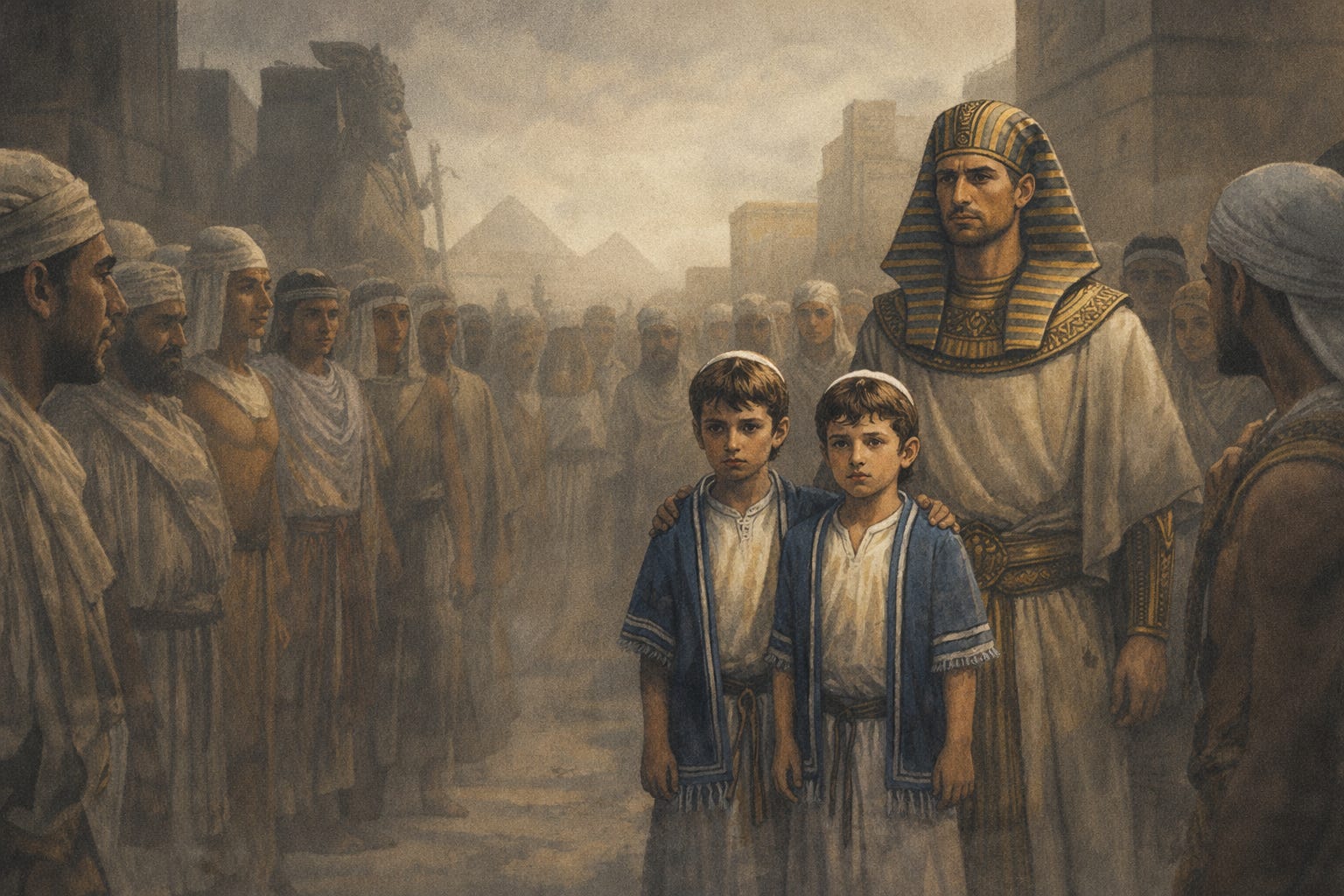
There’s something striking about how Ephraim and Manasseh became two of the twelve tribes of Israel.
Yaakov tells Yosef that the two sons who were born to him before Yaakov came down to Egypt — Ephraim and Manasseh — will each be considered a full tribe. They’re not just Yosef’s children. They’re part of the core structure of the Jewish people.
וְעַתָּ֡ה שְׁנֵֽי־בָנֶ֩יךָ֩ …לִי־הֵ֑ם אֶפְרַ֙יִם֙ וּמְנַשֶּׁ֔ה כִּרְאוּבֵ֥ן וְשִׁמְע֖וֹן יִֽהְיוּ־לִֽי׃
And now, your two sons…belong to me. Ephraim and Menashe will be like Reuven and Shimon
But Yaakov adds something curious. Any sons Yosef has after Yaakov arrives in Egypt won’t form tribes of their own. They’ll be absorbed into Ephraim or Manasseh.
וְעַתָּ֡ה שְׁנֵֽי־בָנֶ֩יךָ֩
הַנּוֹלָדִ֨ים לְךָ֜ בְּאֶ֣רֶץ מִצְרַ֗יִם
עַד־בֹּאִ֥י אֵלֶ֛יךָ מִצְרַ֖יְמָה
לִי־הֵ֑ם
אֶפְרַ֙יִם֙ וּמְנַשֶּׁ֔ה כִּרְאוּבֵ֥ן וְשִׁמְע֖וֹן יִֽהְיוּ־לִֽי׃
וּמוֹלַדְתְּךָ֛ אֲשֶׁר־הוֹלַ֥דְתָּ אַחֲרֵיהֶ֖ם
לְךָ֣ יִהְי֑וּ
עַ֣ל שֵׁ֧ם אֲחֵיהֶ֛ם יִקָּרְא֖וּ בְּנַחֲלָתָֽם׃And now, your two sons
(the ones born to you in the land of Egypt —
before I came to you in Egypt)
belong to me.
Ephraim and Menashe will be like Reuven and Shimon.
But your children who you had after them
will belong to you.
They will be called by the names of their brothers with regard to their inheritance.
That distinction is strange.
Why should it matter when they were born? Why does “before I arrived” versus “after I arrived” suddenly become the deciding factor? If Yosef has more children, why not let them become tribes as well? Let there be thirteen tribes. Or fourteen. What’s the problem?
And if there is a problem with Yosef’s children becoming tribes, then the whole thing shouldn’t work at all. Ephraim and Manasseh should be no different from any other sons Yosef might have. So clearly, that’s not the issue.
So then what is the issue?
What is Yaakov actually drawing a line around here?
What is it about about Yaakov arriving in Egypt that makes all the difference?
The Tangent that Goes Nowhere
There’s another question in this story — and it might be even stranger than the first.
Right after Yaakov makes this distinction between his pre and post Egyptian days, he goes off on a seemingly irrelevant tangent:
וַאֲנִ֣י ׀ בְּבֹאִ֣י מִפַּדָּ֗ן מֵ֩תָה֩ עָלַ֨י רָחֵ֜ל
As for me — when I came from Padan, Rachel died…
How did Rachel — and her tragic death on the road home — end up in this conversation? What does this have to do with Ephraim and Menashe being considered on par with their brothers?
And it’s not just that Yaakov notes that Rachel died, but he goes into great detail. He mentions that she died:
In the land of Israel (בְּאֶ֤רֶץ כְּנַ֙עַן֙ )
On the road (בַּדֶּ֔רֶךְ)
Just a short distance from Beit Lechem/Efrat (בְּע֥וֹד כִּבְרַת־אֶ֖רֶץ לָבֹ֣א אֶפְרָ֑תָה)
And then he adds that he buried her:
There (שָּׁם֙)
On the road (בְּדֶ֣רֶךְ)
And then, as soon as he mentions Rachel he stops talking about her and returns his focus to Ephraim and Menashe.
In short, this tangent comes from nowhere and then goes nowhere.
And what makes this even stranger is that there actually was a time when this story about Rachel was completely relevant — namely, the previous time Yaakov and Yosef spoke.
Let us recall that Yosef is here now because he was told Yaakov is sick — presumably with the illness that will lead to his death. But earlier, before Yaakov became sick, when it was already clear that he was nearing the end of his life, Yaakov summoned Yosef himself.
And when he did, Yaakov made a request. “Please, Yosef. Take an oath that you will not bury me in the land of Egypt. Please, make sure I’m buried in Eretz Canaan”.
Now here is the key point — this point about Rachel dying makes perfect sense there — at that meeting when Yaakov requested that Yosef bury him in Eretz Yisrael. To see how, let’s return to Yaakov’s tangential statement about Rachel dying and read it through the eyes of Rashi.
According to Rashi, Yaakov is addressing an issue that exists between Yosef and Yaakov — and it relates to where Yaakov buried Rachel. Or, more importantly, where he did not bury her.
Let’s start with some geography. Rachel died in Beit Lechem/Efrat which is not so far from Me’erot HaMachpelah in Chevron (Hebron).
That is where Avraham and Sara are buried.
That is where Yitzchak and Rivka are buried.
That is where Leah is buried.
But it is not where Rachel is buried.
No, Rachel is buried on the road.
Or, put otherwise — no where.
Not in Me’erot HaMachpelah.
Not in Chevron.
Not even in Efrat (which is even closer).
What’s more — there was nothing that was stopping Yaakov from doing so. He had not debt to the people of Beit Lechem or Efrat and he had no enmity with them either. And the weather conditions were just fine.
It was not the rainy season when it was hard to travel.
Rather the dry season — when the roads were full of holes live a sieve.
That is what he means by כִּבְרַת־אֶ֖רֶץ.
In short, Yaakov did not put even the most minute amount of effort to give Rachel a proper burial. And yet, he is now asking Yosef to great lengths to bury Yaakov in Eretz Yisrael.
He’s asking him to take a long trip from Egypt to Chevron.
And yet Yaakov didn’t even take a short trip from Efrat to Chevron.
He’s asking him to politically and socially put himself on the line with Paro and the Egyptians.
The Egyptians, who welcomed Yaakov and his family into the land of Egypt.
Egypt, the land where Yaakov lived for 17 years.
Paro, who granted all the requests of Yaakov and the brothers.
Paro, who freed Yosef from jail and made him a viceroy over all of Egypt.
After all that, when all is said and done — Yaakov is going to clearly state that he does not want to be buried in Egypt.
It’s insulting.
And to add insult to injury, Yaakov himself isn’t even making the request. He is asking Yosef to do it.
To make the request.
And then to make the arrangements.
And then to go with Yaakov to Eretz Yisrael, bury him there — and then return.
And yet, Yaakov himself couldn’t even be bothered to travel a small distance when there was no political or social cost and give Rachel (Yosef’s mother) a proper burial.
This request — and its larger context — bothered Yosef. And Yaakov knew that. That is why he is mentioning what happened with Rachel. We just need to get the emphasis right:
וָאֶקְבְּרֶ֤הָ שָּׁם֙ בְּדֶ֣רֶךְ
I buried her there, on the road
That is to say — I purposely buried her there. Not because I didn’t care or want to bury her in Chevron — but because we (the Jewish people) need her (Rachel Imeinu) to be buried there, on the road:
“Know,” says Yaakov, “I purposely buried there because I know that in the future Nevuzaradan (the chief executioner of Nevuchadnezzar) will exile the Jewish people to Bavel (Babylonia).
“And I further know that when they are on their way to galus (exile), the Jewish people will pass on this road and this very spot. And when they do, Rachel will leave her grave, cry and request mercy on them.
“That is why I buried her there, on the road. Because we, the Jewish people, need her buried there.”
That, says Rashi, is what Yaakov is saying to Yosef in this tangential line. It’s a fine reading — and it would make perfect sense — in the other story. The one where Yaakov is talking to Yosef about where to bury him.
But that is not where it appears.
Instead (as I understand it), Yaakov purposely waits and relates this point to Yosef specifically when he is discussing elevating Ephraim and Menasheh to founding members of two of the twelve tribes of Israel.
But if so — why? It doesn’t seem to make any sense.
So now we have a set of questions.
What is the connection between Yaakov coming to Egypt and whether or not Yosef’s sons are considered like Yaakov’s sons or not?
Why didn’t Yaakov mention Rachel’s burial when he discussed being buried in Eretz Yisrael?
Why did Yaakov mention her burial specifically when discussing the tribal status of Ephraim and Menashe?
What Does it Take to be a Tribe?
So let’s try to put all of this together.
I’m going to start with an assumption — to be one of the Twelve Tribes, you need to contribute something fundamentally unique to Am Yisrael.
Each shevet represents a distinct koach — a quality, a capability, a way of serving Hashem — that no other tribe has in quite the same way. It may overlap somewhat with others, but not to the same degree, not with the same depth, and not with the same clarity. And that koach has to be something that can be passed down, generation after generation, and serve the Jewish people as a whole.
That’s my starting point.
And based on that, I want to suggest that Ephraim and Manasseh possessed such a koach — something no other brother had, and something no other child of Yosef could have had.
And it’s something that Am Yisrael would desperately need throughout its history.
What was it?
The ability to stay Jewish — to stay connected to Am Yisrael, to HaKadosh Baruch Hu, to Torah — no matter the circumstances.
No matter where you are.
No matter how isolated you are from other Jews.
No matter how powerful the surrounding culture is.
No matter how attractive it is, or how overwhelming it is.
To still be in.
Nobody had that like Ephraim and Manasseh.
Not even Yosef himself.
Yosef grew up in Yaakov’s house.
He knew his mother. He lived with his brothers. As difficult as things were, he had a deep connection to the family, to its story, to its destiny. He knew who he was before he was ever alone.
But Ephraim and Manasseh? All they had was Yosef.
And Yosef was the viceroy of Egypt.
He dressed like an Egyptian. He spoke Egyptian. He lived Egyptian. Whatever happened inside the house, outside the house he was fully embedded in that world.
They had no Yaakov.
They had no uncles.
They had no extended family.
They had no Jewish society, no institutions, no community.
They were raised in the heart of Mitzrayim — completely assimilated — before Yaakov ever arrived.
And yet, they stayed connected.
They believed what Yaakov believed.
They identified with Am Yisrael.
They were worthy of the bracha: Yisimecha Elokim k’Ephraim v’chi’Menashe.
That koach belonged to them — and only to them.
And that’s why no later children of Yosef could qualify. Any children born after Yaakov arrived would grow up surrounded by Yaakov, by the brothers, by their families, by the emerging Jewish collective. They wouldn’t face the same test. They wouldn’t need to summon the same inner strength.
Ephraim and Manasseh did.
And Yaakov says: that is a tribe.
That is a foundational pillar of Am Yisrael.
That is a koach the Jewish people will need again and again.
The Connection to Rachel
Which brings us back to Rachel.
According to Rashi, what is Yaakov saying when he speaks about her burial? He’s describing a future moment when the Jewish people will be exiled — stripped of their land, their institutions, their sovereignty.
No Malchut.
No Nevi’im.
No Beis HaMikdash.
Surrounded by a foreign culture, on the road into galut.
And at that moment, they will need Rachel’s tefillos.
But I want to suggest something further.
The koach of Ephraim and Manasseh comes from Rachel herself.
Rachel embodied this idea before anyone else did. When she gave Leah the simanim, she didn’t know she would marry Yaakov a week later. For all she knew, that was it. She was giving up her place in the story. Her children. Her future.
And yet she did it anyway.
Not because it was easy.
Not because she didn’t care.
But because she was utterly loyal to Hashem’s ways, no matter the personal cost.
Then, later on — she has trouble having kids. Her sister has children. Her maidservant has children. But not her.
In short — Rachel knows what it is to want to be connected to Yaakov and the dream of the Jewish people. She has felt that longing — lived it.
It is that longing and that dedication which she passed on to Yosef and Yosef to Ephraim and Menashe.
And it was they (Ephraim and Menashe) who brought it to its ultimate fruition — who stayed connected with nothing but the idea of Yaakov.
So when Yaakov speaks about Rachel here, now it makes sense. He’s revealing the source of the koach he’s recognizing in Yosef’s sons. The same reason why I buried Rachel on the road is the reason why Ephraim and Menashe are going to be tribes in and of themselves.
And this, I think, is why Yaakov waited.
He waited for this moment so that the point he was making could fully crystallize for Yosef. Only now — when Yosef sees who his sons have become, and why they are worthy of being tribes — can he truly understand what his father is saying, and why his mother had to be buried on the road.
Yaakov’s Gift
And with this, we can also begin to see one of the unique kochos that Yaakov himself possessed — perhaps more than anyone else.
Yaakov had an extraordinary ability to understand what the foundational pillars of Am Yisrael needed to be. He could identify those kochos in each of his children — not just see them, but draw them out, strengthen them, and then weave them together into a single, unified nation.
That’s why Yaakov had the koach of brachos.
And that’s why he had the ability to extend the status of being a shevet even to his grandchildren.
Because it was never about biology alone. It wasn’t about whether someone was technically a son or a grandson of Yaakov. It was about whether they carried a koach that the nation he was building would need — a koach that could serve as a foundation for Am Yisrael going forward.
And if someone had that koach, Yaakov knew how to recognize it, how to validate it, and how to establish it as one of the fundamental building blocks of the Jewish people.
That’s what he did with Ephraim and Manasseh.
And later, when he blesses all of the tribes together, he does the same thing again. He helps each shevet understand what it uniquely contributes, what it may need to work on, or both — all in service of creating a nation that could endure, remain connected, and fulfill its role in history.
That was Yaakov’s greatness.
And that’s why the story unfolds exactly the way it does.
Know someone who would appreciate Masmid.org?
Please feel free to share it with them: