Hard as a Rock
This week I'm going to do something different. I'm not going to write a Dvar Torah — I'm going to speak it out. I'm not going to polish it or edit it afterwards. There is one fundamental idea I want to get across from our parsha, and I truly believe it is one of the Torahs our generation needs.
And it has to do with rocks.
You might have missed it, but rocks play a fundamental role in the story of Yaakov and his dream.
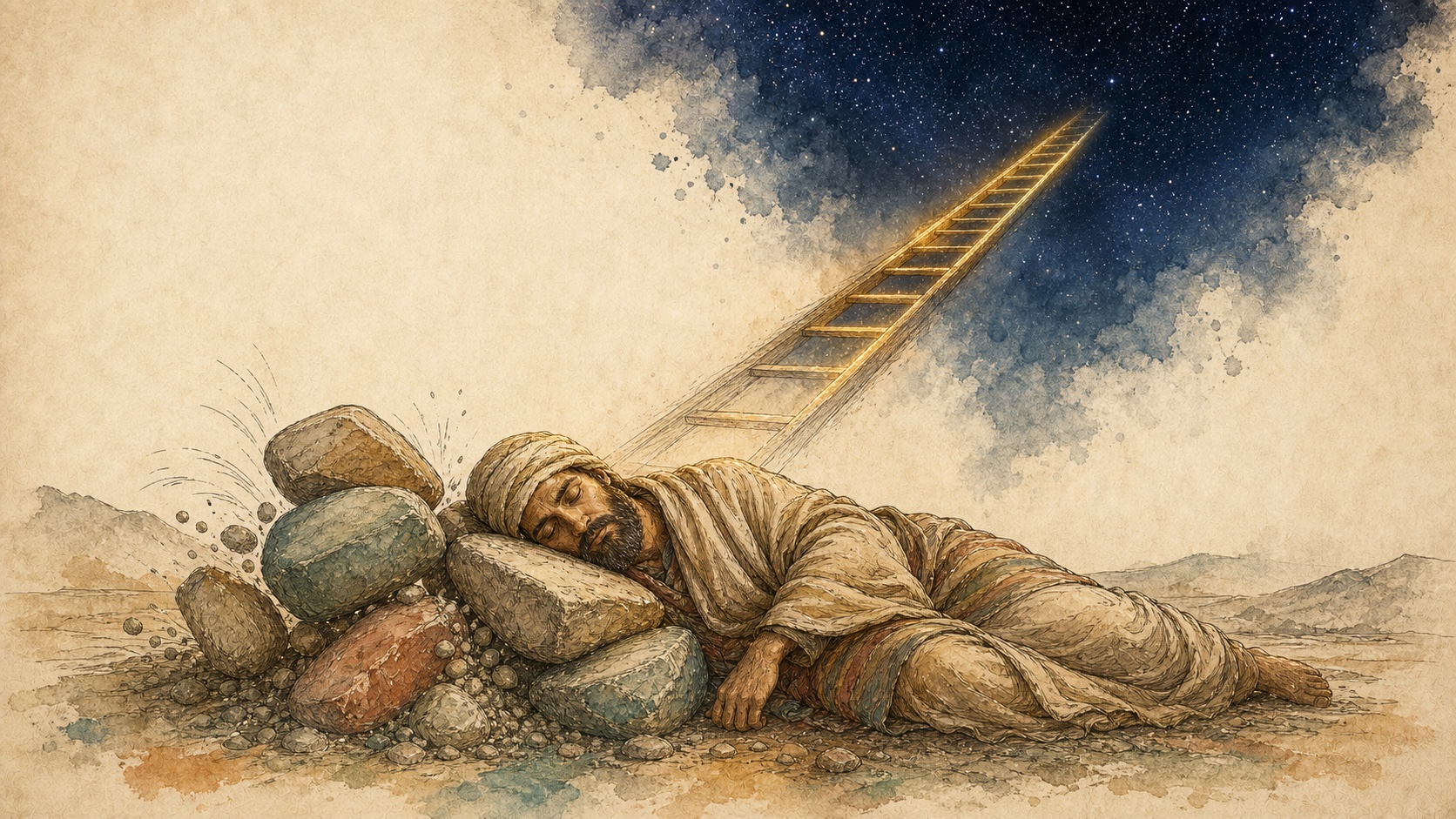
Yaakov is fleeing from Esav. He is also traveling to Lavan. And in this in-between state — between leaving and arriving — he finds himself alone, at night, on a hill, with nowhere to stay.
So he takes from the rocks of the place and puts them around his head. Rashi says this was to protect him from wild animals.
This is an interesting detail, but it's not the kind of detail you expect the Torah to emphasize unless something deeper is going on. And indeed, the story itself hints that there is something significant here.
Because in the morning, Yaakov gets up, takes one of those rocks, and sets it up as a matzevah — a memorial stone.
Yaakov clearly sees something significant in these stones.
He sets one up as a memorial.
And when he makes his neder, he says that if Hashem brings him back home, he will take that same stone and make it a Beit Elokim, a house of God.
Yaakov sees something here.
We don't — at least not yet.
But then comes a Rashi that helps.
Rashi quotes a fascinating Midrash: the stones began fighting.
Not a disagreement. Not a simple machloket. A merivah — a battle.
One stone said, "This tzaddik — Yaakov — will rest his head on me."
Another said, "No — he will rest his head on me!"
Back and forth they fought.
Then God saw this and — miyad, immediately — made them into one stone.
And that stone became the one Yaakov set up as a matzevah.
What in the world is going on here?
What are these stones fighting about? What does God see in their fight? Why does He make them into one? And why does Yaakov choose this stone?
There is a tradition — and I found it in at least one commentary — that there were twelve stones.
Twelve!
That number should immediately make you think of something. Yaakov is on his way to Lavan to marry Rachel and Leah, to have children who will become the twelve tribes of Israel.
So if you tell me there are twelve stones fighting, I immediately think: twelve tribes fighting.
Each tribe, each stone, saying: "The tzaddik will rest his head on me."
What is in Yaakov's head that they are so eager to support?
We know exactly what it is. It's happening right now in the story:
His dream.
Yaakov is about to go to sleep and have the dream — the vision — of connecting heaven and earth. The ladder. The malachim going up and down. G-d standing atop the ladder, or over Yaakov.
It is the vision of uniting Shemayim and Aretz.
And each rock — meaning each tribe, each future shevet — each one as stubborn and unyielding as a rock — says:
"I am the one who supports this dream. Yaakov will rest his head — the head containing the vision — on me."
Meaning: my shevet, my path, my perspective is the right way to bring heaven down to earth.
This is a battle over how to connect heaven and earth.