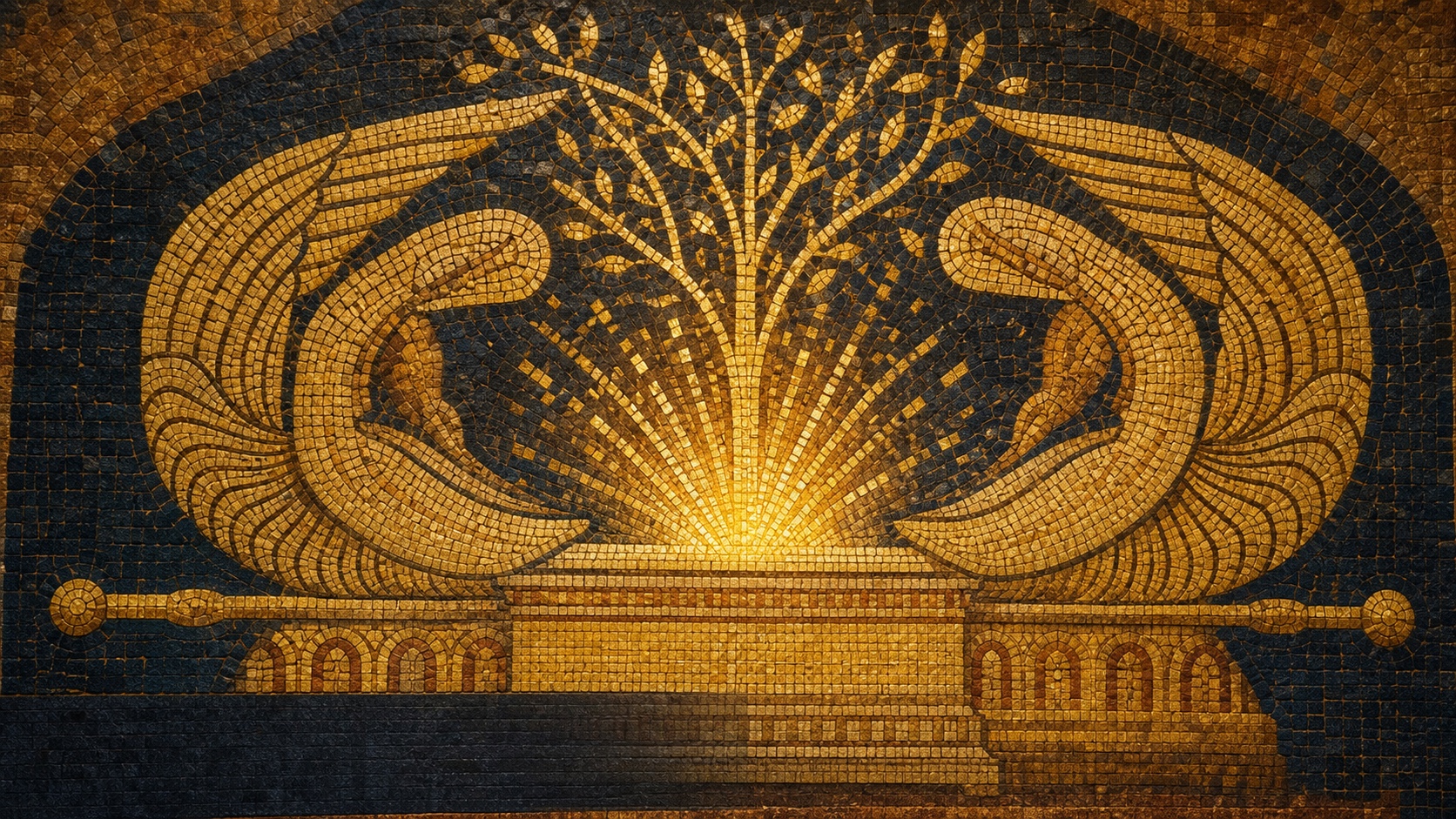
Let’s look at the Kruvim a bit more carefully.
וְעָשִׂיתָ שְׁנַיִם כְּרֻבִים זָהָב מִקְשָׁה תַּעֲשֶׂה אֹתָם מִשְּׁנֵי קְצוֹת הַכַּפֹּרֶת
Shemos · 25:18You shall make two Kruvim of gold, hammered from one piece, from the two ends of the Kapores.
Two points.
First: מִקְשָׁה — hammered from one piece. They come from the same stock. They are united in their source, in their etzem, in their essence.
Second: מִשְּׁנֵי קְצוֹת — from the two ends. The two extremes. Two opposites — as far apart as they physically can be while still being on top of the aron.
In short, same source, opposite positions. And our two extremists are facing each other.
And let’s not try and wiggle out of their extremism — the Torah emphasizes this over and over again:
וְעָשִׂ֛יתָ שְׁנַ֥יִם כְּרֻבִ֖ים זָהָ֑ב מִקְשָׁה֙ תַּעֲשֶׂ֣ה אֹתָ֔ם מִשְּׁנֵ֖י קְצ֥וֹת הַכַּפֹּֽרֶת׃ וַ֠עֲשֵׂ֠ה כְּר֨וּב אֶחָ֤ד מִקָּצָה֙ מִזֶּ֔ה וּכְרוּב־אֶחָ֥ד מִקָּצָ֖ה מִזֶּ֑ה מִן־הַכַּפֹּ֛רֶת תַּעֲשׂ֥וּ אֶת־הַכְּרֻבִ֖ים עַל־שְׁנֵ֥י קְצוֹתָֽיו׃
Shemos · 25:18-19And you shall make two Kruvim of gold, hammered from one piece, from the two ends of the Kapores. And make one Keruv on one end and one Keruv on the other end, from the Kapores you shall make the Kruvim on its two ends.
At the same time, it emphasizes their singular, shared source.
They will be “hammered from one piece“. They will be made from the Kapores.
Each Kruv has its position. Each has its perspective. Each has its edge — its extreme. And yet, they are both sourced from the same gold, from the same Kapores. They are opposites, but they are unified in their source.
And they face each other.
Why? What does it mean to face each other? What does that look like?
Let me give you an example of two people who faced each other and tell me, is this the vision you have of the Kruvim?
Muhammad Ali and Joe Frazier.
In case I date myself, let’s put it this way. Imagine two boxers, in the ring. One in this corner, the other in the opposite corner.
Two extremists. The bell rings and they each work their way to the center of the ring to face each other — and to try and knock each other’s face off.
Is that what you have in mind when you think of the Kruvim?
No? Why not? Isn’t that an example of two people facing each other — in battle, conflict, confrontation?
Why wouldn’t our Kruvim be like that? After all, they are opposites. And what’s worse — they come from the same stock.
Tell me, who hates each other more. A capitalist sitting in the United States and a communist sitting in Cuba
OR
A capitalist sitting in the United States and a communist sitting in the United States? How about MAGA and leftists? Bibi and leftists?
I could go on and on.
So is this the way to revelation? By staking out our position, sticking to it and hating those who oppose it.
I don’t think so. But it’s not as far off as we may imagine.
For now, though, let’s change the vision. Let’s leave behind the battles and hatred and be a bit more positive.
What is the phrase — opposites attract? Or how about the idea that men and women are two halves of a whole?
That also sounds a bit like our Kruvim, doesn’t it?
Love, care and respect — all wrapped up in a strange sort of attraction alongside a natural sort of frustration. Husbands frustrate wives and wives frustrate husbands.
The modern way of saying this is that men are from venus (or is it mars) and women are from the other one.
The Torah way of saying this is that woman was created from the side of man — and thereby became a helper, opposite him.
Or perhaps we could just say that men are hewed from one side of the Aron and women from the other side.
So, which is it?
Opposites attract. The battle of the sexes. A fight to the death.
It’s all of the above.
And within the world of the Torah, we have one particular relationship which contains all of these elements in one — it’s called a chavrusa.
A chavrusa — from the word “chaver” — a friend. But what kind of friend?
The kind you yell at when they say something ridiculous. The kind you battle against when they say something foolish. And the kind you listen to when you (finally) realize that it was you who was saying something foolish and ridiculous all along.
Of course, it’s not just a Chavrusa.
It’s Satmar vs Chabad. Or Satmar vs Zionism. Or Zionism vs Chabad. Or Daati Leumi vs Chareidi. Or Modern Orthodox vs Chareidi. Or Litvish vs Chassidish. Or Musar vs Chassidus.
Battles. Look at all these battles. And look at all the Torah that has come out from them.
Is it pretty? No! Is it enjoyable? Oftentimes doubly no.
And yet, we keep doing it. Because we care! Because it’s about the Torah and truth and values and what is right and what is wrong.
And I have a secret. Through all those battles. All that yelling and passion and more, there is something much deeper — love.
You don’t believe me? Let’s see.
A number of years ago, a young man named Gilad Shalit was kidnapped by Hamas. Now, that very same week, a young boy from Yitzhar was also murdered. I wish I remembered his name. I ask him and his family for mechila that I do not remember his name. But I remember him. He was hitch-hiking outside of Beitar and was picked up by Hamas (or some other similar terrorist group).
And minutes later, they brutally murdered him (because that is what Hamas does). Hashem Yikom Damo!
Now, all of this happened around the time of disengagement. I don’t remember if it was before, during or shortly after. But it was that time period.
And, as is often the case with the Jewish people — we were divided. We were each of us in our camps, in our extremes.
I remember my mother was sure that it was going to come to bloodshed. “I hope I’m wrong”, she said. But she didn’t see how such heated passions over such fundamental issues could end otherwise.
Thankfully, my mother was wrong. And that should already tell us something.
But that is not the point I want to make. The point I want to make is about this young man’s mother. Let us remember, she lives in Yitzhar. I don’t personally know her, but one can imagine Yitzhar on one extreme of the Jewish world. I’m not saying it’s good or bad, right or wrong. That’s not the point of this story. I’m just noting that it is on a polar opposite of the political spectrum of those who fervently believed in disengagement.
And during that week, she said something akin to the following:
There are big disagreements in our nation and heated passions surrounding those disagreements. We are in many ways divided. And I’m not going to pretend otherwise.
But this week, I saw something deeper. I saw that deeper than all of those divides is a love that unites us all. I saw Jews from all walks of life, all ends of the political and religious spectrum come to support us and show us their love.
So yes, there are differences. But there is a unity much deeper than those differences.
I think this is one of the most profound and honest truths that I have ever heard. And I think it describes our nation to the t.
And I don’t think this is a one-off occurrence. I think we all experienced it on October 8th (even if we don’t all still experience it right now).
We have seen the love that can shine. And we have for sure seen the divisions that can also shine.
And when these two elements are properly combined, you have a special unit known as Kruvim (notice the plural).
Divided in their extremism, united in their source — and therefore in their love.
And they are facing each other, but not only each other.
וּפְנֵיהֶ֖ם אִ֣ישׁ אֶל־אָחִ֑יו אֶ֨ל־הַכַּפֹּ֔רֶת יִהְי֖וּ פְּנֵ֥י הַכְּרֻבִֽים
Shemos · 25:20And their faces, one towards the other, towards the Kapores shall the faces of the Kruvim be.
They are looking at each other while also looking down towards the Kapores (the Kapores which covers the Aron which contains the Luchos).
They see each other while they simultaneously see the Torah.
In other words, Kruvim don’t battle each other. They battle for the Torah. They aren’t trying to win. They aren’t trying to overpower. They are trying to understand.
They each come from their perspective. They each have their point of view. But it is a perspective focused on the Torah.
What does it mean? What does Hashem want from us? What am I supposed to do?
This is what I think the Torah says. No, that’s wrong — this is what it says.
It’s about the Torah. It’s what Chazal call a machlokes l’shem shamayim. Machlokes — from the word “chalak” — to divide. A division for the sake of heaven.
I am divided not because I’m distant from you, but because I see the Torah differently than you do. But I am facing you, because I am facing how you see the Torah. I face you as I face the Torah. And you do the same with me.
And through that, we remain divided — but in service of the same Torah. And through that honest division, we reach new understandings. And we even sometimes change our minds:
חזרו בית הלל להורות כדברי בית שמאי
The School of Hillel revised (their opinion) to teach according to the position of the School of Shamai.
So you have these two Kruvim. Made from the same Kapores, housing the same Luchos, but from the two different sides. The two different perspectives. The two different angles. Facing each other — hammering it out with love, with care, but with passion and with strength.
And that space between these two lovingly different perspectives has a name — the path to the Eitz HaChaim.
The path is found between this divide — in the space that is formed when two extremes can lovingly, yet honestly face each other in their unified, but different love for the Torah.
If you can master that, then you can receive the Torah which G-d sends down that path.
And the one man who could master that more than anyone else was Moshe Rabbeinu.
We all know (or should know) the different Gemaras and midrashim. That anything that a Talmid vatik was destined to say was already given over to Moshe on Har Sinai.
That he (Moshe) received the Tanach and the Mishnah and the Gemara.
Okay — but how? How could Moshe receive all of this? What did he possess that enabled this?
Let me make a suggestion — by mastering the art of being an extremist.
Because, let’s be honest. There is no reason why one man can’t be an extremist on both sides. Why he can’t see both sides of the argument and both perspectives.
After all, we walk into Yeshiva and spend our time understanding the machlokes between:
Beis Hillel and Beis Shamai. Between Abaye and Rava. Between Rashi and Tosfos. Between the Rambam and the Raavad.
And then we stop. Some of us may go a little further — until it reaches something we care about. Then, we don’t try to understand, we try to be right.
But who says we have to wait until after the machlokes to understand both sides? There is no law of nature that that need be the case.
Indeed, if we can understand both sides of an issue after the fact, then it is at least theoretically possible to understand both sides of an issue before the fact.
And my guess is that Moshe Rabbeinu didn’t just understand both sides of a machlokes — he lived them. He stood at both ends of the Kapores. He felt the truth and passion of each position without being captured by either — holding the contradictions in his love for the Torah.
He was, in a sense, both Kruvim at once.
And that is why G-d spoke to him from between them.